Anna Sandri

tekenen , spiritualiteit , interactief , installatie , DIY , Digitaal , cross-over

I am a visual artist from Canale (IT), currently based in Rotterdam (NL). My practice explores the material and spiritual dimensions of image-making through a mix of analogue and digital techniques. I am deeply interested in how images act as carriers of intergenerational memory—how they emerge, shift, and persist across time, often resurfacing in moments of rupture.
To explore these qualities, I work with drawing, sculpture, and build custom tools such as analog projectors and DIY devices. These hybrid workflows—combining clay modeling, 3D printing, and electronics—allow me to animate sculptural forms through light and motion, creating transitional spaces where images hover between object and apparition.
I approach technology as a space for inquiry and experimentation, often using repurposed components and developing custom methods tailored to each work. I enjoy crafting new workflows—blending analog and digital techniques—to explore how different materials and processes can shape the way images behave and are perceived. My work usually takes the form of moving images and installations, inviting viewers to experience images not just as representations, but as poetic presences.
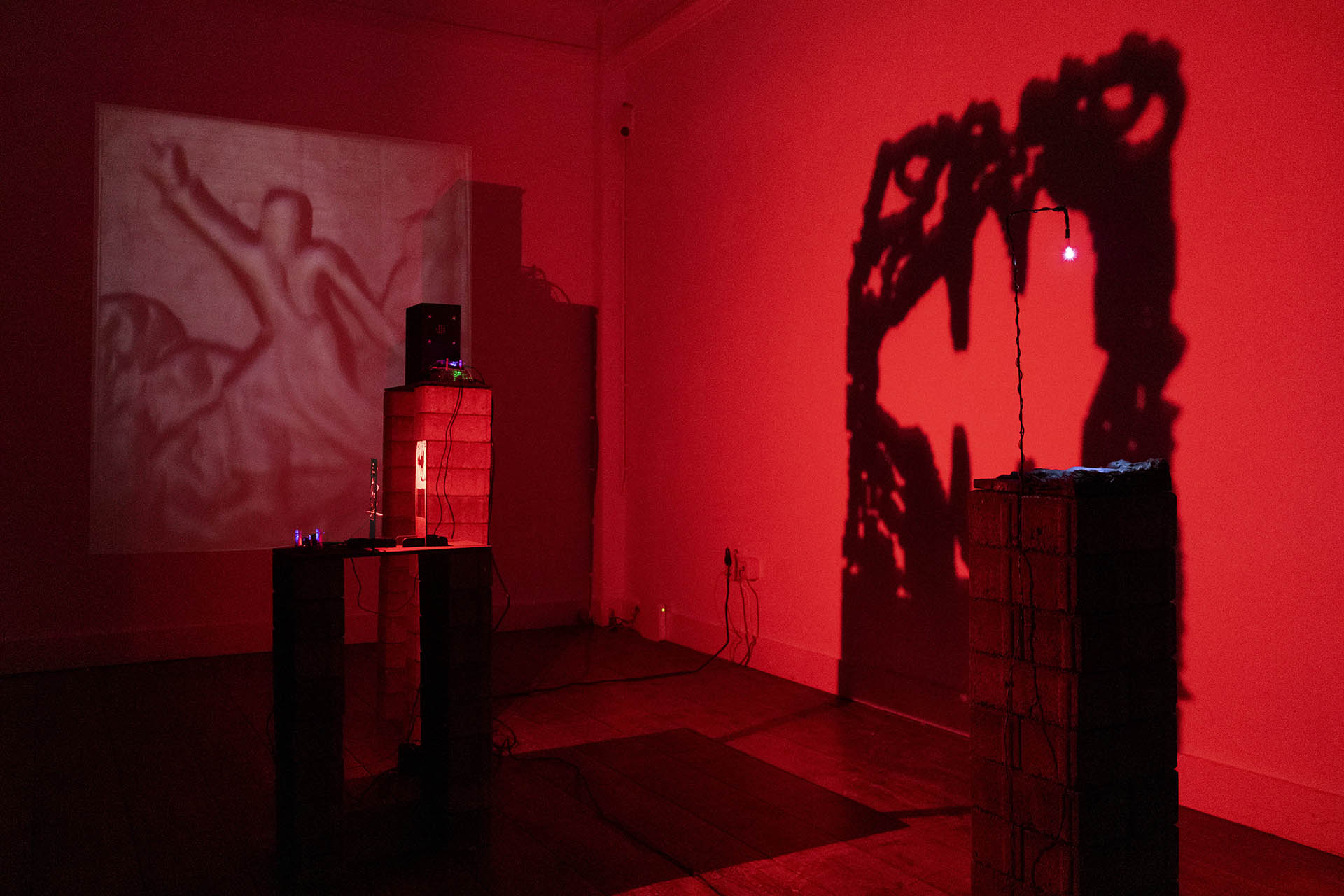
lone swimmers in the surge's grey
lone swimmers in the surge's grey - lone swimmers in the surge's grey[...] is an installation that explores the concept of cultural apocalypses, a term borrowed from Ernesto De Martino to describe moments when a collective value system begins to collapse, threatening a community’s ability to make sense of its historical experience. The work investigates how images persist through such crises—surviving as visual “ghosts” that carry emotional memory across generations. Drawing inspiration from Aby Warburg’s Mnemosyne Atlas and Georges Didi-Huberman’s reflections on the atemporality of images, the project focuses on iconographies of loss and hope, and their role in transmitting affective memory. The installation is part of an ongoing research into the materiality of images—how they manifest as both solid objects and ephemeral light. It combines sculptural and optical elements to explore the question: Where are images born, and how do they manifest? This inquiry led to the development of custom-built projection devices that operate outside conventional formats. These devices are crafted using salvaged components, microcontrollers, and DIY prototyping techniques, and are designed to animate light through motion, opacity, and absence. Central to the process is the transformation of three-dimensional objects into projected images. Sculptures are first modeled in clay, then 3D scanned and printed using SLA resin, a material chosen for its ability to retain transparency and fine detail. These printed forms function as “slides” within the projectors, which are engineered to manipulate light and optics in real time. The devices use motorized systems to shift focal lengths and animate the projection, while microcontrollers regulate timing, transitions, and light behavior. Alongside projection, the installation incorporates shadow-making mechanisms that evoke early cinematic and theatrical traditions. These elements allow for layered visual experiences, where images emerge through both presence and absence, material and light. The project was first presented at the exhibition Rewriting the Future at PARK, Tilburg, and is currently in development. It consists of a series of evolving prototypes that explore different relationships between image, object, and light.
Ovunque e sempre proteggimi - Always and everywhere bless me
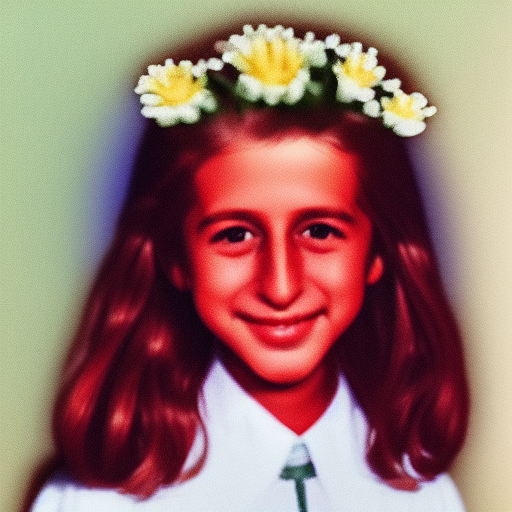
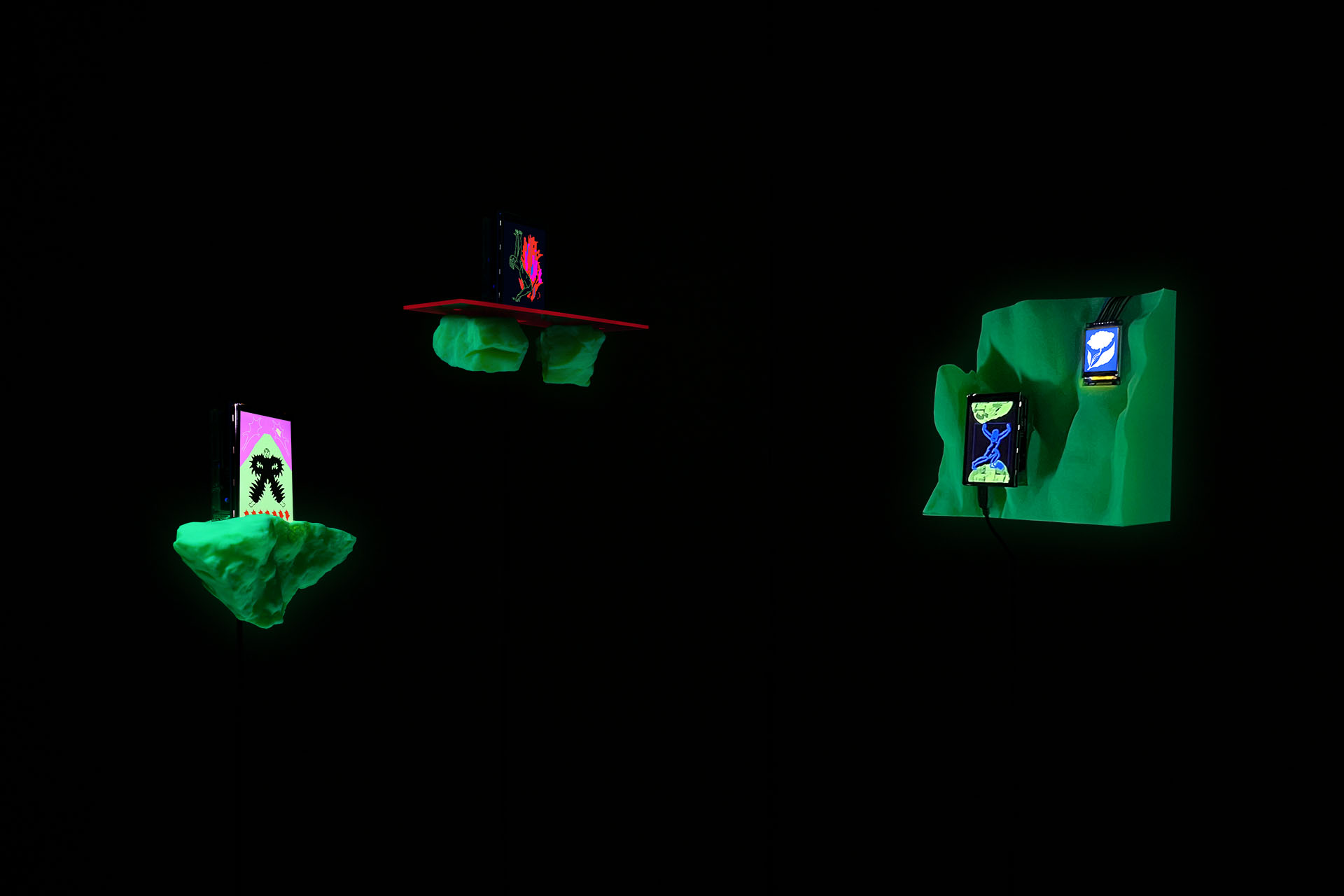
Ovunque e sempre proteggimi - Always and everywhere bless me - Ovunque e sempre proteggimi is a mixed media installation that stems from an ongoing research into folk religious worship and its visual language, particularly the iconography of holy cards and ex-votos. In my native region of Piemonte, ex-votos often take the form of small paintings depicting traumatic events—natural disasters, work accidents, injuries—alongside their resolution through divine intervention. Unlike official religious imagery, these artifacts were typically created by non-professional artists on improvised supports, placing the suffering subject at the center and relegating divine figures to the margins. They reflect a raw, intimate form of storytelling rooted in pain, gratitude, and survival. The installation draws from this tradition while weaving in contemporary digital iconographies, such as self-hate memes and emotional disclosures on social media. By juxtaposing historical devotional aesthetics with digital expressions of vulnerability, the work explores how grace and disgrace are visualized across time, and how suffering becomes a site of symbolic and emotional investment. I am particularly interested in how ex-votos operate within atemporal scenarios—many depict events like natural disasters or personal crises that resonate strongly in today’s age of climate instability and collective precarity. These images, though rooted in specific historical contexts, continue to speak to contemporary anxieties and desires for protection and meaning. Technically, the installation consists of a series of UV-reactive shrines, each housing a liquid crystal display. The shrines are first modeled digitally and then 3D printed in UV-sensitive PLA, which reacts to the light emitted by UV lamps integrated into the setup. Each display features low-resolution animations based on iconographic moments, rendered on TFT screens controlled by Arduino microcontrollers. The choice to use Arduino as a computing platform is intentional: its limited capacity for image rendering results in a visual language that is rough, pixelated, and unpolished. This aesthetic echoes the naïve spirit of traditional ex-votos, where emotional immediacy often overrides formal refinement. A magnetic speaker, also driven by a microcontroller, generates a layered soundscape that complements the visual rhythm of the piece. The work reflects a broader interest in how devotional objects and digital artifacts both serve as vessels for emotional memory. Through a combination of digital fabrication, low-tech electronics, and symbolic layering, the installation invites reflection on the persistence of ritual, the aesthetics of suffering, and the ways in which personal and collective pain are mediated through images. The work was previously presented at Park, Tilburg during the show Rewriting the Future, at Soup, Rotterdam and Springboard Art Fair.
chance
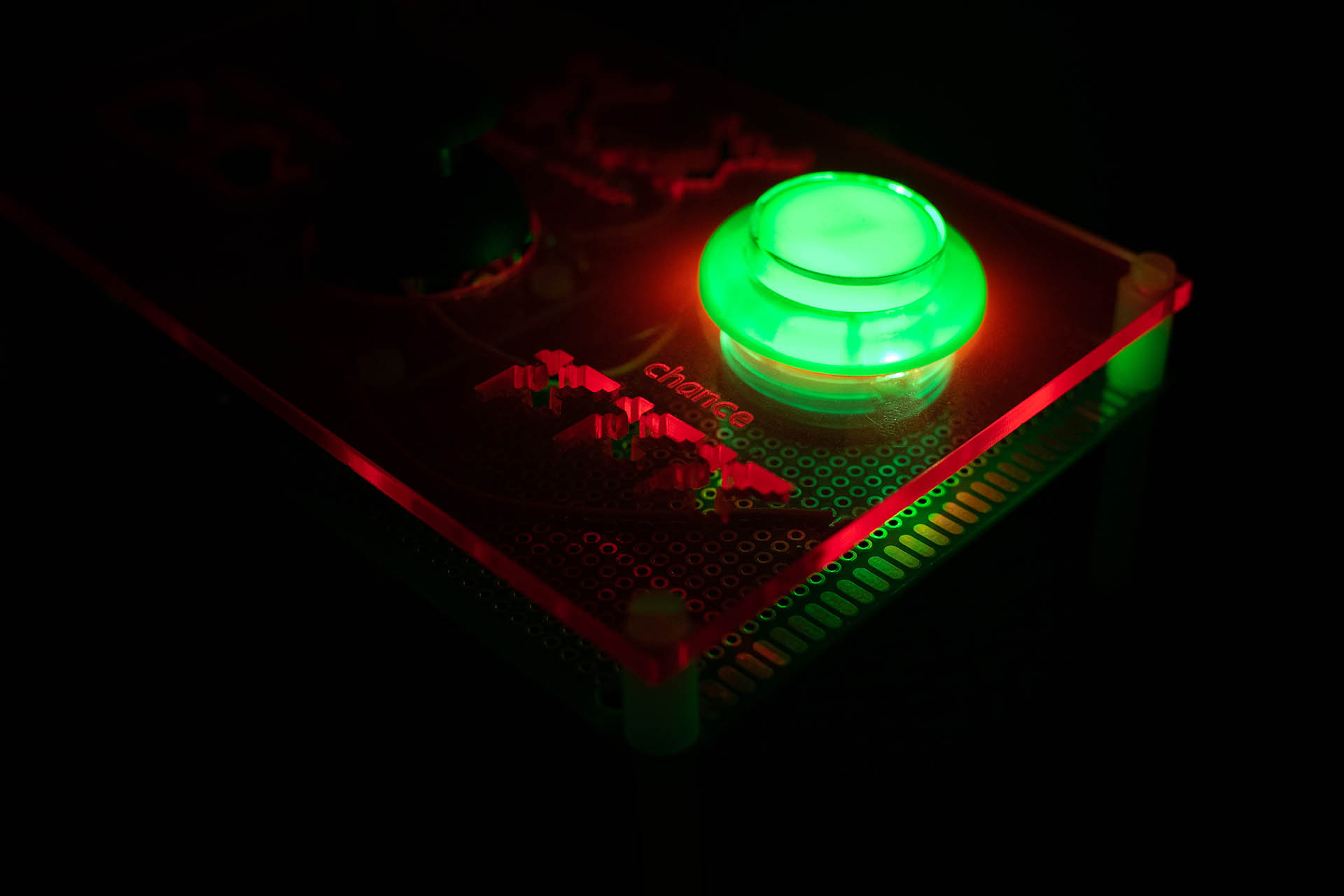
chance - chance is a mixed media installation that takes the form of an almost-game, reflecting on themes of fate, fatality, and fatalism. The work is part of a broader research trajectory rooted in the Catholic tradition of ex-votos—votive artifacts created to thank a holy figure for intervening in moments of crisis. In this piece, the symbolic logic of ex-votos is reinterpreted through the lens of contemporary existential uncertainty. The game structure plays with ideas of chance and agency, drawing parallels between religious fatalism and the pervasive sense of powerlessness in the face of environmental, economic, and political instability. The scenarios unfold in a continuous loop, presenting outcomes as emotional fluctuations rather than rational consequences—blurring the line between personal and collective experience. Technically, the work is built around a custom-made game controller, fabricated using joysticks, buttons, and switches mounted on a laser-cut acrylic panel. The controller is connected to an Arduino microcontroller running the TV Out library, which allows for direct video output to a hacked CRT monitor. This setup bypasses conventional display systems, enabling the creation of a minimal, low-resolution interface that feels both tactile and symbolic. The choice of Arduino and TV Out is deliberate: the system's limited graphic capacity produces a raw, pixelated aesthetic that echoes the naive visual language of traditional ex-votos. Just as those artifacts were often made by non-professional artists using modest materials, the game's visual simplicity reinforces its emotional immediacy and symbolic weight. Players interact by selecting an avatar and navigating a sparse digital space, only to be confronted with a single inevitable action: pressing the “chance” button to see what fate delivers. The game resists resolution, emphasizing the cyclical and unpredictable nature of its outcomes. chance explores how systems of belief—religious or algorithmic—shape our understanding of destiny, and how interactive media can serve as a space to reflect on the tension between choice and inevitability. The work was previously presented at Soup, Rotterdam and Springboard Art Fair
Macht van wie!! - Power of who!!
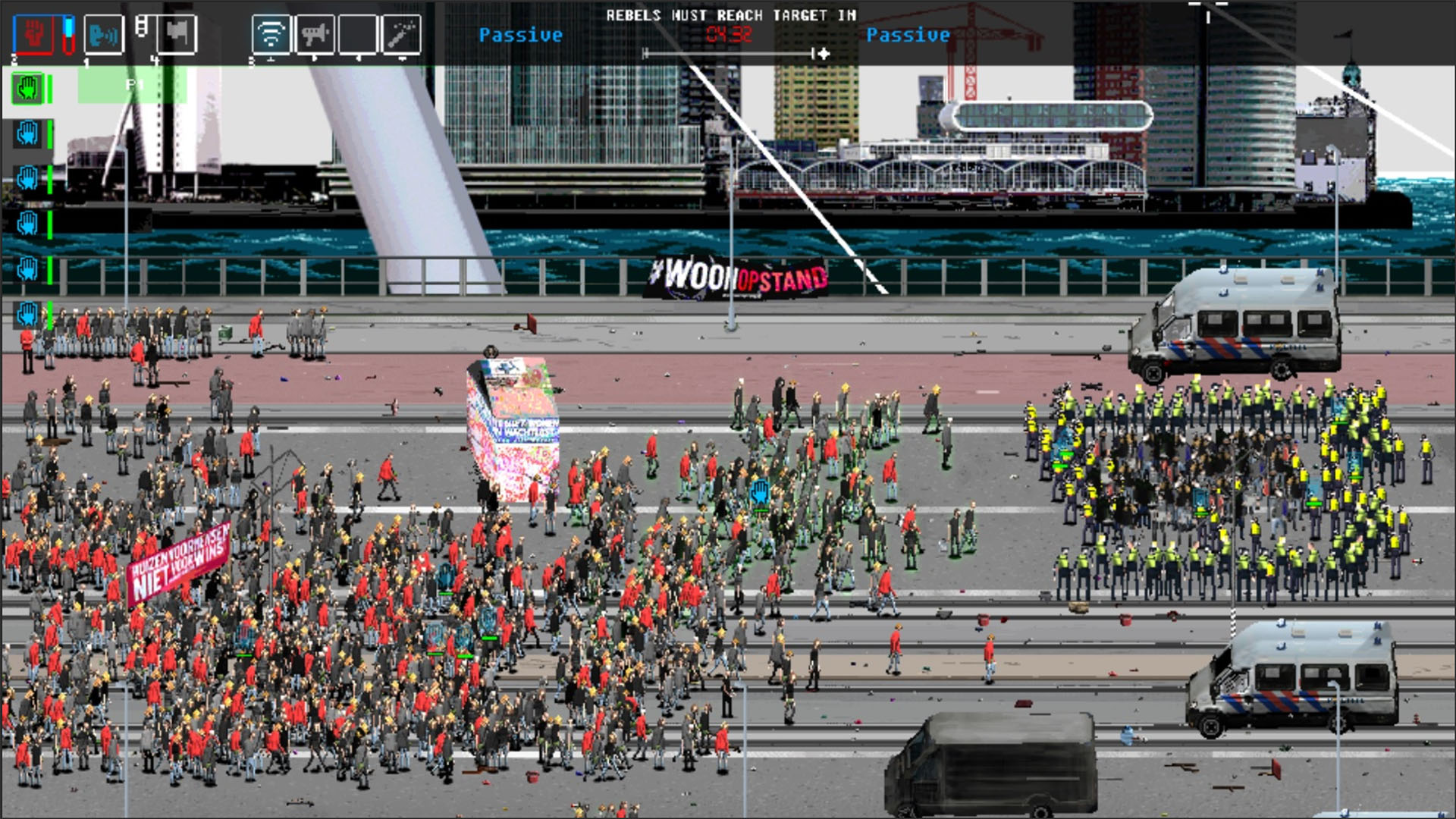
Macht van wie!! - Power of who!! - Power of whom!! is a game-based installation developed for the exhibition of the same name at MaMA, Rotterdam, exploring how video games can function as mirrors of society and tools for protest. The project responds to the increasing tension between civic demonstration and state control, particularly in the context of growing police violence and the erosion of public agency. The work centers on the Woonopstand (Residential Revolt) protest that took place in Rotterdam on October 17, 2021. In collaboration with curator Sebastiaan Hoogstraten, I developed a new playable level within the game RIOT: Civil Unrest, originally created by Leonard Menchiari to simulate real-world protest scenarios. I created all the visual assets and game sprites specifically for this level, designing the environments and characters to reflect the urban context and emotional tone of the protest. Power of whom!! explores how digital environments can be used to simulate, document, and critique real-world political events. By embedding protest within a playable structure, the work invites reflection on the limits of control, the aesthetics of resistance, and the role of interactive media in shaping public discourse. Mural work of Guido de Boer and pictures by Lotte Stekelenburg. Special thanks to Leonard Menchiari, Actiecoalitie Woonopstand and the MaMA staff Presented during the exhibition Power of who at MaMA, Rotterdam.
When you might go astray
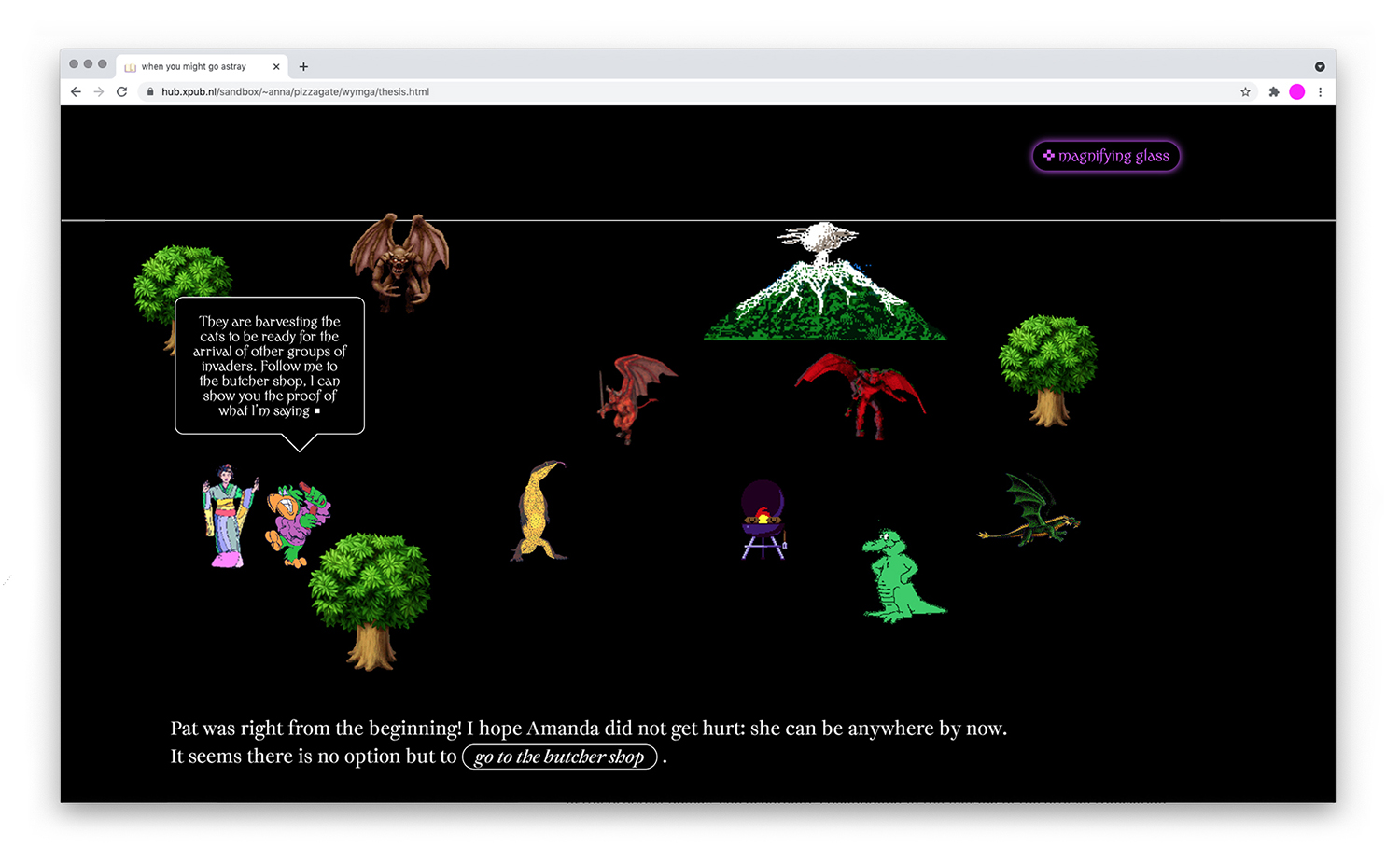
When you might go astray - When you might go astray is a research project dealing with conspiracy theories, fictional narratives, and how their narrative patterns shape the stories of their believers. The research starts from the following questions: How much of the pervasiveness of conspiracy theories is generated by their compliance to certain narrative schemes? What happens when the legitimate need to generate counter-storytellings gets trapped in other kinds of narrative templates? When you might go astray deals with these questions by exploring the dangers of conspiracy theories and their entanglement with narrative schemes transforming their believers into heroes on a quest. I started my research by analysing famous conspiracy theories by tracing a series of archetypes and elements that can be found in many of these stories simultaneously. Guided by this first exploration, I have been centering my research around the idea of the monomyth1 and similar narrative theories. When you might go astray is divided into two parts: a game designed for the browser where the player is asked to undertake a journey, and an essay examining conspiratorial narratives through the lenses of the mono-myth. The game employs a fictional lens to ultimately unravel the links and sources to real events and anecdotes related to the conspiracy theories universe. In parallel with the theoretical inquiry, I conducted a research into gaming workframes, ending up crafting a game engine of its own, following the storytelling needs. This results in a combination of a game, interactive fiction, digital book and theoretical essay. This project has been initiated in the context of the graduation research conducted during the Experimental Publishing Master course at Piet Zwart Institute. The work was previously presented at RIB Gallery, Rotterdam during the Experimental Publishing Master Course graduation show. Thanks to Aymeric Mansoux, Michael Murtaugh and Marloes de Valk.

Nexus Program

Datum:
Locatie: Tetem
In samenwerking met: Tetem Media Lab, Universiteit Twente

Artist residency for conducting research, developing new skills, and creating artistic productions.

Rewriting the Future

Datum:
Locatie: PARK

Group show curated by Niek Hendrix.
Together with Dario D'Aronco, Frederique Jonker, Maaike Kramer and Amrith de Zoete.

https://www.park013.nl/en/exhibitions-and-activities/rewriting-the-future

Springboard Art Fair

Datum:
Locatie: Werkspoorkathedraal
In samenwerking met: This Art Foundation, This Works

I took part of the Springboard Art Fair. The fair was specifically created in order to display work of artists who graduated just before of during the pandemic.

https://springboardartfair.nl

Macht van vie! - Power of Who

Datum:
Locatie: MaMA
https://thisismama.nl/en/events/home-en/power-of-who/
Deze kunstenaar heeft nog geen toekenningen.