ieke Trinks

samenwerking , publieke ruimte , performance , Objecten , internationaal , Conceptueel , Audiovisueel , Artistiek onderzoek

I create performances and performative works that take place in both art galleries, in the street, and other semi-public spaces, where the work often functions as an intervention or interaction with the environment and the public. Many of my performances are an expression of language in relation to and object, but can also be about the translation of a live event, such as of performance art pieces. In my recent work I reuse discarded materials, but also (re)use (archive) material from other artists, and make it visible in a new context. Collaboration is an essential part of what I do. I am part of the performance collective TRICKSTER since 2008, and I have organized performance art events with the artist run initiative PAE since 2010.
Conserved Energies
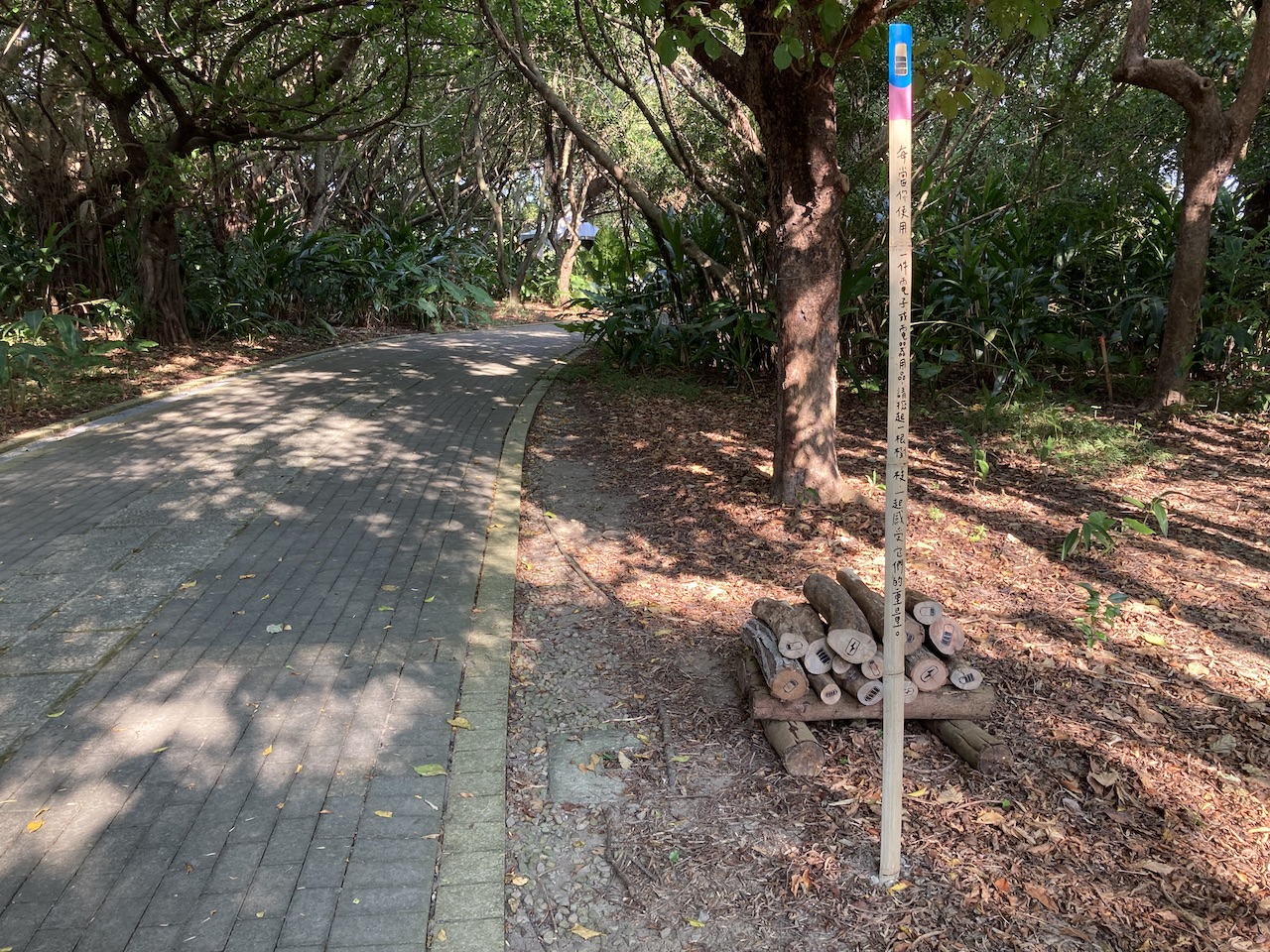
Conserved Energies - From September 15 to December 31, 2025, you can find six sites throughout Guandu Nature Park. These were created with the help of volunteers for the Guandu International Nature Art Festival in Taipei. The work invites visitors to follow simple, poetic instructions at six different locations in the park. Through these gestures, I want to reflect on our immense use of electricity and electronic devices.
Behala Working Song
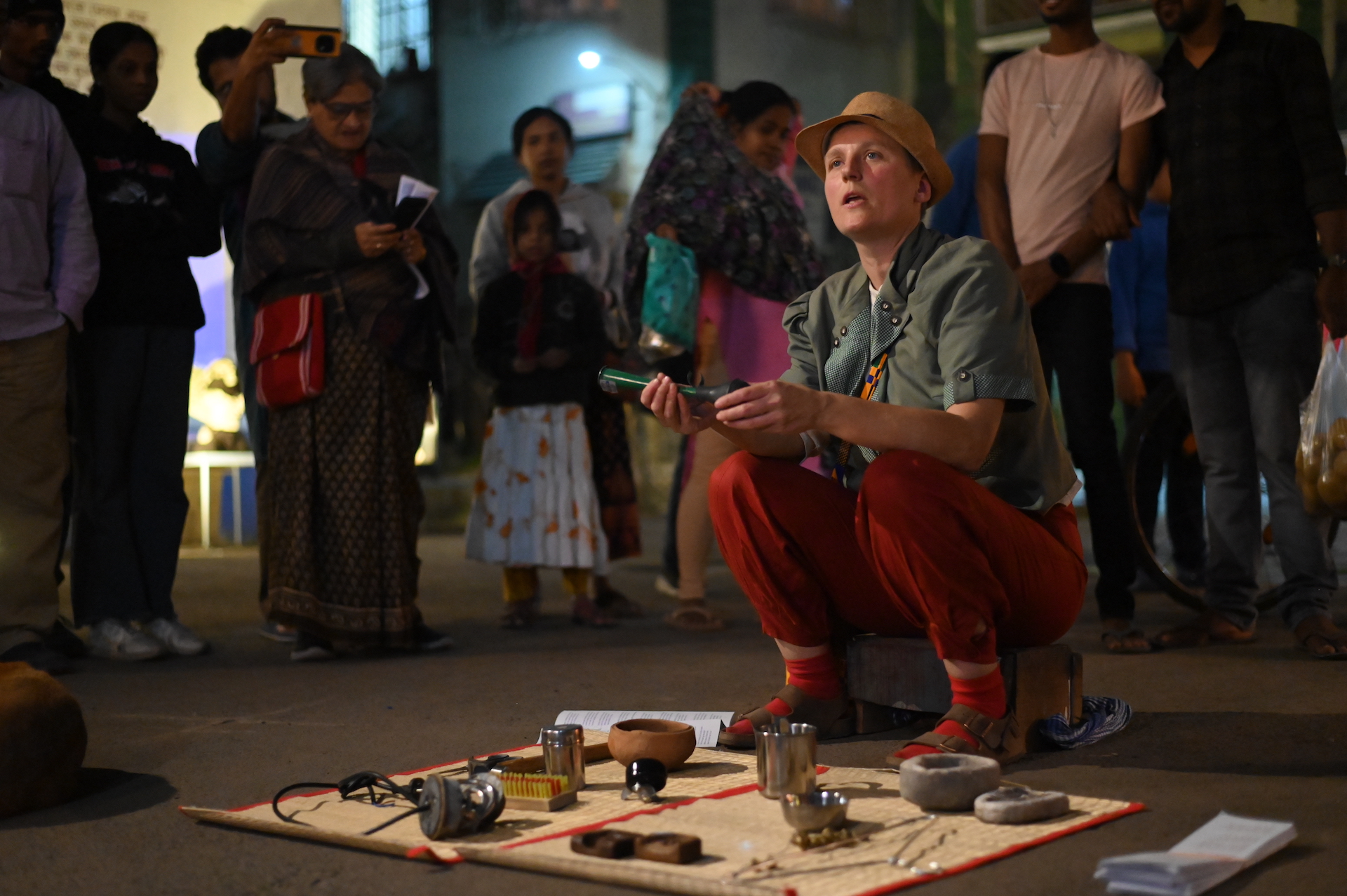
Behala Working Song - For the Behala Art Fest in Kolkata from December 19 to 22, 2024, I develop the performance Behala Work Song over a period of 6 weeks. In the run-up to the festival, I collected stories from various local workers, entrepreneurs and street vendors in the area where the festival would take place. The question of manual and mechanical changes in the working environment and the skill requirements of people is a central element of this project. How does technological progress change the social reality of people, what does it offer and how does it affect the increasing demand for fossil fuels? With the material from all the interviews, I wrote a song of 17 verses, which I sang to an audience on the street during the festival. The performance started with me walking through the crowd with a large bag full of objects that I organized on a mat in front of me. As I did this, the audience began to gather around me, and for those who wanted, I handed out the Bengali translation of the song on a pamphlet. It was up to the audience to choose which verse I would sing, depending on which object on my mat they pointed to. The objects included a hammer connected to the verse about the carpenter, a cup with a spoon connected to the tea stall owner, and so on. People were very curious about which part of the song was connected to which object, and how I then used the object to keep a rhythm for the singing. There were also audience members who spontaneously started singing along.
Teach the Guest Artist
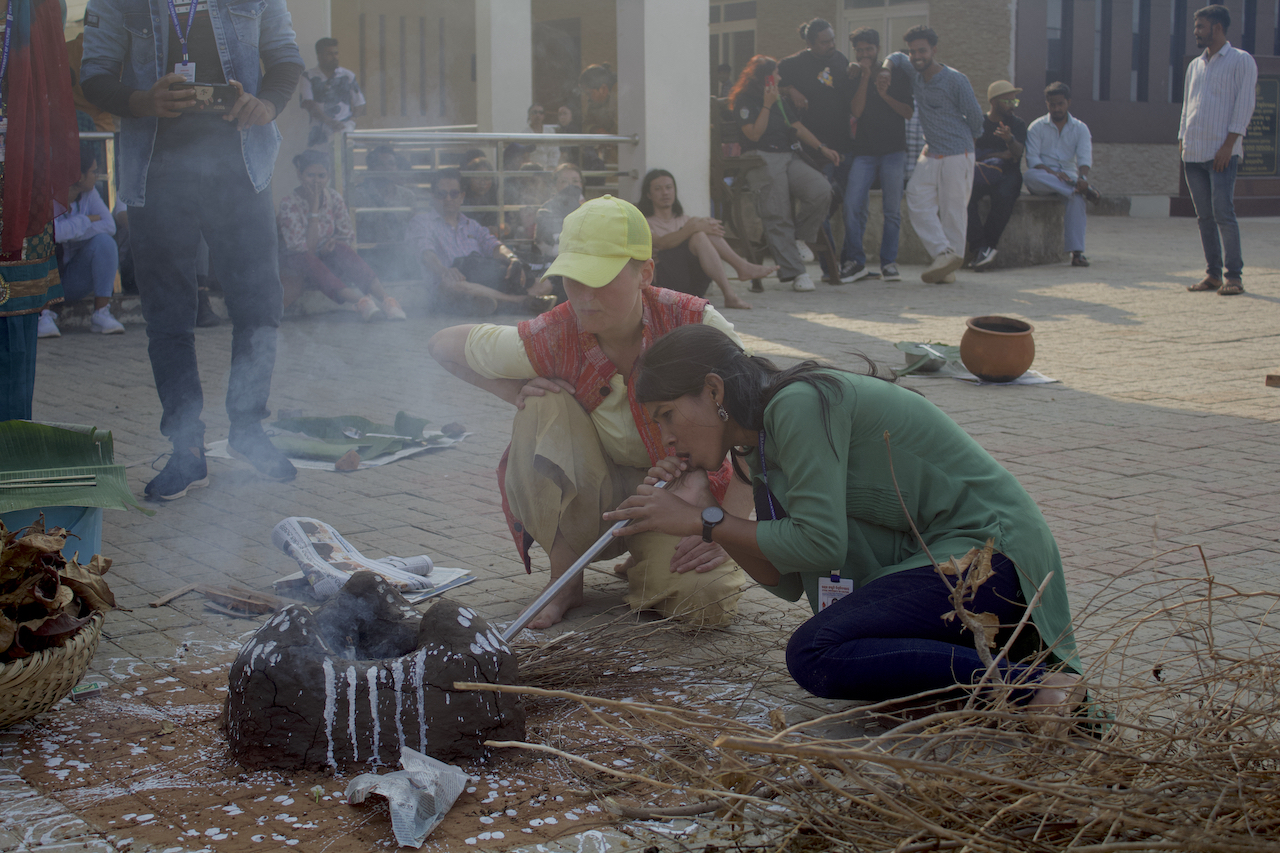
Teach the Guest Artist - During the Performance Art Festival and Symposium: Posthuman - Body, Ecology & Technology from December 10 to 13, 2024, I performed the participatory performance Teach the Guest Artist. The festival was organized by the Utkal University of Culture in Bhubaneswar, Odisha. The performance took place over two days, December 11th and 12th, and grew out of reflections on modern technological advances in the tools and devices we use on a daily basis. During my visits to India, I came across traditional tools such as the "clay stove" (called Chulhi in Odia) and the vegetable slicer (called Panikhi in Odia). These tools, used primarily by earlier generations, tribal communities, and on special occasions, have largely been replaced by modern alternatives in today's lifestyle. The craftsmanship required to build a chulhi and master the art of making a fire is no longer practiced with the advent of modern versions such as induction stoves. The performance was divided into four segments: making the chulhi, lighting the fire and keeping it burning, using the panikhi, and making banana leaf bowls. I invited students and teachers to teach me the techniques of these four segments while I prepared the traditional Odisha dish Dalma. The performance ended with the distribution of food in the banana leaf bowls.
Linocut on Newspaper Bag
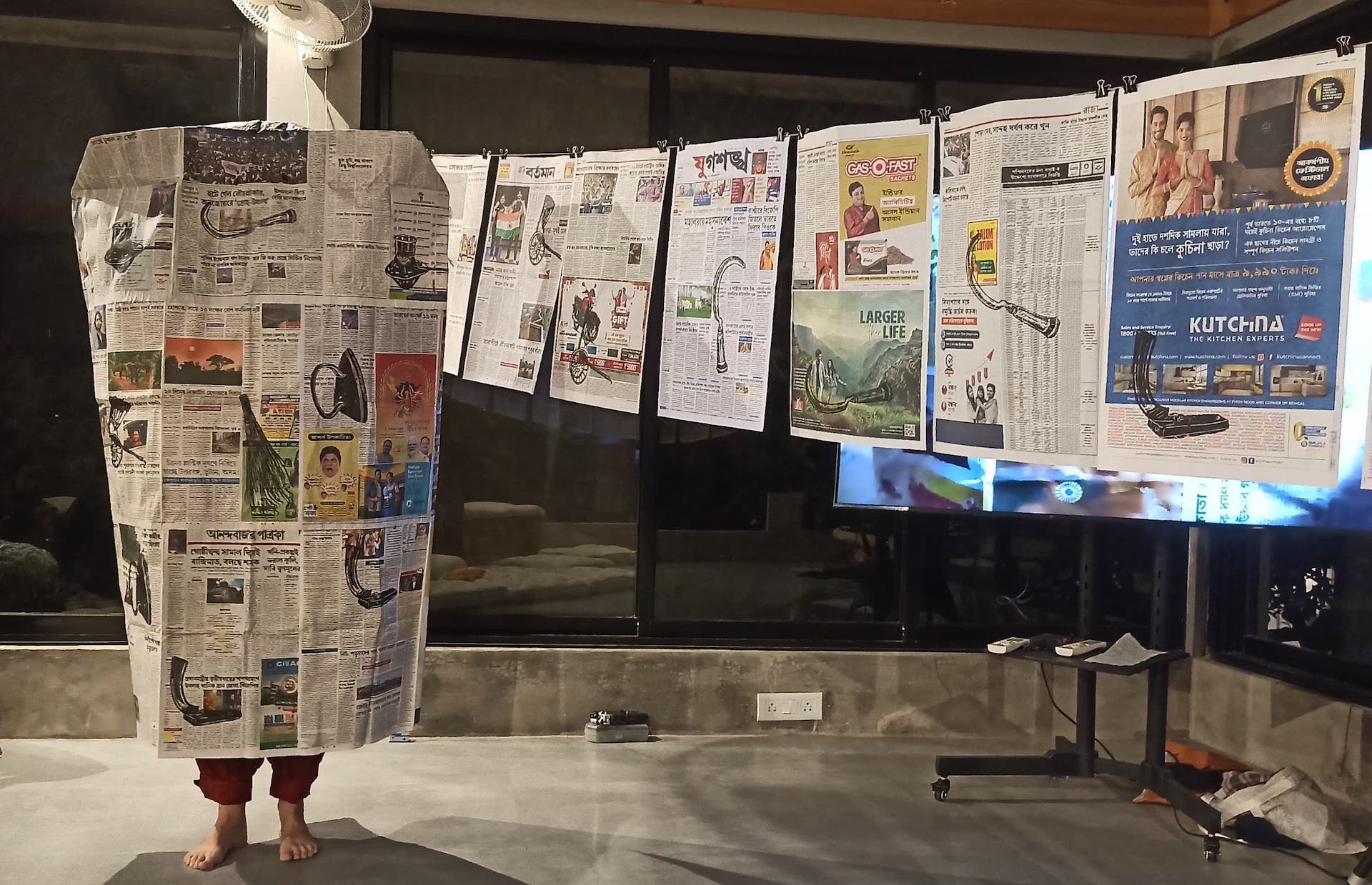
Linocut on Newspaper Bag - In November 2024, I spent three weeks at SSVAD (Santiniketan Society of Visual Art and Design) in Santiniketan, West Bengal. I looked at tools, instruments, and vehicles, and thought about labor and environmental issues related to manual and automated machines. During my month and a half in India, I saw several objects that made me wonder if they were becoming obsolete. My goal during this residency was to explore different techniques using newspaper as a material and canvas. During my residency at SSVAD, I lived above the printing workshop, and after more than 25 years, I resumed printmaking, making simple linocuts and pressing them onto Bengali newspapers with a spoon. I also reused the human-sized thonga (Bengali for newspaper bag) on which I also printed linocuts. At the end of the residency, I presented the work I had developed along with video footage of my previous performances from 2022 in Kolkata. It was during these performances that I first began to work with newspapers and the thonga in my art. In this presentation, as well as on other occasions, I experiment with bringing together multiple forms.
Pillow Person
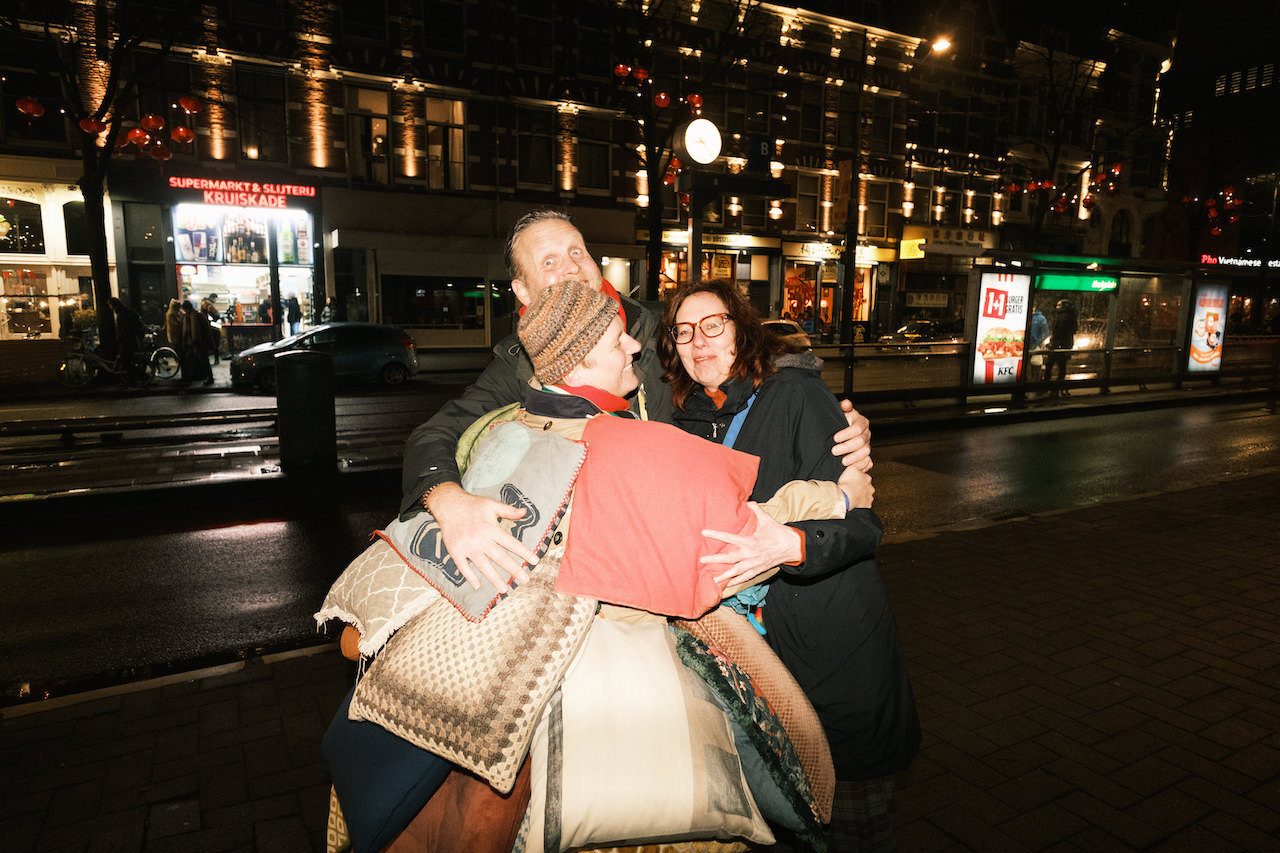
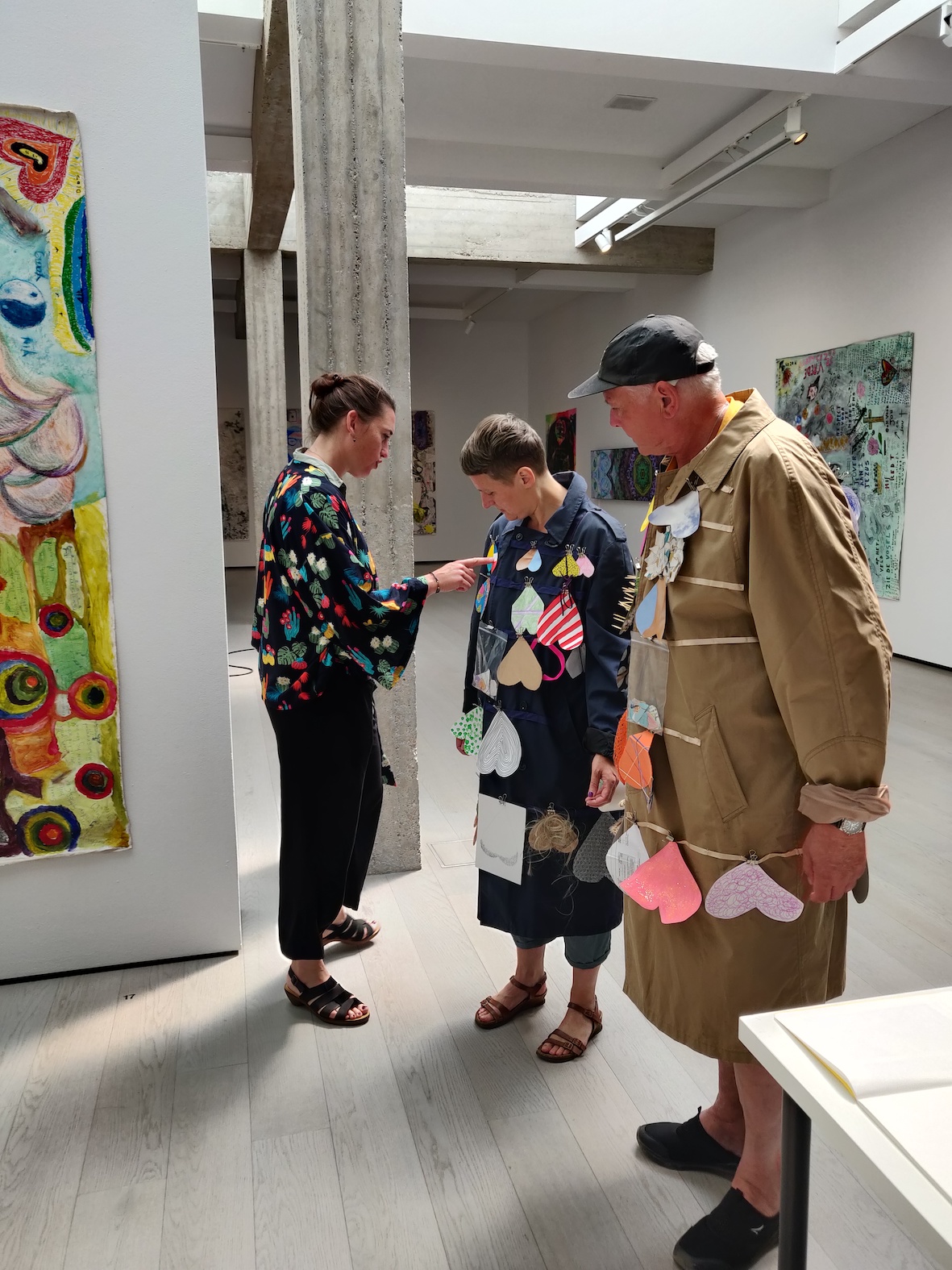
Pillow Person - Pillow-Person, performance by ieke Trinks, Right to Rest, 3rd edition, Rotterdam, Netherlands, photo Eden Calgie, February, 2024 I organized and performed a special act for the third edition of Right to Rest (Recht op Rust) in Rotterdam. The aim was to raise awareness about homelessness by providing beds in public spaces. To make sure that the event caught people's attention, I stood at the entrance of the park wearing a unique costume. This costume was made up of 30 pillows, attached to a jacket with loops and buttons. It made me look like a giant pile of pillows with legs and a head. As the evening progressed, I started distributing the pillows to those who were spending the night. Throughout the event, I acted as both a human and a moving piece of art, engaging in conversations with people. They shared their stories of homelessness or simply chatted about various topics. I offered hugs to anyone who wanted one.
The Myth of Progress
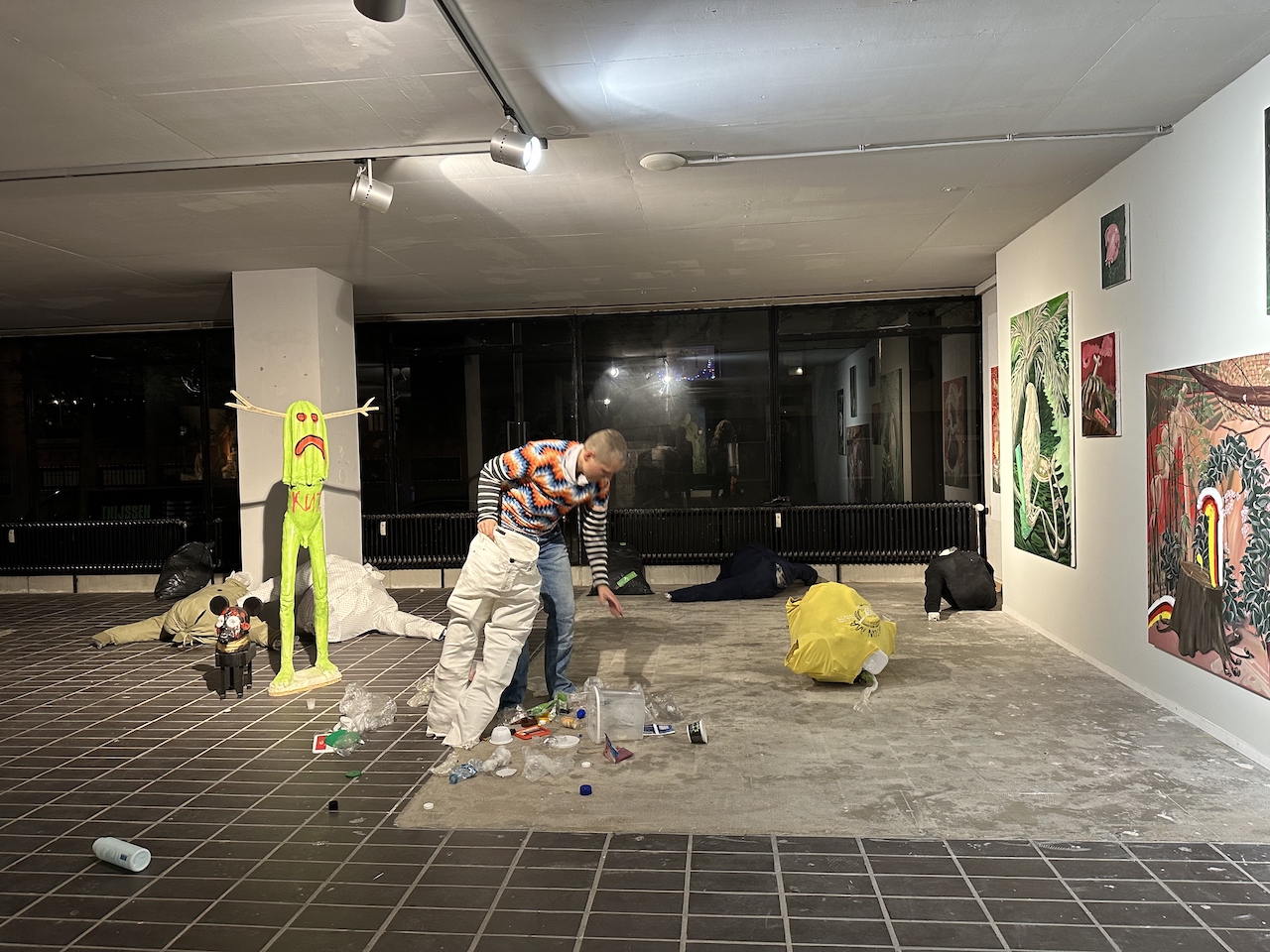
The Myth of Progress - The Myth of Progress, performance by ieke Trinks, Het Archief, Rotterdam, Netherlands, photo Marieke van der Lippe, 2023 Since 2019, I've been gathering single-use plastics for my art project called Post-Consumers (plastics). It was a one-hour performance that took place in November 2019 at the Pipa event in Pictura, Dordrecht, the Netherlands. The plastics I collected didn't just stop there, they found their way into other art projects too. One of them was a collaboration with Nathalie Smoor and Nina Boas from the Trickster collective. We did a performance involving small children at Villa Zebra, a family museum in Rotterdam. We piled up the plastics there for a few weeks. Later on, I brought all the plastic I had collected to Attent, a venue in Charlois, Rotterdam, for the Tiny Tuin music event. I organized a participative performance using garbage bags and plastics. It was quite an experiment! Eventually, I started stuffing clothing items with the plastics and created an installation for the Groot Rotterdams Atelier Weekend (GRAW). I wanted to give the plastics a more lasting cover, so I decided to dress them up like humans. This led me to my performance called The Myth of Progress, where I aim to address important issues like over-consumption, poverty, waste accumulation, and the exploitation of underpaid workers in poor and unhealthy conditions. I do this through rituals of emptying, filling, dumping, cleaning, littering, and collecting.
Antracite
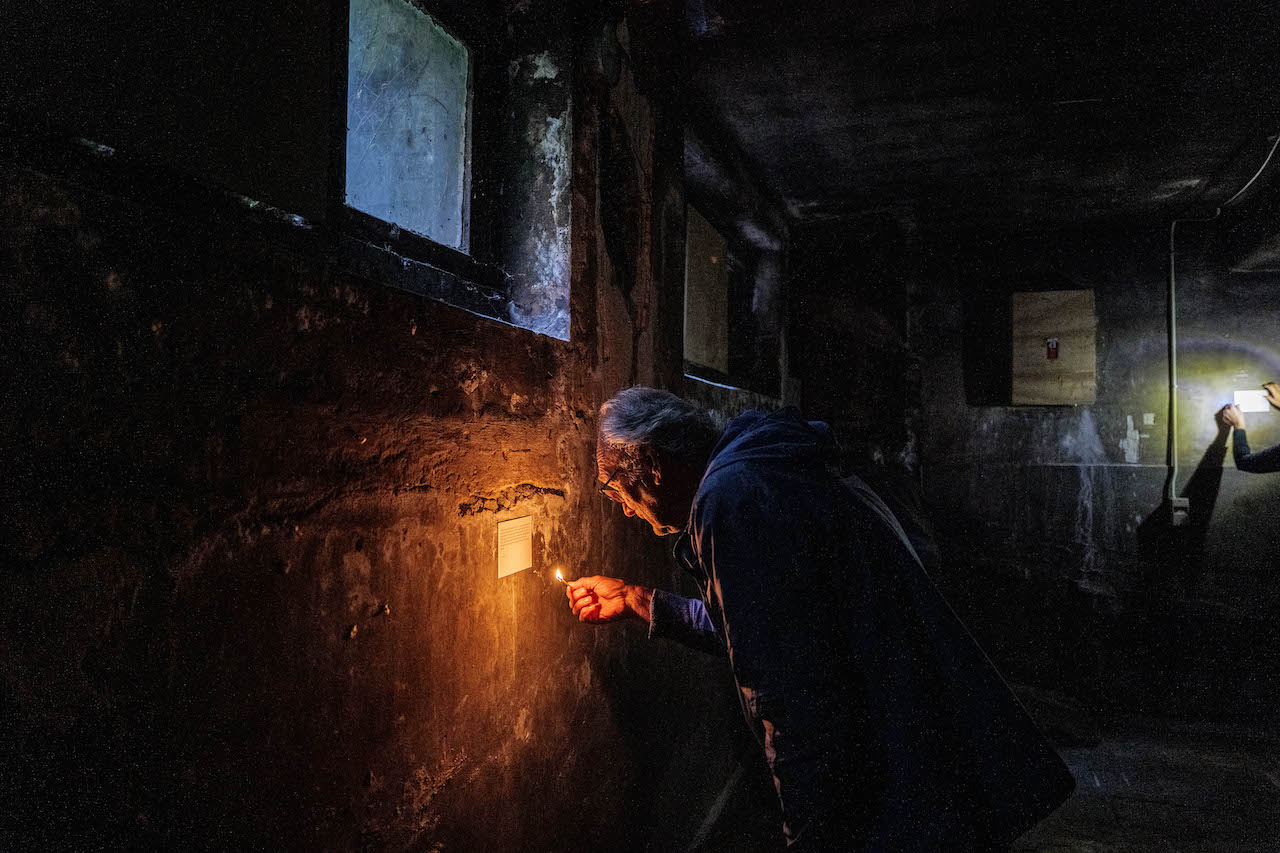
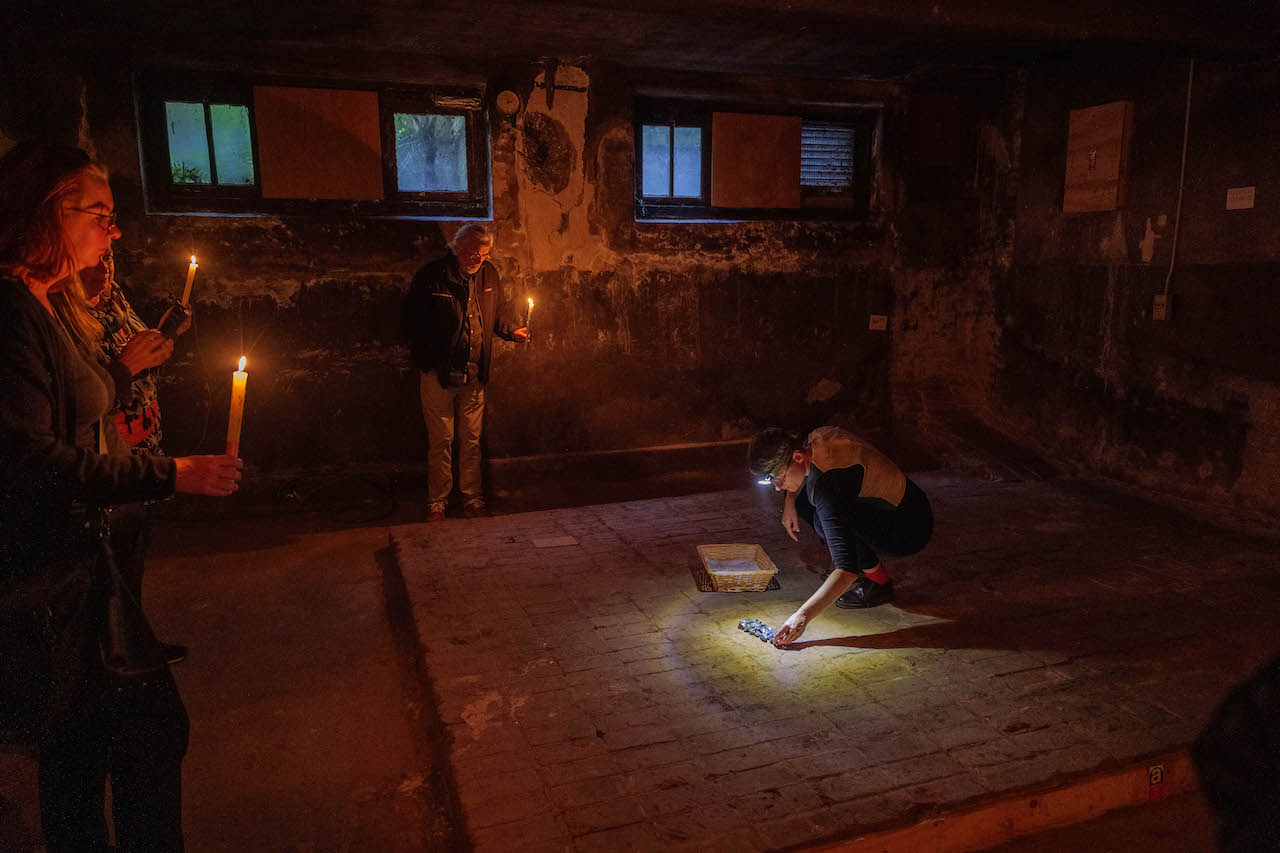
Antracite - Anthracite, performance by ieke Trinks, site specific, deKelder, 222lodge, Dordrecht, Netherlands, photo Nico Parlevliet, 2023 When Frans van Lent asked me to create a site-specific piece in the basement of 222Lodge, I was intrigued by its history as a coal storage area for the heating system in this old school building. Coal, anthracite - what exactly is this material, I wondered. Thinking about coal brings to mind energy, warmth, wealth, but also hard work and exploitation. It's a product of millions of years of history. The layers of earth where we've found organic plant matter, transformed over time and pressure into fossil fuels. The extraction of coal, along with oil and peat, has fueled the rise of some nations, while others have suffered under colonization and exploitation. The basement felt like a dark cave to me, where I wanted visitors to rely on a simple flame for light. People wandered around, searching for the text cards I had placed on the walls. The texts explored themes of fire, warmth, anthracite as a resource, and even its potential healing properties.
Water management - Equinox - same but different, a group performance on the square the Hof in Dordrecht, organized by Lodge 222, photo by Frans van Lent, March 26, 2023
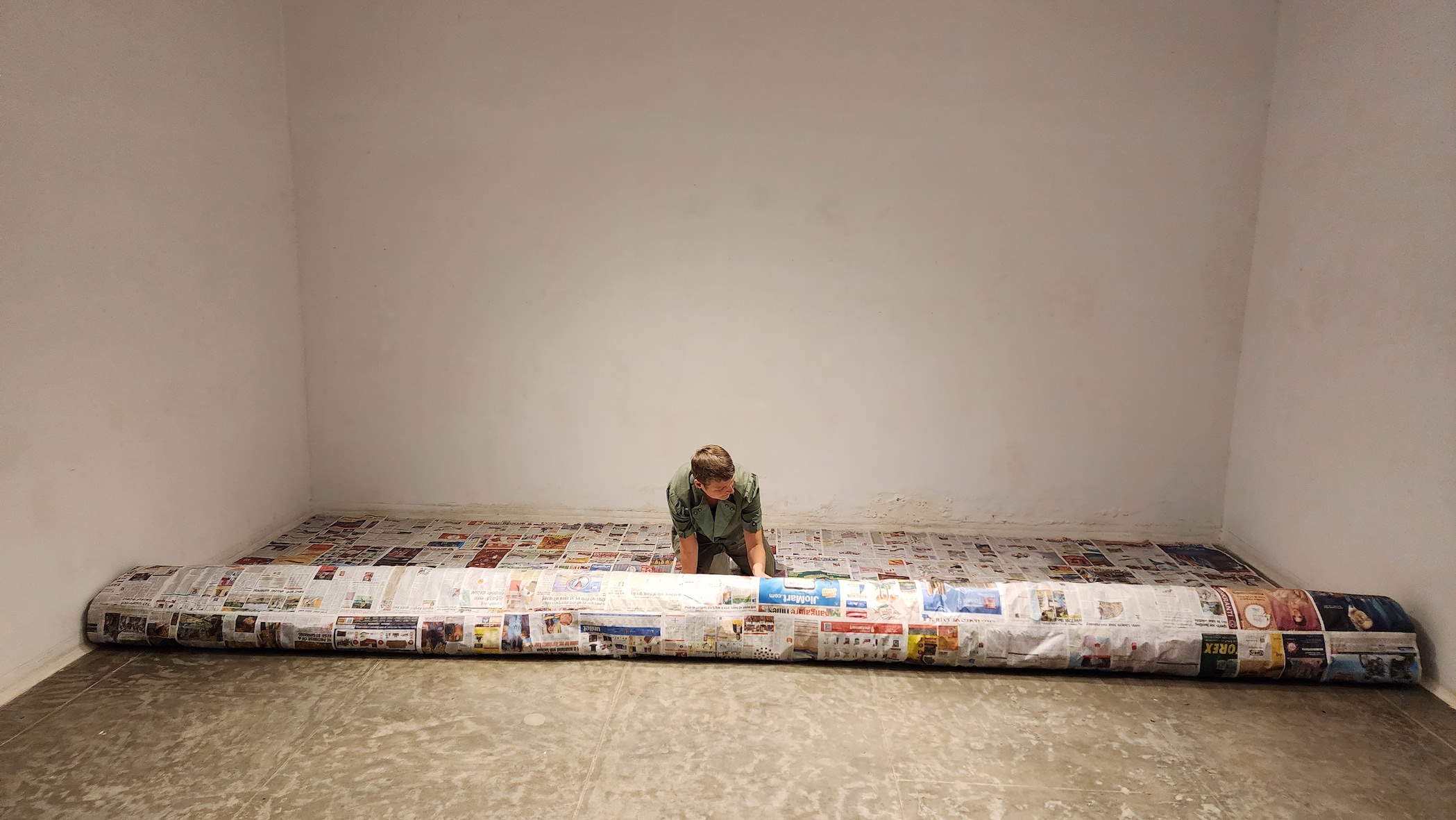
No answers, just observations - On January 19, 2023, Dimple B Shah and I performed an evening called Sites & Observations at the 1Shantiroad Gallery in Bangalore. 1ShantiRoad was my last destination in India, where I stayed for about a week to bring together the artworks I had developed during my trip to India. This performance was called No Answers, Just Observations. The lecture-performance consisted of four parts. The first part focused on the work before I came to India, called Value Products, and my dilemma of putting my found items into plastic bags. I had brought my sales coat and showed some of my Value Products while showing video footage of the Value Products project. The second part was about my first performance in India in Chandigarh. I performed with a jute sack to showcase non plastic packaging. In the lecture, I showed a video documentation of me unraveling a jute sack by projecting the video documentation on my back as I tried to untangle the bundle of rope left over from the performance in Chandigarh. In the third part, I showed the audience the video tutorial on how to make the Japanese square lashing knot technique. We had brought branches and rope together, and like a workshop, we tied the pieces of wood together to make a clothes hanger. In the last part, part four, I showed the video footage of Celebrating Thonga II, with the performance of two people walking in human-sized thongas (newspaper sacks) on a street in the outskirts of Kolkata. I had prepared a huge sheet of newspaper, which I rolled out to cover the entire gallery floor. Together with the audience, we folded it into a giant thonga that we could all enter together.
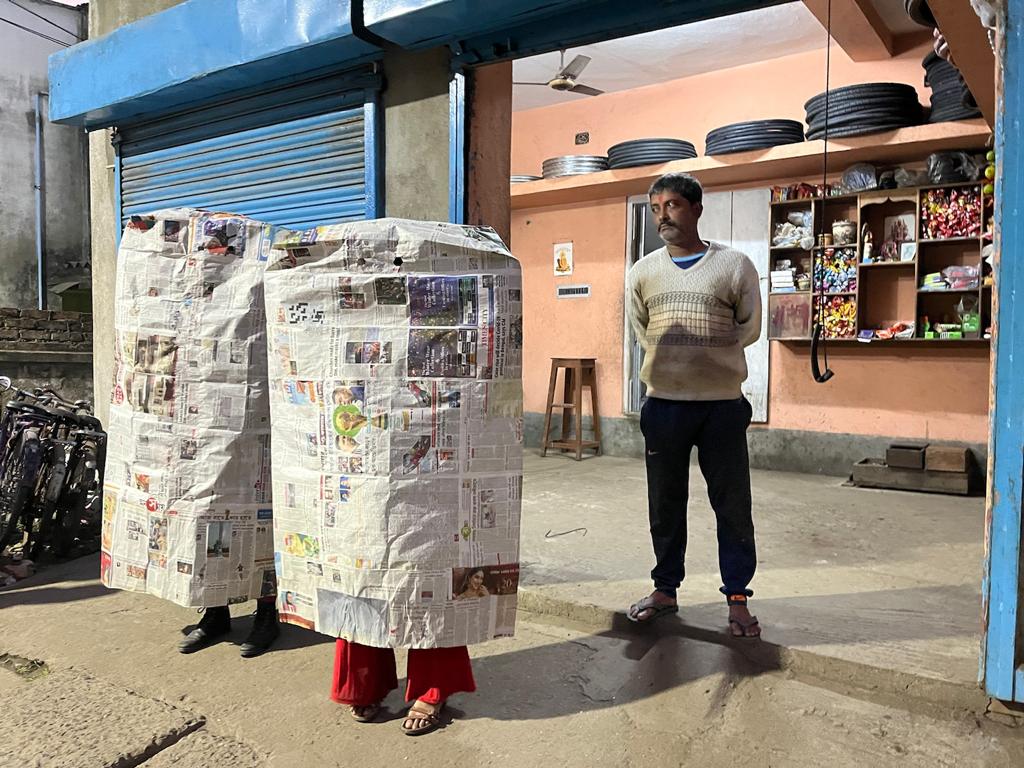
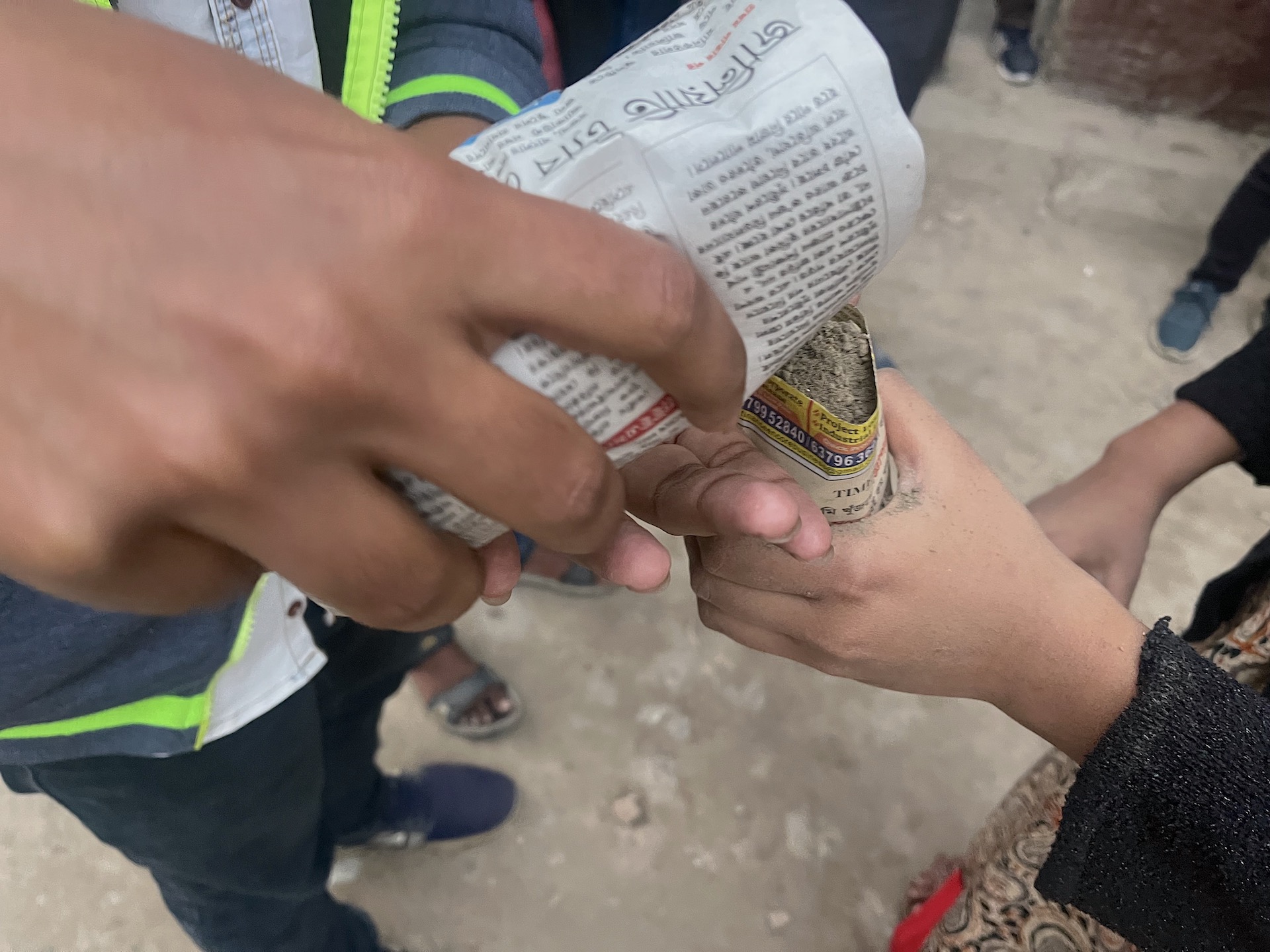
Celebrating Thonga II - The performance Celebrating Thonga II, was performed immediately after Thonga I. Again, Kushi performed at my side. In addition to the outdoor area of the Chander Haat Art Residency, it was important for me to visit the "main street" of Sarsuna with all its shops, the neighborhood where I was staying. Here I saw the garbage collectors, but also the recycling shop with newspapers sold by the kilo, and the shops where I bought products in thongas. For this performance and with Kushi, I had made two human-sized thongas. Each of us walked in the thonga through the street, where the shops reopened their shutters after their lunch break and the street came to life again. Kalpana Bhattacharjee, who lives in a small corrugated iron house in Sarsuna, a poor suburb of Kolkata where Chander Haat is located, folds and glues newspaper bags to earn some extra income. Kalpana taught me how to fold and glue these newspaper bags.
Celebrating Thong I
Celebrating Thong I - Thonga means newspaper bag in Bengali. Newspapers are recycled by folding them by hand into paper bags for shops to put in their products, such as biscuits, eggs, or peanuts. For 10 days in December 2022, I stayed at the Chander Haat Art Residency on the outskirts of Kolkata. It was my first time in West Bengal. I walked around the neighborhoods and noticed the small newspaper bags in the small shops. I also noticed the economy of waste and recycling as there was a lot of garbage in the gutters, canals, water bodies, gardens, vacant lots and streets. Waste has changed since the industrialization of food. Before, waste was organic and digested by nature, our modern times give us an overload of food, often highly processed in single-use packages, often made of plastic. This type of consumption requires a fully functioning waste management system. The system I could see with my eyes was a system of different ranks and classes. The lowest rank is the one who goes around with a big sack collecting recyclable waste from public areas and sells it to the recycling shop for a price that I think is far from a living. The higher ranked one is the one who rides a bicycle and visits homes with household products, such as plastic Tupperware, in order to exchange them for recyclable waste, such as old newspapers. These recyclables have a higher value to the recycler, which gives the scavenger just enough to get through the month with only the most basic necessities. These garbage collectors are not hired by the municipality, sometimes the city maintenance comes to clean, but too infrequently, so the residents can't do anything else with their garbage by dumping it in a garden, in the canal or burning it. For Celebrating Thonga I, I made together with Kushi, the neighbor, 11 thonga’s from large to small. Thinking of access to clean soil for growing food, I decided to start the performance with a heap of soil. With Kushi audience were invited to move soil from one bag to another until the smallest bag was filled, just like the economical chain of unequal distribution of resources and income.
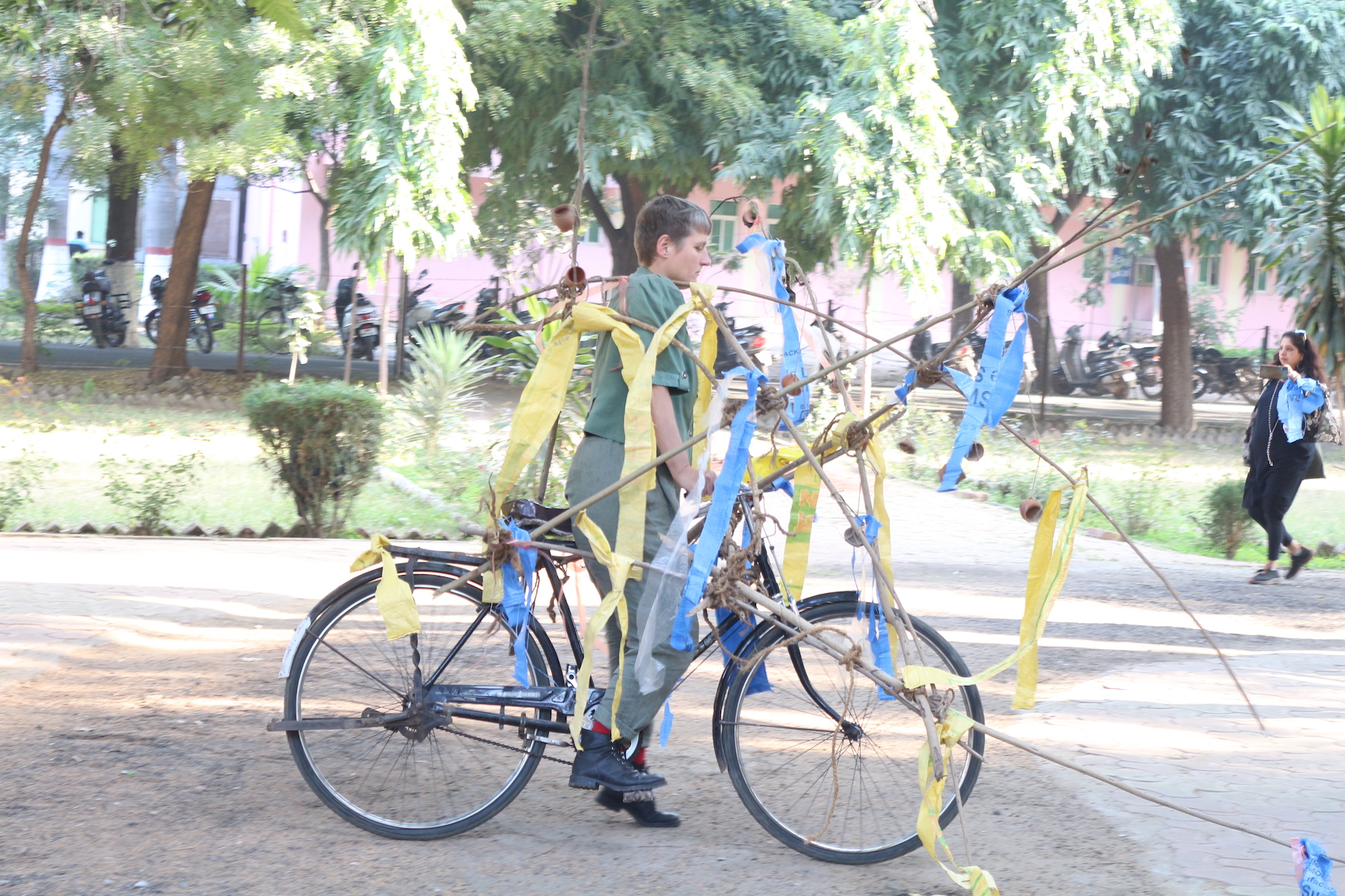
Indian Bicycle - This performance, called Indian Bicycle, took place on December 18, 2022. It was my second durational performance in India and it took place on the campus of Jiwaji University in Gwalior as part of the Jaipur Art Summit. I like this typically Indian sturdy bicycle and I have seen amazing shapes, constructions and stacks of things that people carry on their bicycles. For me, it belongs to the category of bricolage.   Artist Dimple B. Shah invited me to participate, and among a variety of different art forms that were demonstrated and presented throughout the days of the summit, Dimple and I were the only ones to emerge in performance art. The materials for my performance were collected by Dimple and I as we walked around the campus and the surrounding neighborhood. Materials were collected from under trees, from the streets, and from garbage heaps. The materials included branches, coconut husk rope, disposable clay tea cups, and the diya (clay cup oil lamp for worship). The most important object for this performance was this typical solid Indian worker's bicycle. Rajendra (staff of the university) was so generous to lend me his bicycle for the duration of my performance. During this performance, I practiced the knotting technique called Japanese Square Lashing to build my own construction on the bicycle with all the collected materials and rode it around the campus. The duration of the work must have been about 5 hours.
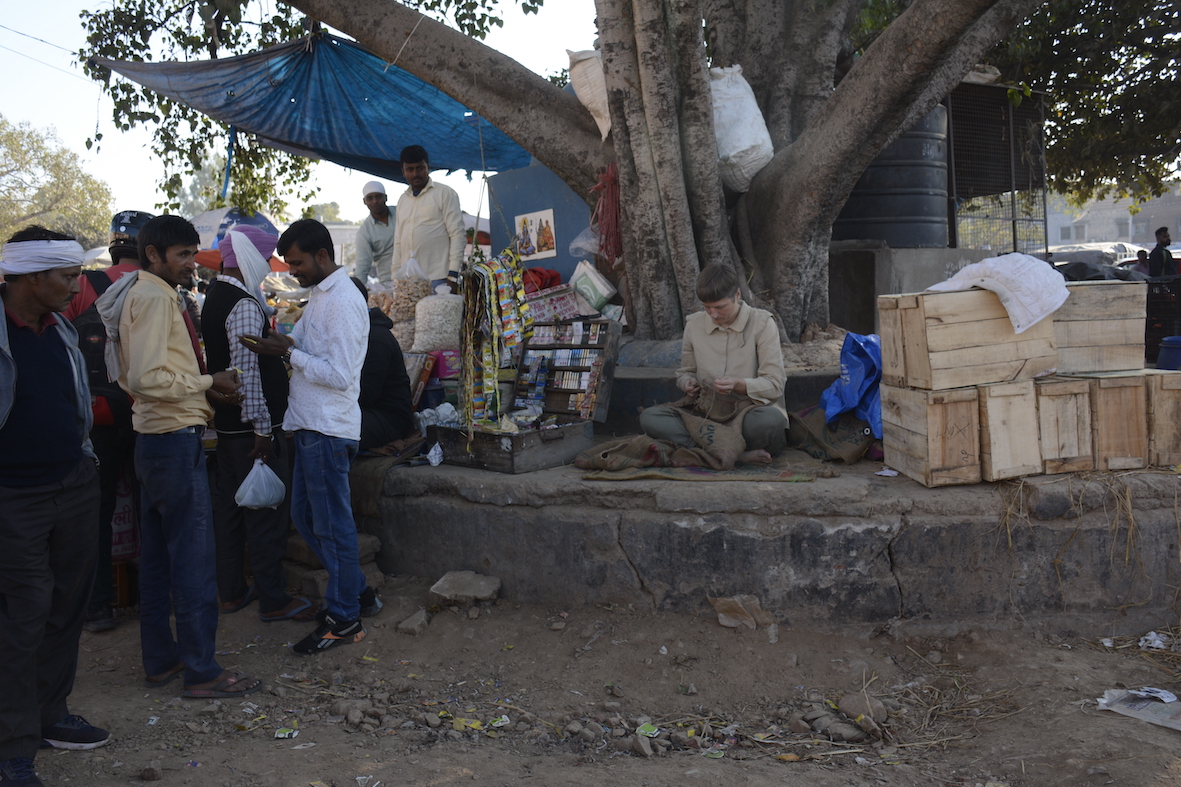
Unsacking - During my visits to other countries, I often find discarded materials, especially plastics, on the streets. However, when I visited India, I decided to change my focus and work with materials that can naturally decompose. While exploring the Sabji Mandi Market, I stumbled upon jute sacks, which brought back nostalgic memories of my childhood on the farm. I had not realized before that jute is actually grown in India and imported to the Netherlands. I spent a good 6 to 7 hours untangling an old jute sack with my bare hands until it transformed into a pile of rope. It was a slow experience to witness the whole transformation from a bag to a pile of rope. Apart from jute, a polypropylene varied is used to package, transport and distribute staple foods. There are also individuals dedicated to repairing jute bags. The performance was created during the self-organized residency at B Ajay Sharma's in_process in Chandigarh, India, December 11, 2022, photo by Keshav Soni.
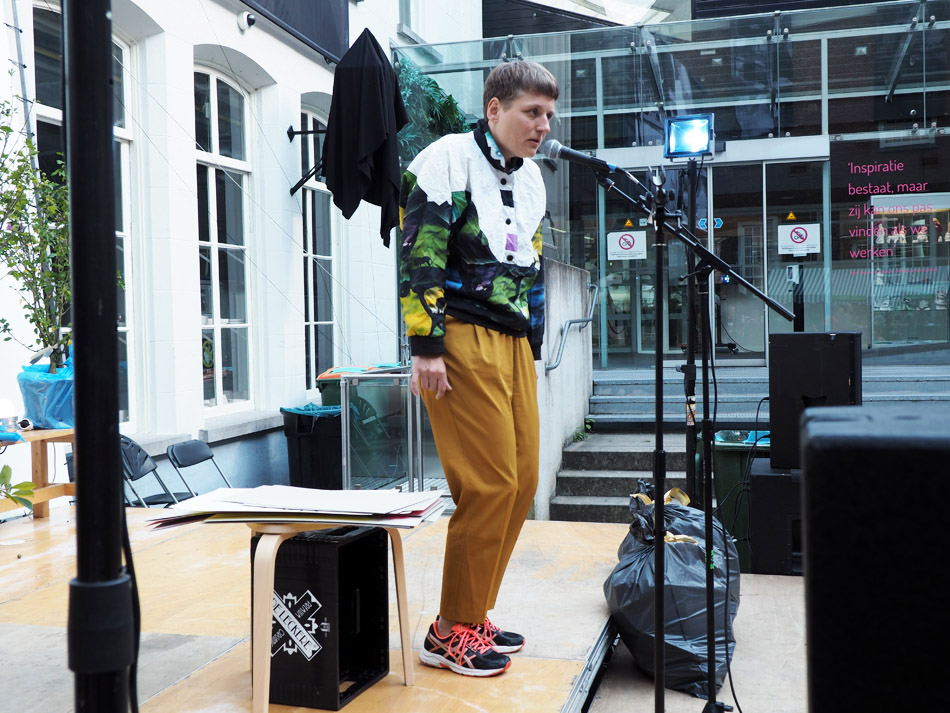
The New Currency (Free Treatment) - BUT Film Festival I know since 2008, and it stands for B movies, Underground, and Trash. I was invited to perform in their program, and created a stage piece playing with the commercial jargons in advertisements. Many public speakers speak like they have been trained to sound all the same. I wanted to be the opposite, like the "shit" that I brought with me in my trash bags. The "shit" I had carefully selected from the litter that is everywhere along the roads and streets in my neighborhood. BUTFF, Breda, September 3, 2022.
Handing out Hearts - During my internship at the Pauluskerk, I joined Marcha van den Hurk's atelier and the group of several regular Pauluskerk visitors. With her group of artists, Marcha exhibited their Dialogue Drawings in Garage Rotterdam. On an afternoon I was asked to do a performance. I had created one together with "Simon" who has no documents, and lives in the Pauluskerk. He suggested to do something positive, such as to hand out hearts to others. He was not there on that day, but luckily Peter was there to help me. Garage Rotterdam, July 16, 2022, photo by Nandu Menon.
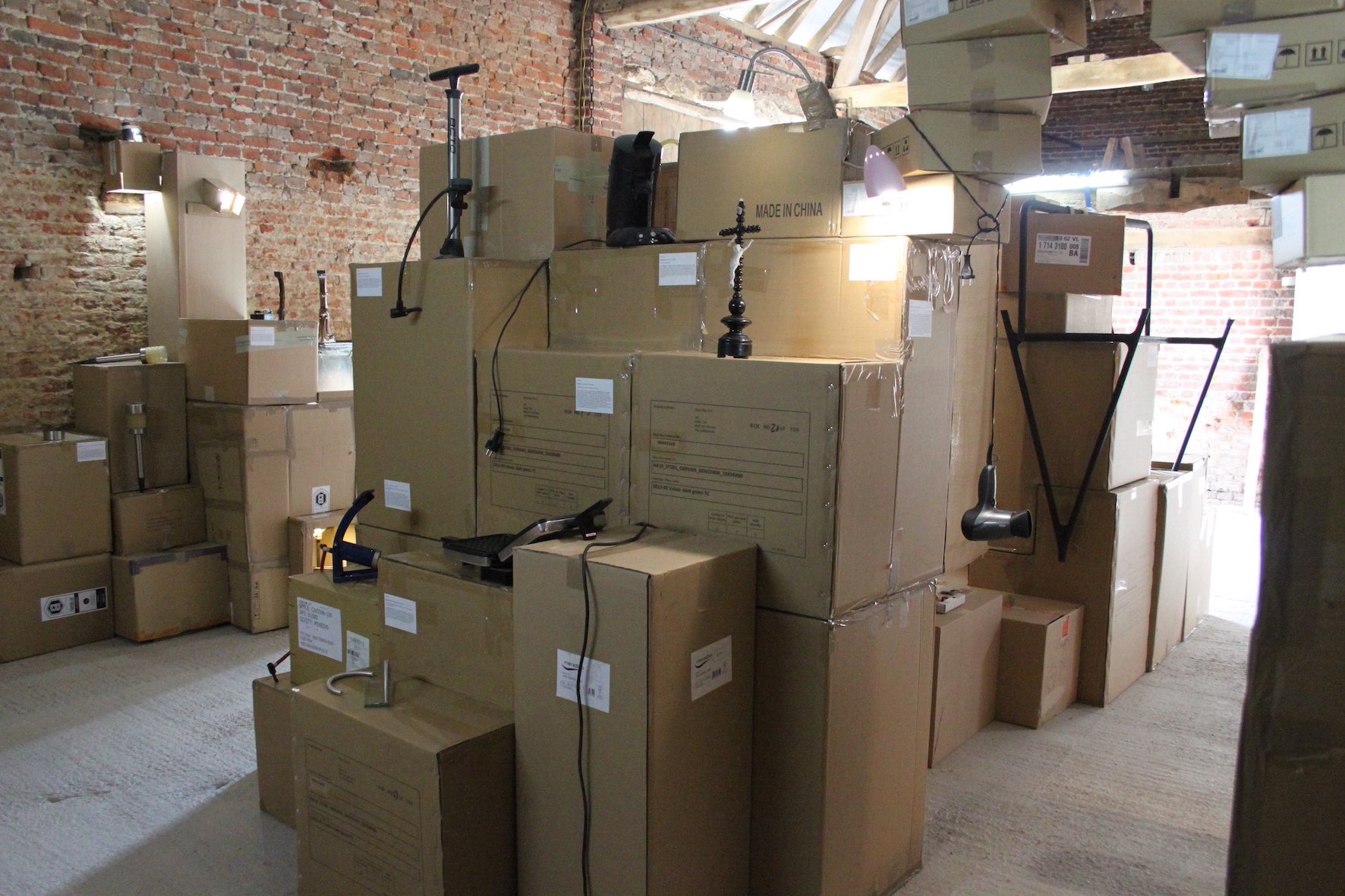
Museum voor Kapotte Spullen - The temporary Museum voor Kapotte Spullen (Museum for Broken Things) shows objects collected from residents in the vicinity of the art route Kunst & Zwalm. Each broken object is accompanied by a short text about the function of the object and how it broke. I generated each text by interviewing the owner of the broken object. Kunstroute Kunst & Zwalm, Sint-Denijs-Boekel, Korsele, Oost-Vlaanderen, August-September, 2021.

Anthracite

Datum:
Locatie: De Kelder, Lodge 222

A Site-Specific performance about Coal.

https://dekelder.222lodge.nl/2023/06/

Equinox - same but different

Datum:
Locatie: Hof
In samenwerking met: Lodge 222

The Equinox is an international day of public action for freedom for all people. On the Equinox, which takes place twice each year (around 20 March and 22 September), the day and night last approximately the same length around the world. In this spirit of this cosmic equality, a global connection emerges between people performing together in public space.

https://222lodge.nl/index.php/2023/03/28/equinox-maart-2023/

No answers, just observations

Datum:
Locatie: 1Shantiroad

For the final destination of my 7 weeks of India art trip, I created a series of four performances responding to the performances created in different parts of India. Each of them focused on a particular material and technique. Part one was about the Value Products, part two about jute sack and jute as a material, the third part was about tying techniques using branches, the fourth was about newspaper bags.

Celebrating Thonga

Datum:
Locatie: Chander Haat Residency

This performance was created during my stay in the outskirts of Kolkata. I noticed the use of newspapers being sold to garbage collectors, and resold to little shops with recycle materials. Some old newspapers are readapted to little bags for shops to put their products in. Around the recycled paper of newspapers, and the economics around used materials in India, I find intriguing. I created two performances using old newspapers that I bought from the little shop with recyclables.

Indian Bicycle

Datum:
Locatie: Jaipur Art Summit
In samenwerking met: Jawaji University

During the first weeks of my experiences in the North of India I felt connected to this typical Indian worker class bicycle. The traffic in the cities and the streets are busy and used by all sorts of vehicles. Particular bicycles and the transportation of large numbers of objects made me think of movable art sculptures. I borrowed this bicycle from a member of the university's staff. The materials that I constructed on it were found on the campus and the neighborhoods around.

Unsacking

Datum:
Locatie: Sabji Mandi Market, Sector 26
In samenwerking met: in_process, Live Art Practice

I've worked a lot with discarded materials (mostly plastics) from streets around the world, but when I traveled to India, I wanted a change of focus, and looked at materials that can be fully decomposed by nature. At the Sabje Mandi (fruit and vegetable) market I re-encountered the jute sack. There I untangled one old jute sack with my bare hands, until it was fully transformed into a heap of rope.

https://inprocessopensource.wordpress.com/portfolio/artist-in-house-ieke-trinks/

The New Currency (Free Treatment)

Datum:
Locatie: BUTFF

BUT Film Festival I know since 2008, and it stands for B movies, Underground, and Trash. I was invited to perform in their program, and created a stage piece playing with the commercial jargons in advertisements. Many public speakers speak like they have been trained to sound all the same. I wanted to be the opposite, like the "shit" that I brought with me in my trash bags. The "shit" I had carefully selected from the litter that is everywhere along the roads and streets in my neighborhood.

Handing out Hearts

Datum:
Locatie: Garage Rotterdam
In samenwerking met: Marcha van den Hurk, Pauluskerk, & Simon (Pauluskerk resident)

During my internship at the Pauluskerk, I joined Marcha van den Hurk's atelier, and with several regular Pauluskerk visitors. With her group of artists Marcha exhibited their Dialogue Drawings in Garage Rotterdam. On an afternoon I was asked to do a performance. I had created one together with "Simon" who lives in the Pauluskerk without documents. He suggested to do something positive and to hand out hearts to others.

Museum voor Kapotte Spullen

Datum:
Locatie: Kunstroute
In samenwerking met: Croxhapox, BOEM

The temporary Museum for Broken Things (Museum for Broken Things) shows objects collected from residents in the vicinity of the art route. Each broken object is accompanied by a short text about the function of the object and how it broke.

Onbestendige Dingen

Datum:
Locatie: DC Community Market
In samenwerking met: Charlois Speciaal

Precarious Things represents the changing nature of objects that surround us in our everyday environment. ieke Trinks has invited three other local artists (collectives) to develop a work or an activity in one of the thrift stores of Oud-Charlois.

Value Products in de Vitrine

Datum:
Locatie: De Vitrine, Mijnsherenplein
In samenwerking met: Cultuurwerkplaats Tarwewijk

De Vitrine is a showcase glass box, located in the neighborhood Tarwewijk. I've started with the Value Products Project in 2015. The Vitrine was to me the perfect place for the products to be exhibited, because the products, the items in the bags are from the street themselves, and in the this glass box they are just as much present as when they were in their previous life on the street.

https://cultuurwerkplaatstarwewijk.nl/programma/de-vitrine/

What Remains

Datum:
Locatie: ARC Gallery
In samenwerking met: Joseph Ravens, Defibrillator Performance Art Gallery

The starting point for this project was my response to Joseph Raven's collection of performance art relics, leftover materials and objects from over a hundred performances by different artists. A call was send out for proposals for new performances using or based on one of the relics. An exhibition was built with the relics and there were weekly events with performances and presentations. I was the instigator of What Remains, and responsible for the artistic content.

https://dfbrl8r.org/event/remains-chapter-one
Deze kunstenaar heeft nog geen toekenningen.