María José Crespo

video , sculptuur , installatie , Artistiek onderzoek

Living in the Bordertown of Tijuana in Mexico has made me question the way I inhabit limits as a woman. Limits are thick because they can be expanded into a zone of possibilities: they regulate everyday life, and everyday life always exceeds them. When stretching limits as geographical layers, territories become a double-edged zone: informalities become formal, and personal matters become public by understanding how legality operates in daily life.
These types of zones are indecisive, they disavow any attempt to be controlled by leaving material remains as evidence of the way they have been administrated. I think of the territory as a body that carries with it the traces of experiences; memories and stories, and things speak to me through materialities: textures, sounds, and found objects that embody its characteristics as a place.
Female Flickers
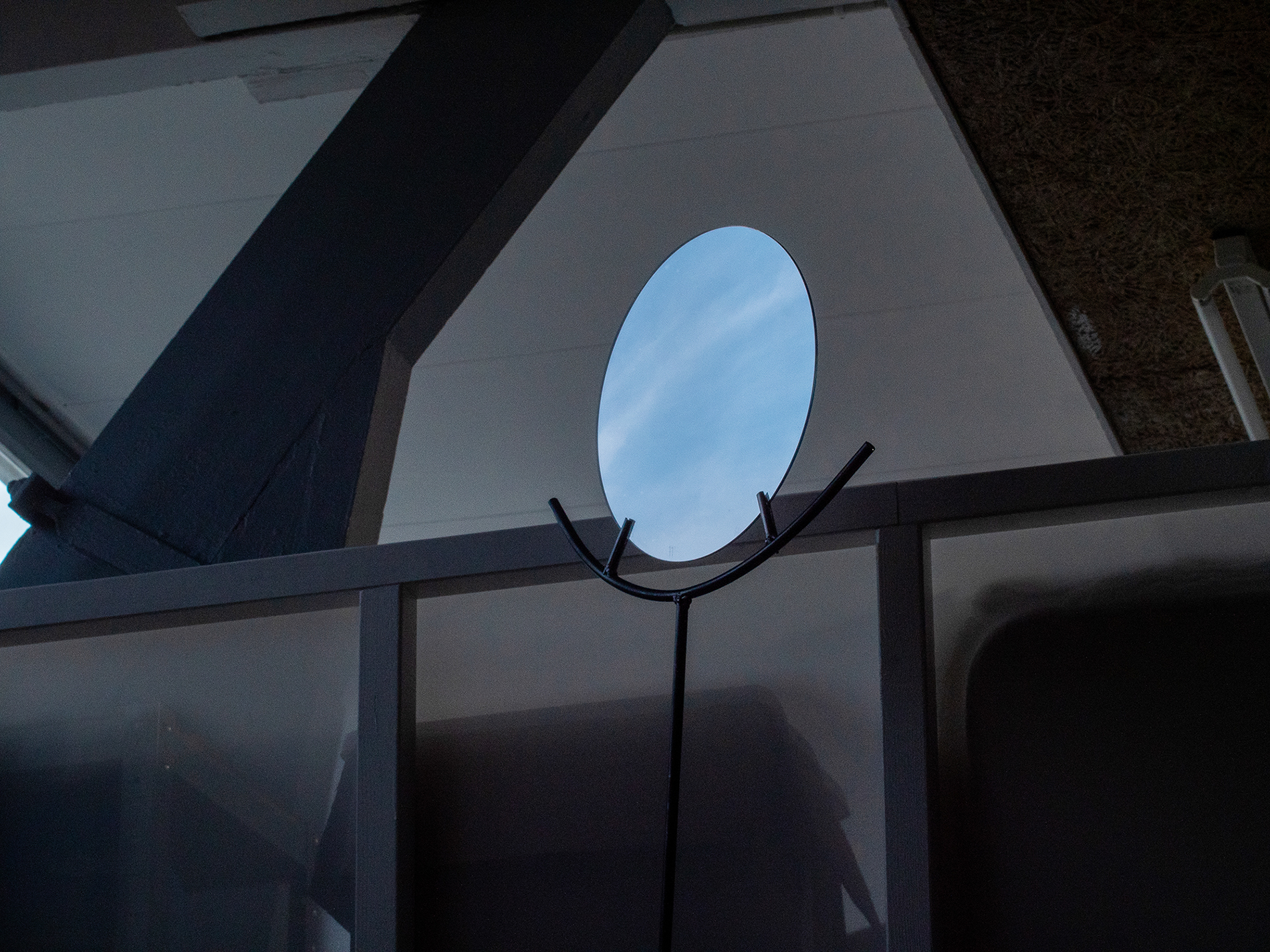
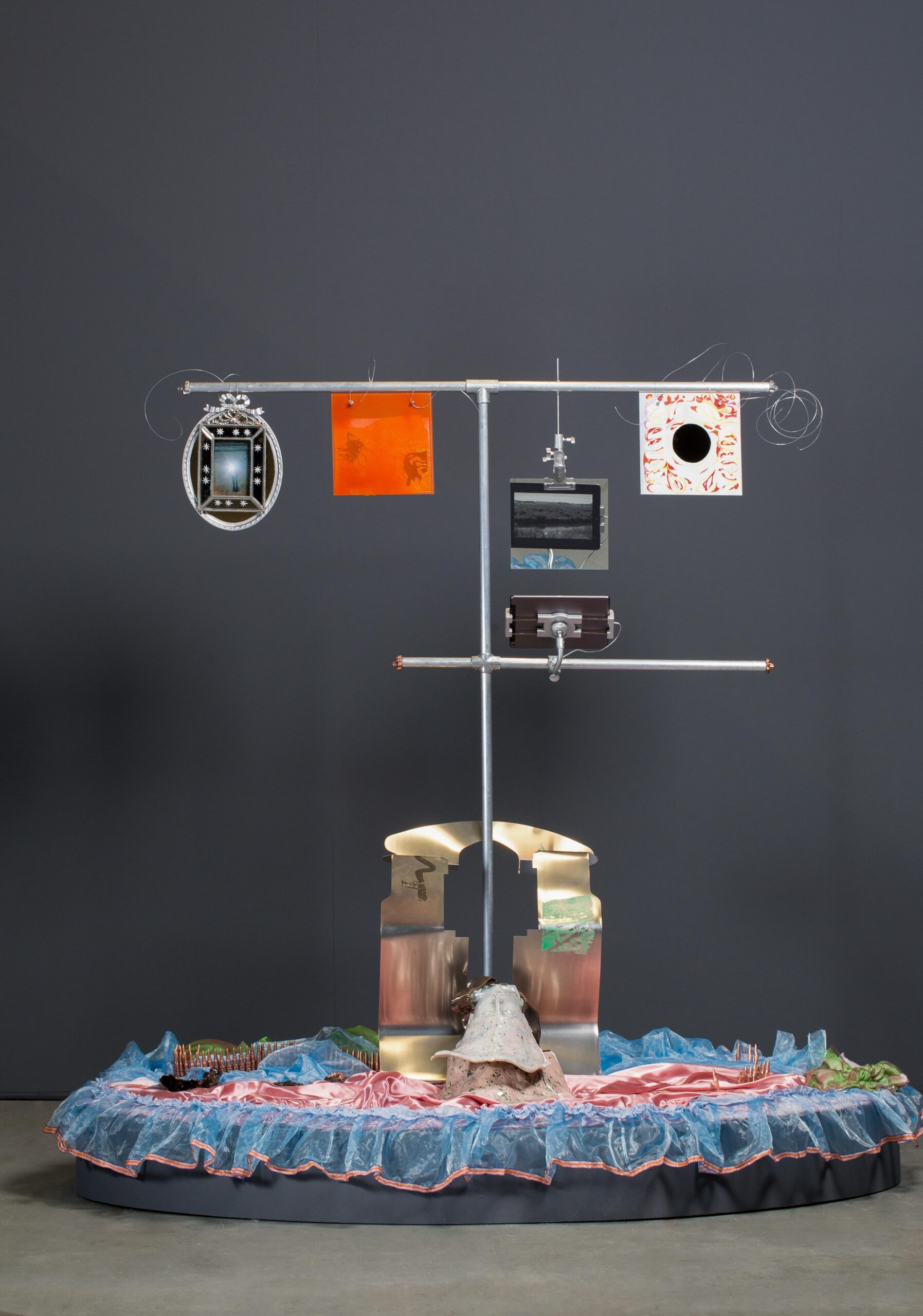
Female Flickers - The installation revolves around the story of avisadoras, female messengers who flashed messages with a vanity mirror across the border between Mexico and the USA during the Mexican Revolution (1910-17). Most of the avisos were daily life communication, but also warnings, for example, to inform of the approach of the early border patrol. Avisadores were usually men, but while researching the archive of W.D Smithers at the Ransom Center in Austin, TX., I came across an image referring to female avisadoras. Departing from this finding, I created a setting where avisadoras meet with other female figures marked by struggle and different communication strategies during times of conflict, mostly in remote landscapes, like women who fought in the Mexican Revolution. Their activities and gestures are embodied in the work through tools and structures that liberate and constrain their activities, like a teleprompter, bullet belts, and a telegraph. Such is the installation's structure, inspired by a Dutch optical telegraph model from the Rijksmuseum used to send coded messages over long distances.
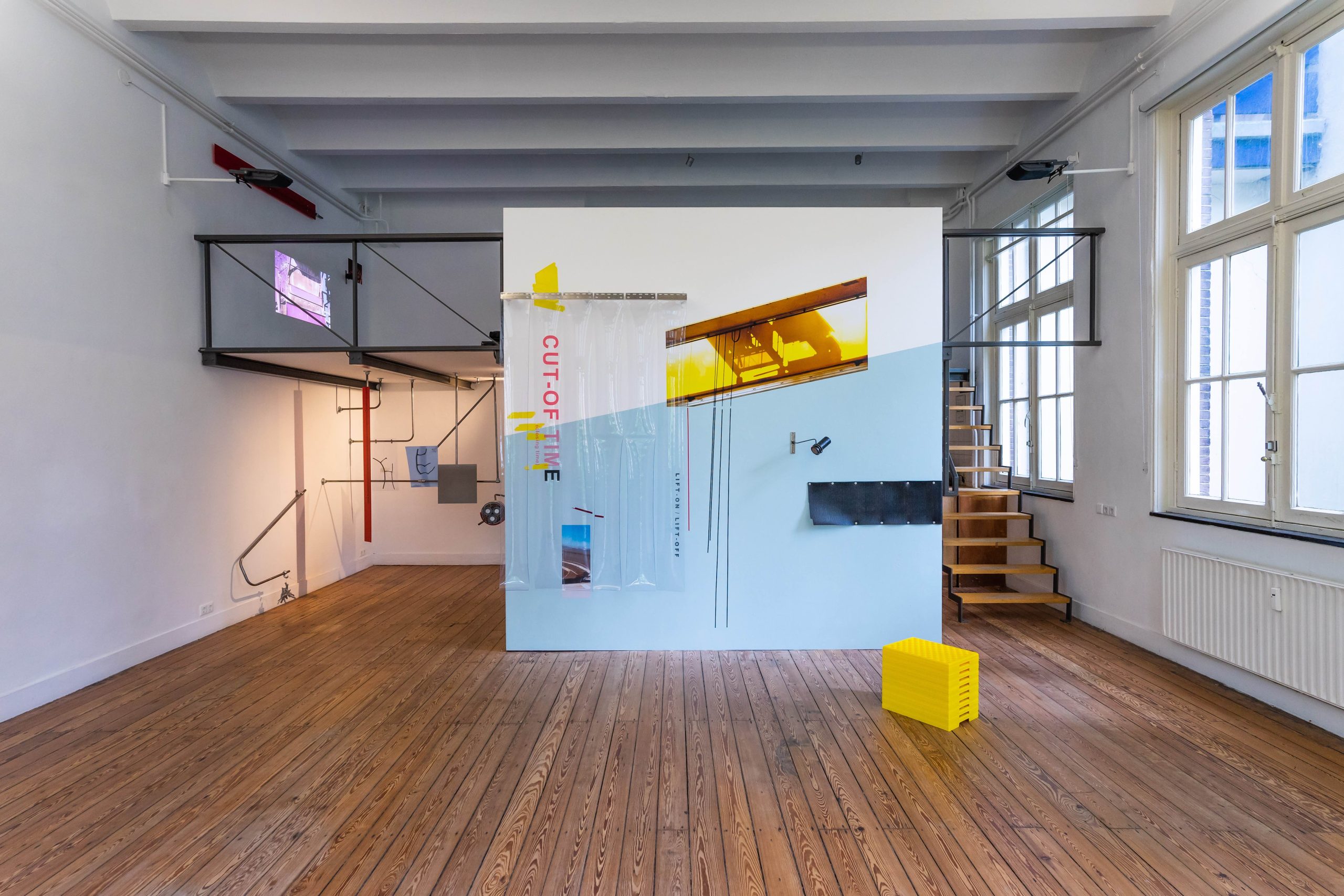
The gateway as a point of encounter - In collaboration with Madeleine Ruggi the exhibition features sculpture, video, print and sound to draw relationships between personal site-specific experiences during visits to the Port of Amsterdam where we witness the vastly connected world of commodity demand. The work exhibited at PuntWG in Amsterdam, shifts our previous mode of research from the audiovisual presentation format towards material experiments applied to ideas around the relationship between our own bodies gaining access to and being confronted with trading systems, territories, maritime history and port infrastructures.
Female flickers over built enviroments - The exhibition presents María José's ongoing research on female communications at the Mexican border. For this first presentation, she echoes the idea of an Avisadora: a woman who flashes messages with a vanity mirror at the border between México and The United States. The lack of representation of Avisadoras in public archives and collective memory has opened an opportunity to create a network for them to meet: an atemporal space for women that uses different tools to communicate and share secrets, performing acts of self-governance through experimenting with speech. In this chapter, an Avisadora meets other women in the context of the Mexican Revolution. By layering sonic documents from field research, social media, archives, and golden age Mexican movies a landscape is created for them to meet at a crossroad: the railways at the northern border of México and the river Grande/Bravo.
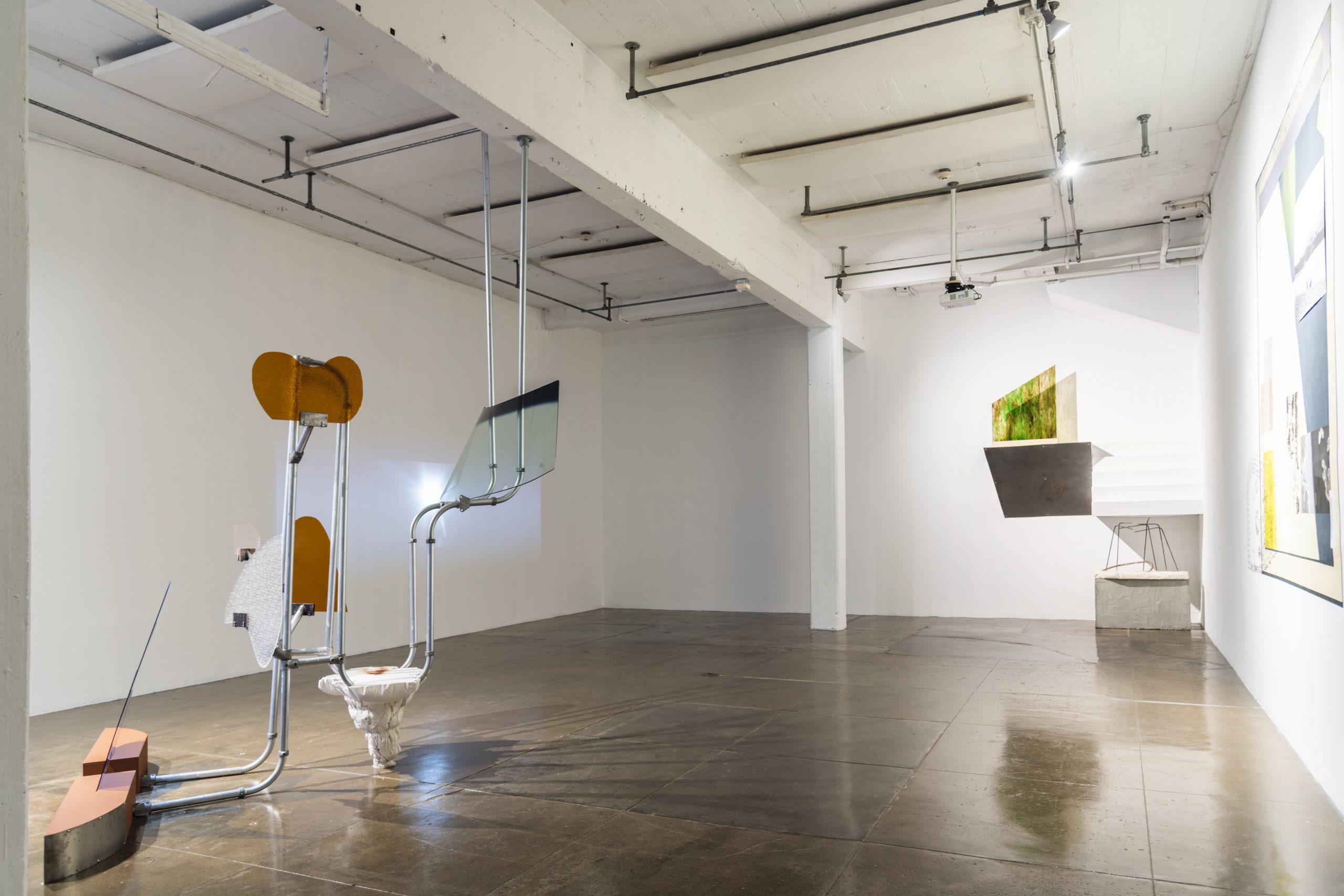
Flaws in negotiation with non-cohesive sand, 2022 - Installation: Fence pipes, metal, glass, acrylic, wood, plaster, digital print, rebar, and digital video. - This exhibition was comissioned by Artpace San Antonio, Texas where I made a residency. During this time I explored on-site and in archives how different landscapes, objects, and mechanisms around the Rio Grande - Bravo are part of a history that can be expanded into multiple materialities and observed as diverse layers of experience in different settings. Flaws in negotiation with non-cohesive sand is an environment where clashing acts of self-governance and politics embedded in physical forms question the way history is displayed and therefore understood, contrasting the infrastructure of the space in itself with the intimacy that materials offer, unfolding in a series of structures informed by gestures that administer water and land at the border between Mexico and the United States during the 20th century.
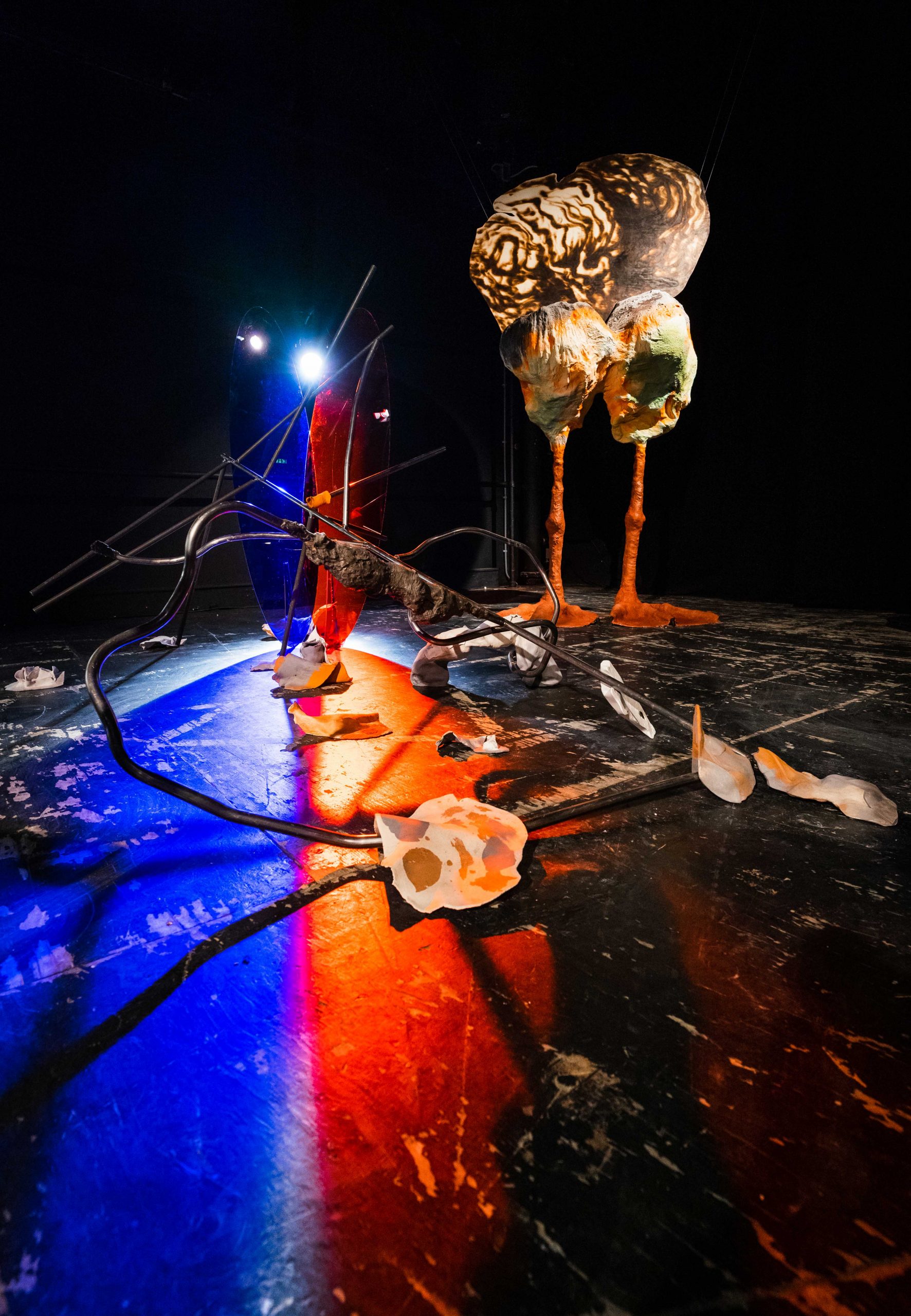
A set of conditions, constantly being updated, 2022 - Installation: acrylic, ceramic, digital print, metal, plaster, wood, digital video. - By unfolding unclear spaces as zones of possibilities, the installation operates as an orientation device that positions the audience to encounter the in-betweenness of a border crossing zone and surveillance mechanisms employed to administer ambiguous semi-informal spaces of existence. Meanwhile legality cannot slim into the most quotidian spaces of negotiation, other gestures expand local limits and are performed by agents that claim the territory because they own it: at the Port of Rotterdam seagulls being displaced by policies protecting companies, and at the border entry points in Tijuana, deported migrants known as Los Gaviotones jumbling the order of the crossing waiting line. This set of conditions is proposed as a double-vision zone composed of elements that embody the failure of land administration, addressing contingent relations on materials within their surroundings and mediators like seagulls and gaviotones. These relations are plural and positioned at different times as visual layers that may expand, nevertheless, they remain the same: a permanent conflict between what is concealed and what is revealed.
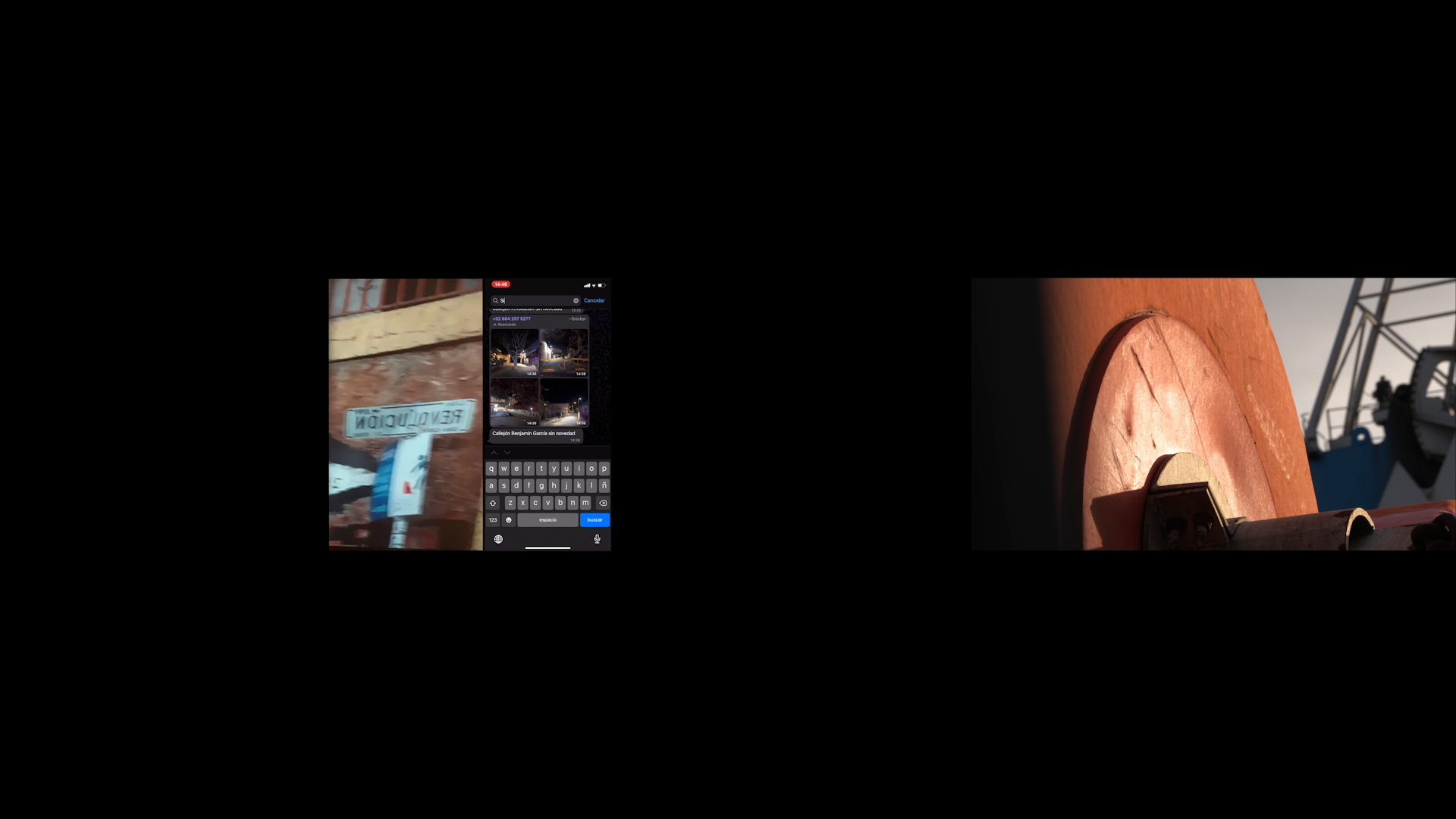
Govern yourself accordingly, 2022 - Three-channel video installation. - This work is a collage of experiences and stories in Spanish that have also sometimes been auto-translated into English. These automatic translations, which come from layering different voices and materialities as found objects – pieced together words and images from the Internet – act somewhat like surveillance footage from a Tijuana–San Diego border website, or images from a police chat, from a social media group that posts daily updates on the best currency against the dollar, legal treatises, various stories from the streets of Tijuana, and observations on the different devices employed to administer this ambiguous semi-informal space of existence.
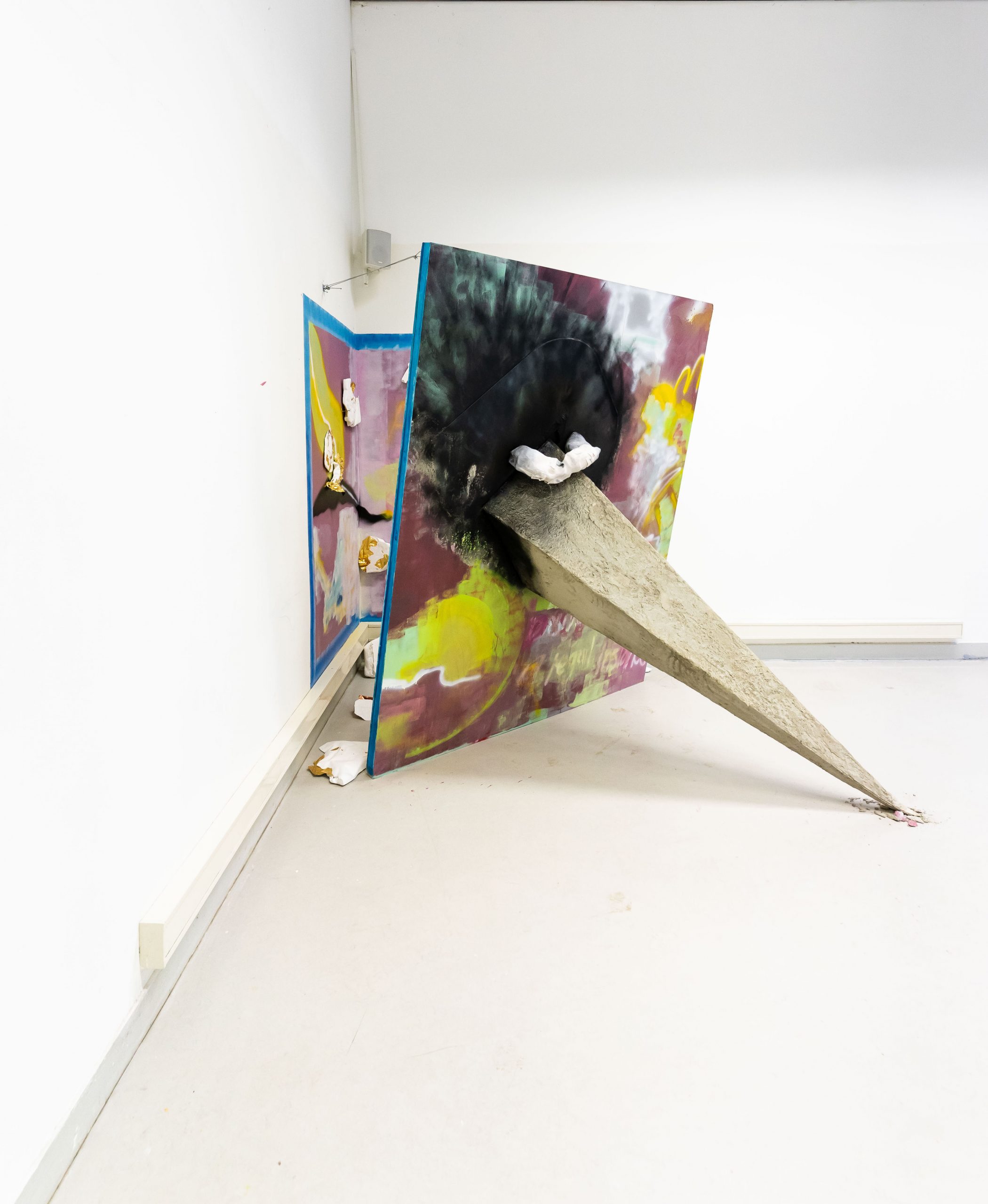
Elements of erasure, 2022 - Installation: acrylic, wood, concrete, digital print, plaster, thermal blanket, copper. - Ambivalent feelings are floundering authoritarian arenas like the borderlands where alienated bodies fear, hope and doubt at all times building a tolerance for ambiguity to understand the in-betweenness of things, where layers, wrappers, and pleated folds clash with a possibility of being stable and surrender, but they choose not to, permeating glimpses of self-governance on the materialities that surround them. Materialities at the borderlands compose an extension of plural bodies: objects, feelings, structures, tools, and laws that together collide with the institutional ways of administering them like a boundary marker and a treaty. Through the lens of legality as a way of collecting, I collaged different border treatises about land and water throughout the history of the boundaries between México and USA, together with a colonial memoir from the demarcation of boundaries in Nigeria. By making visible the different styles and typographies of the files, I am interested in their materiality as found objects on the internet, highlighting the arbitrary gesture of gluing them together, erasing locations and names to question legality as a tool that updates and deploys a border anywhere.
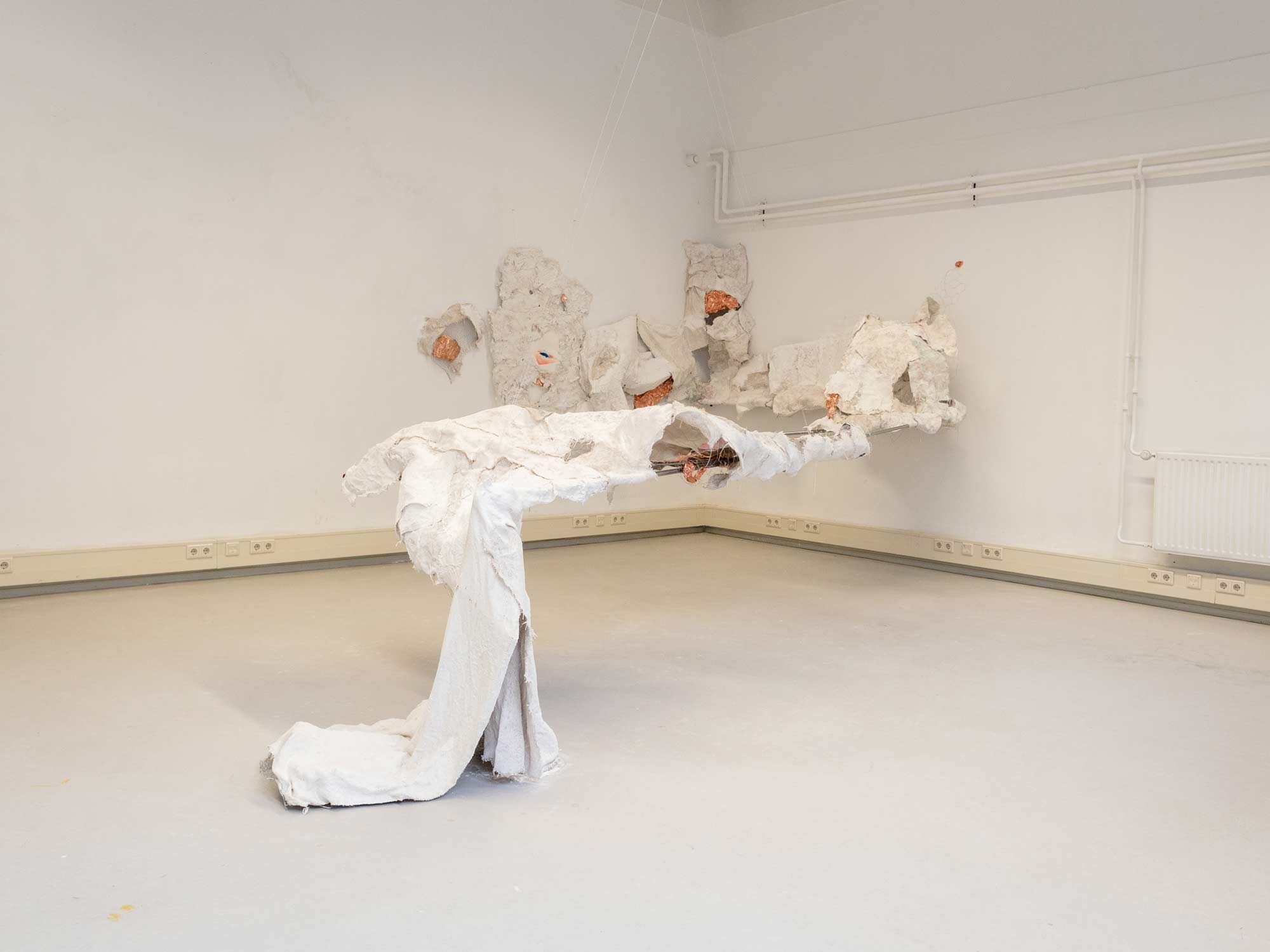
An excess that limits bodies to exile, 2021 - Installation: jute, plaster, watercolor, cotton, metal and copper. - The structure holds the in-between boundaries to modulate the territory through the body in order to understand my displacement process regarding language, body, and territory. The way I expand the in-between is materialized by my body’s gestures and traces, which is a way of mapping and thinking of my body as the first territory from which I am researching, articulating an ensemble of bodies, built by different forces. The layering of materials creates a collaboration, Is it volunteer or forced?
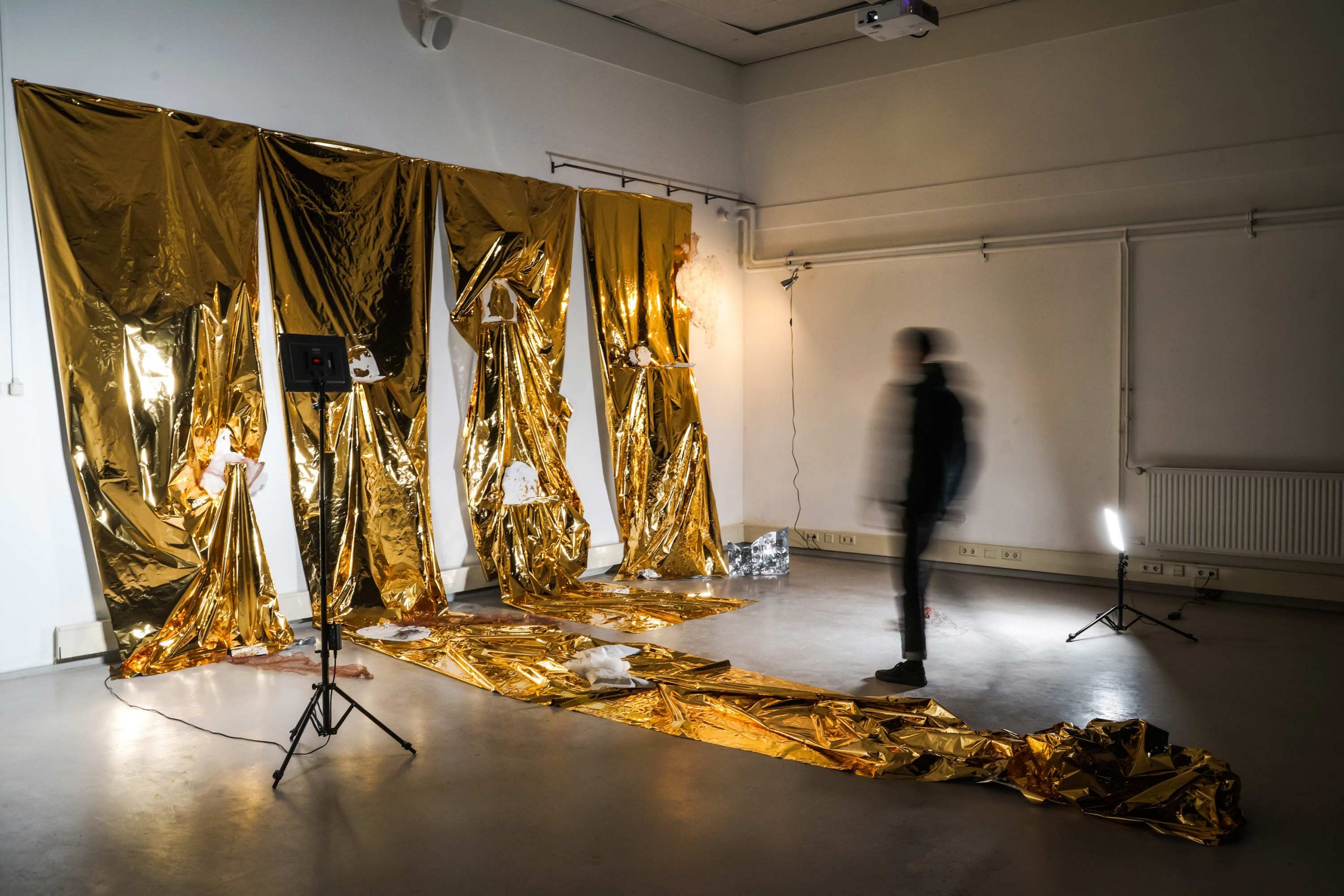
A barbed sun of possibilities, 2021 - Installation: thermal blanket, digital video, halogen lights, plaster, metal, copper mesh - The installation highlights zones of intensity as spaces of simultaneous situations where boundaries are being performed and seen through CCTV surveillance videos from a Tijuana border checkpoint, fictions of casted found objects revealing the passage of people against a thermal blanket drop scene, halogen lights spotlighting fenced bodies. Rather than thinking of these spaces as processes of exile and exclusion, I am interested in the possibilities of inventing new negotiations and new forms of living. Borders are thick and don’t have fixed limits. They can be encountered anywhere because they are constantly being redrawn, relocated with administration processes and fictional tools, leaving traces in emergent and disoriented bodies.
Variaciones para clasificar paisajes, 2019 - Installation: ceramic, sound. - The installation organizes the landscape through assemblies of ceramic that work as archives generating sound taxonomies that describe their characteristics as territory. The project studies spaces without a clear definition, with abandonment, and generally in the margins of the cities. They are spaces that do not express power or submission, they are unclear. By being aware of elements such as vegetation, minerals, limits, location, living beings, materials, and the game of relations that are in between them, categories are being assambled by making field recordings or creating sound fictions with the found materials.
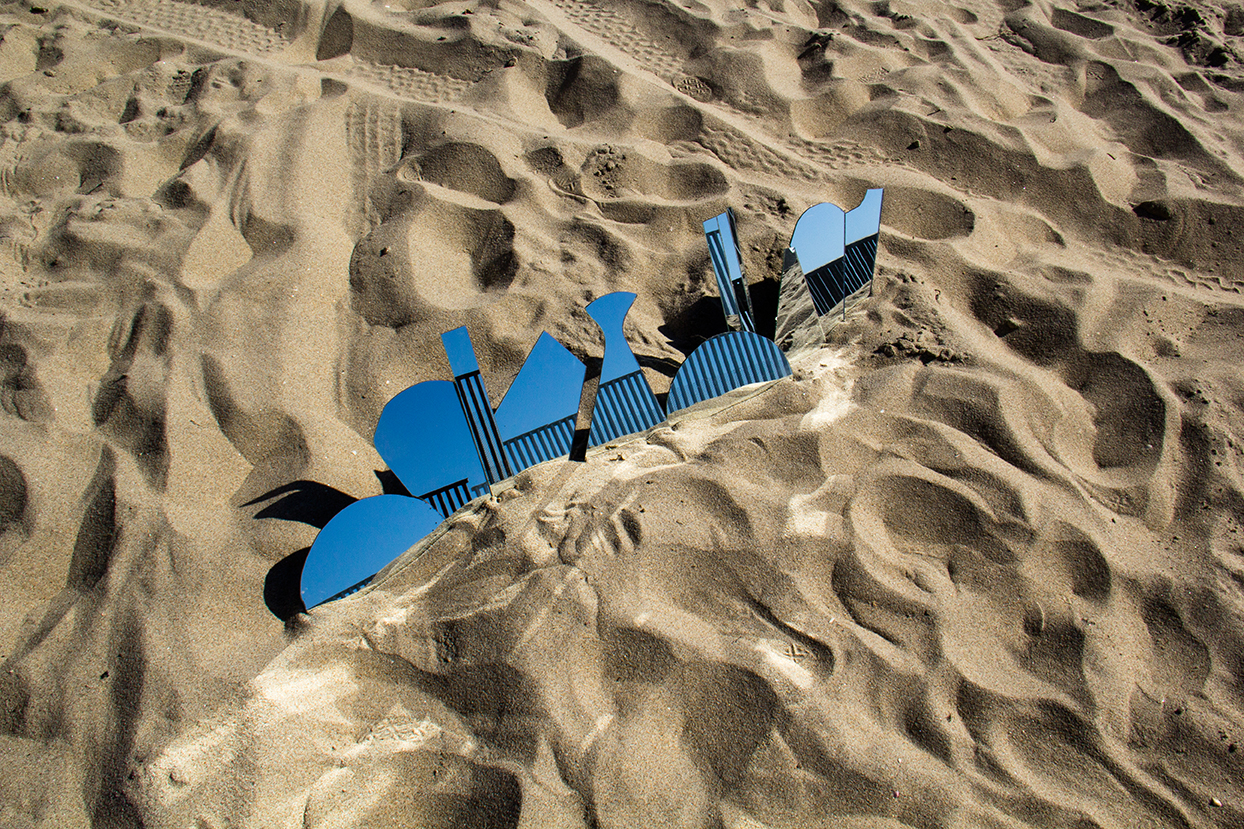
Significados dormidos, 2019 - Photography - A line of mirrors placed deliberately reproduces a non-existent space in the reality. Divided into unequal parts, that space enunciates a sentence which lecture is slowly digested, as when we articulate syllables to learn words. When placing a sculptural object of these characteristics, a spatial order can intervene with another one to include a different state of things: a landscape, a building, or even an institutional context, including the spectator.

XXIII Bienal Plástica de Baja California

Datum:
Locatie: Baja California

Acquisition award on the XXIII Bienal Plástica de Baja California where I participated with my work "A barbed sun of possibilities".

https://www.mariajosecrespo.com/a-barbed-sun-of-possibilities

17th Annual Dia de la Mujer Exhibition: Invisible Traditions

Datum:
Locatie: The Front Arte y Cultura

Certain socio-cultural practices might fade into obscurity or become less visible in everyday life, but they still hold significance. They can contribute to a sense of belonging among members of a group or exert control, particularly over those who are marginalized. When these practices are rooted in power dynamics, they might perpetuate inequality, suppress voices, and limit opportunities for those who already bear the weight of societal disadvantages.

https://thefront.casafamiliar.org/archivos/4075

La permeabilidad de una línea

Datum:
Locatie: Material Art Fair
In samenwerking met: Planta Libre

For Vol. 10 of Material Art Fair, María José presents an installation around the idea of being in the middle and its translation into what Crespo calls "visualities of legality", where different autonomies operate within the same normativities, spaces and agreements that put in tension the limits of the legal.

https://material-fair.com/platform/feria-material-vol-10/

Female flickers over built environments

Datum:
Locatie: WET
In samenwerking met: CBK

Female flickers over built environments is an installation where different female characters meet, make plans, share secrets, and furnish each other with communication tools for different scenarios reflecting on the Mexican revolution at the border between México and the United States.

https://wetfilm.org/2023/07/12/maria-jose-crespo-female-flickers-over-built-environments/

Malt AiR

Datum:
Locatie: Maltfabrikken
In samenwerking met: The Jutland Art Academy and The Danish Art Workshops

During my residency I experimented with the form of speech and its multiple ways of understanding it nowadays through multimedia possibilities and settings to be performed or displayed. By using my voice to probe fiction, I explored enunciations in sound, staged oral stories like malleable scripts. Part of this residency time was used to finalize the audio work presented at WET for my solo exhibition.

https://www.maltair.dk/artists

The gateway as a point of encounter

Datum:
Locatie: puntWG
In samenwerking met: Madeleine Ruggi

'The gateway as a point of encounter', a collaborative exhibition of new sculpture, video, print, installation and sound from artists María José Crespo and Madeleine Ruggi, reflects upon the artists' firsthand bodily encounters with the massive Port of Amsterdam, a vast transport hub at the service of mass commodity demand. Supported by AFK

https://puntwg.nl/the-gateway-as-a-point-of-encounter

This is reality and it was but a chat away

Datum:
Locatie: UBIK, MAMA show room

Graduation Exhibition MFA class of 2022: This is reality and it was but a chat away A real chat is hard to come by. Trust is in short supply. But trust is needed to get a chat going, and let it generate what may qualify as social reality.

http://bindermfa.pzwart.nl/issue-6/this-is-reality-and-it-was-but-a-chat-away/

Goethe Investigating

Datum:
Locatie: Goethe Institute

María José Crespo will research informal ways of communication at the border between México and the United States in the context of the Mexican Revolution Avisadores were sending avisos with mirrors flickering a blinding flashlight. Her research will explore the untold female perspective of the Avisadores and how the avisos - along with other informal gestures -, allowed acts of autonomy in an environment of industrial excess.

https://www.goethe.de/ins/nl/nl/kul/gin/investigating-female-flickers-.html

Land of Milk and Honey

Datum:
Locatie: MexiCali Biennial, The Cheech Marin Center for Chicano Art & Culture of the Riverside Art Museum
In samenwerking met: Archivo Familiar Rio Colorado / Planta Libre Espacio Experimental

The Colorado River Family Archive is a project that explores the relationships between people, ecosystems, settlements, and water in Mexicali – the delta region of the Colorado River. In this chapter we think about the notions of scarcity and abundance; where do they come from; how the measures that operate from them work and for whose benefit. Extractive relations are still valid in our way of commodifying the territory and looking at the landscape, but there are also fissures in those stories;

https://riversideartmuseum.org/exhibits/the-land-of-milk-honey/

Water as displacement

Datum:
Locatie: OnCurating

'Water as displacement' is the third chapter in 'stories of water. About its chapters, the program explores the multifaceted formal qualities of water, the complex symbiotic entanglements in which humans and water coexist, as well as the politics of water in our current globalized reality. Throughout this third chapter, we are looking into the politics of water, borders, expropriation and self-governance.

https://oncurating-space.org/chapter-iii-water-as-displacement/

Artpace

Datum:
Locatie: San Antonio

María José Crespo has created an environment that layers human presence, land and water politics, and an ever-changing territory into a border poem. Specifically, her exhibition, Flaws in negotiation with non-cohesive sand, references the US – Mexico border and how it functions and adapts through time, space and materiality.

https://artpace.org/exhibitions/flaws-in-negotiation-with-non-cohesive-sand/

Witnessing as a method of getting through gateways

Datum:
Locatie: Kunstinstituut Melly
In samenwerking met: Madeleine Ruggi

Within the context of the Piet Zwart Institute MFA graduation 2022, Madeleine Ruggi and María José Crespo draw together their separate processing of information within their artistic research by sharing ideas and working methodologies into an audiovisual performance presentation. The presentation will navigate different ways of collecting information, and the translation of found materials as research.

https://www.kunstinstituutmelly.nl/en/engage/1725-performance-graduation-programs-piet-zwart-master-of-fine-art

European Alliance of Academies

Datum:
Locatie: Akademie der Künste

LOOM Interweaving the Arts in Europe is a project of the European Alliance of Academies. This transnational alliance of currently 68 art academies and cultural institutions from all over Europe is united by the will to act in solidarity against nationalistic appropriations in art and culture and to champion the freedom of art – an indispensable element in a functioning democracy, pivotal for social cohesion in Europe

https://loom.allianceofacademies.eu/project/govern-yourself-accordingly/

Todo menos un fantasma

Datum:
Locatie: Centro de la imagen
In samenwerking met: PFC: Programa de fotografía contemporánea

The exhibition brings together and intersperses the results of two important complementary training programs in photography and visual arts in the country: on the one hand, the Contemporary Photography Program (PFC, 2018), under the tutelage of Javier Ramírez Limón, with support from the BBVA Bancomer Foundation at the Tijuana Cultural Center.

Deze kunstenaar heeft nog geen toekenningen.