
Zalán Szakács is an artist who brings together immersive art, scenography and media theory research. Through his work, Szakács explores the relationship between space, body and technology, resulting in multi-sensory experiences that include elements such as light, sound, smell, tactility and movement. Szakács’ art installations invite the viewer on a mystical journey where reality and fiction intertwine. Attuned to both the individual and collective experience, it evokes a deeper awareness of the body in space and is capable of transporting the viewer to another place and time. Based on the research of media theory and media archaeology, his artistic work brings forgotten analogue technologies – such as 17th-century optical experiments and 18th-century phantasmagoria – to the contemporary context, unfolding as experiential art installations. For each project, Szakács closely collaborates with scientists and researchers as well as filmmakers, artists, sound designers, and local communities.
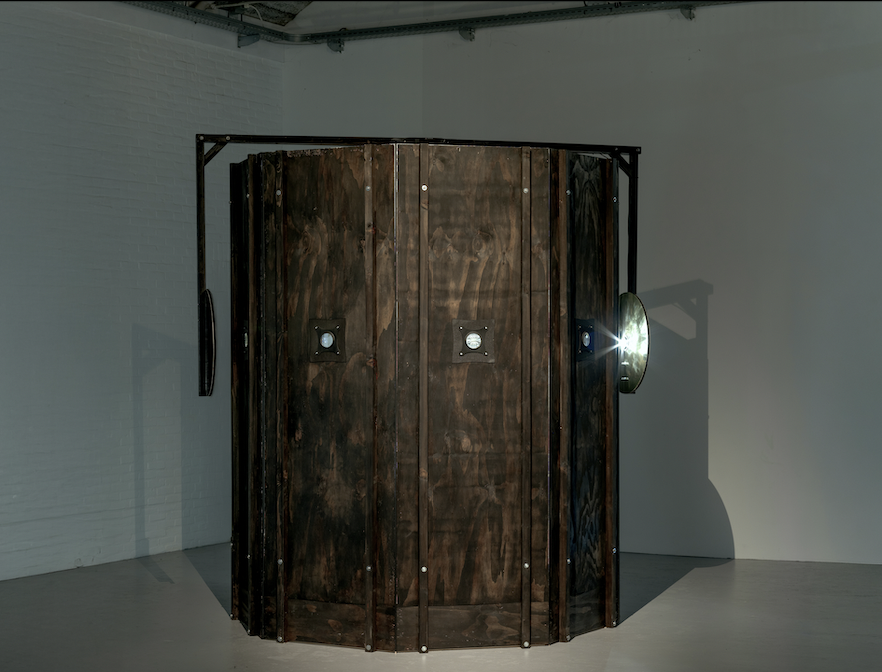
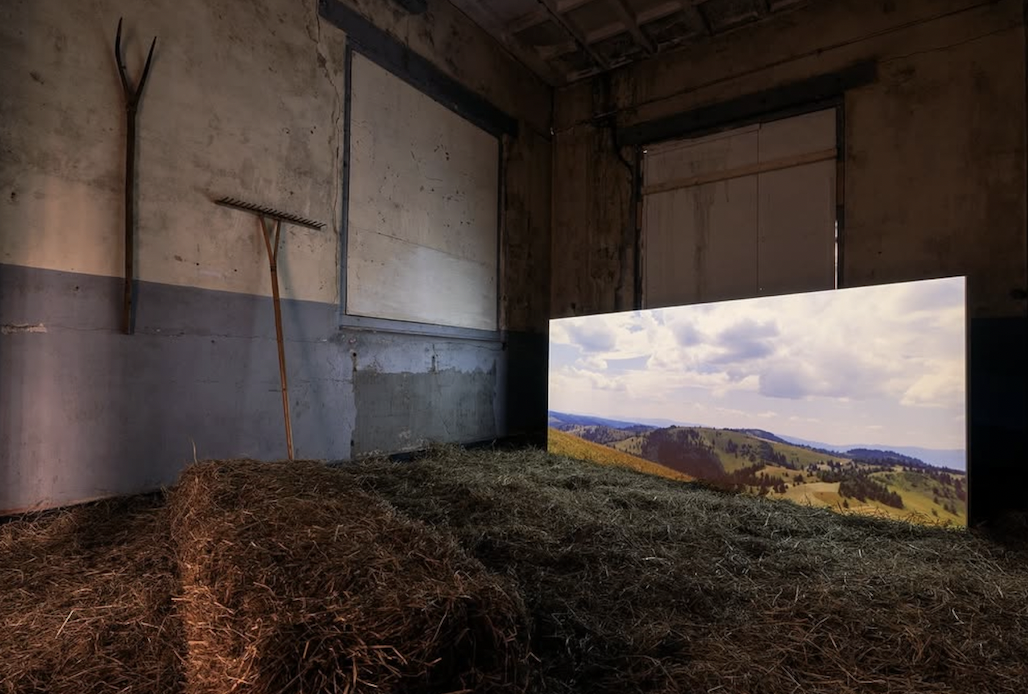
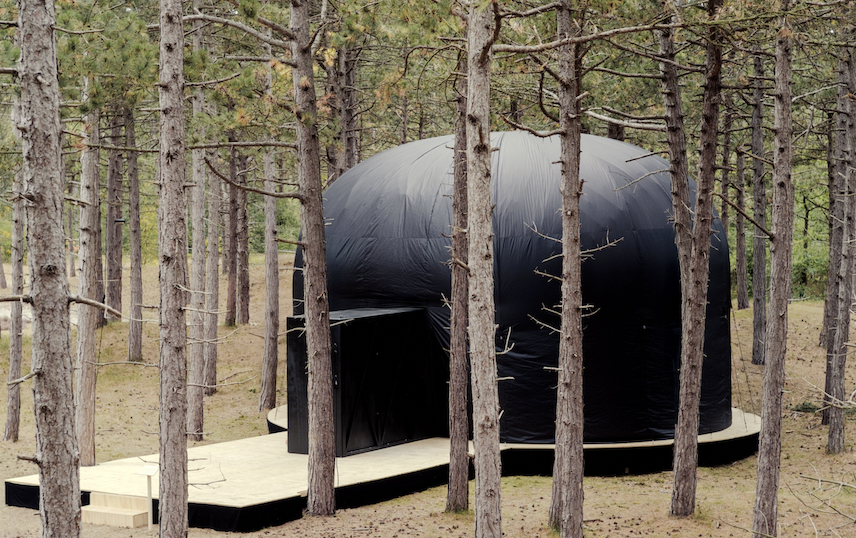


Lichtspiel & New Atlantis
For the exhibition Cosmic Cabinet, he further developed two existing installations, Lichtspiel and New Atlantis, and presented them jointly. Lichtspiel reconfigures seventeenth-century optical instruments using contemporary means such as LED lighting, lenses, and motors. New Atlantis deals with historical ideas regarding knowledge, discovery, and utopia. A rotating disc refers to the movement of the sun and moon and creates a contemplative space that invites introspection and wonder. Both works
Topia
The installation presents a modern version of a cinema screen, serving as a digital window with a sculptural aspect. This light installation transforms the surface as an architectural element, introducing a concept that transcends the material object. By opening and closing surfaces, it weaves together various atmospheres and constructs new worlds within existing spaces. The work forms visible yet intangible walls of light within the Leerer Beutel exhibition space, encouraging the audience to im
Topia
The installation ‘Topia’ resembles a modern version of a cinema screen: a digital window that also has a sculptural dimension. The light installation reworks the surface as an architectural element and invents a new concept for it that moves away from the material object. To achieve this, surfaces are opened and closed, different atmospheres and moods are interwoven, and new worlds are constructed within existing ones.
New Atlantis
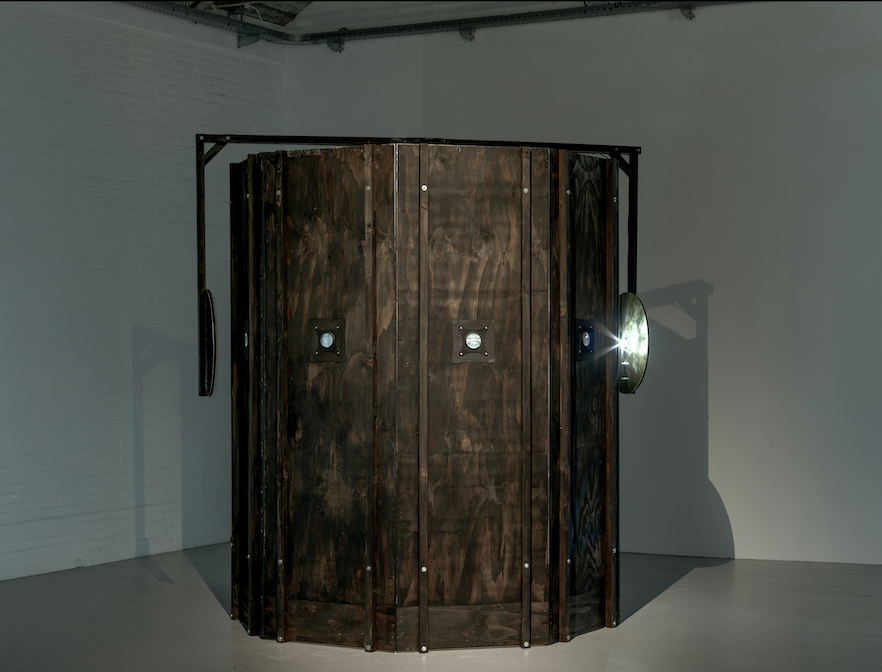
Het werk van Zalán Szakács geïnspireerd op eeuwenoude ideeën van wetenschappers, denkers en filosofen. Voor deze tentoonstelling maakte hij ‘New Atlantis – Experiment no. 1’, een plek voor introspectie, geïnspireerd op 17e-eeuwse ontwerpen, uitvindingen en droomwerelden.
Eigengrau Pavilion
The Eigengrau Pavilion is a 360° sensory environment where light and darkness interplay. This unique inflatable space, filled with haze, immerses you in an intimate atmosphere in which the boundaries of the spaces are blurred. The dome takes inspiration from the Movie-Drome (1965) by Stan VanDerBeek, a pioneer artist of the expanded cinema movement, which redefined cinema by returning it to its core elements: light, space, and time.
Tisztás
Once called the ‘Land Beyond the Forest’, Transylvania inherently carries a multicultural history entangled in the landscape. The work is based on a ten days research field trip in the Carpathian Mountains, where together with an interdisciplinary team, we conducted interviews with locals, created in-situ interventions, and collected sounds, scents, and visual materials.
Topia
V2_ presents a site specific version of Topia, a light installation that builds worlds within worlds. The work shapes an immaterial space, making the viewer shift between perception and reality.
Topia
Topia builds worlds within worlds. The work shapes an immaterial space, making the viewer shift between perception and reality. Topia is a light installation inspired by the Renaissance architect Leon Battista Alberti’s idea of perspective. It can be seen as a modern version of cinematic screens, set in a stage-like space, using sculptural elements and a tactile dimension. Szakács’ work reflects on the evolving concept of the screen throughout history. Initially, screens had an architectural fun
Ursula Licht
The Ursula Chapel once belonged to the Passau Court and was severely damaged in the great city fire of 1532. The stained-glass windows were also shattered. The stained-glass windows created a special lighting atmosphere for the people inside the chapel. After the fire, the Ursula Chapel was only partially restored, and the stained-glass windows were omitted. Zalán Szakács’s intervention transports us back to the Middle Ages. He presents a contemporary interpretation of the original stained-glass
Eigengrau Pavilion (premiere)
Eigengrau Pavilion is a 360° cinematic experience and sensory ritual in total darkness that uses only light, mist, smell, sound and movement. The unique domed inflatable space offers an intimate experience of the work. Inside, a custom-made circle of light creates a spatial cylinder that invites the audience on a mystical journey through light and darkness. A journey that, thanks to the abstract nature of the work, will be different for each participant.
Eigengrau Pavilion (documentation)
During Nederlands Film Festival a documentation in form of a scale model and video documentary represents the immersive cinematic experience.
Lichtspiel: Ars Anaclastica
In ‘Lichtspiel’ (Experiment No. 6), Szakács uses the refraction of light through kinetically controlled lenses to transform the Plein 1940 into a mesmerizing display of light and color whilst interacting with the architectural features of the outdoor square.
Lichtspiel: Ars Anaclastica
Lichtspiel - Ars Anaclastica (Experiment No. 5) is part of a series of projects in which Zalán Szakács (lecturer HKU Audiovisual Media), in collaboration with Utrecht University, investigates historical light projections from before the existence of cinema. The work in AG utilizes the refraction of light through kinetically controlled lenses, creating a relationship with the architecture of the exhibition space.
Topia
Topia is a light installation inspired by the Renaissance architect Leon Battista Alberti's idea of perspective. It can be seen as a modern version of cinematic screens, set in a stage-like space, using sculptural elements and a tactile dimension. Szakács' work reflects on the evolving concept of
the screen throughout history.
Lichtspiel: Ars Anaclastica
This work is part of an ongoing artistic research project series where Szakács eplores historical pre-cinema light projections, integrating them with a site-sensitive approach to architectural spaces. In ‘Lichtspiel’ (Experiment No. 4), he uses the refraction of light through kinetically controlled lenses to transform the entrance hall into a mesmerizing display of light and color, interacting with the architectural features of Amare.

Lichtspiel | Experiment Nr. 3 – Catoptric Theatre
Speciaal voor het Fiber Festival ontwikkelde Zalán Szakács ‘Lichtspiel: Catoptric Theatre’, dat het midden houdt tussen een installatie en een lichtscenografie. Het werk is een verdere ontwikkeling van zijn serie ‘Lichtspiel’, waarin de kunstenaar gebruikmaakt van de breking van licht door kinetisch gestuurde lenzen. De installatie van Szakács bestond uit drie op maat gemaakte kinetische spiegelinstrumenten van roestvrij staal, messing, koper en multiplex.
Tisztás (2023)
'Zalán Szakács made the sensuous Tisztás after a ten-day exploration of the Romanian region of Transylvania. The film combines interviews with visual interpretations and gathered sounds. Against the backdrop of this remarkable landscape, we watch and listen to the residents and their myths, tales and traditions that revolve around the connection between culture and nature.'
Lichtspiel | Experiment Nr. 2 – Underworld
Szakács’ site-specific version of Lichtspiel engages with the water-flooded basement of Koelhuis Eindhoven through light, haze, and sound. Lichtspiel interprets unrealised machine drawings from four centuries ago through contemporary technologies. Inspired by the writings of the Jesuit scholar Athanasius Kircher, Szakács guides the public through the shifting environment of the underworld.
Eigengrau
Eigengrau (2021) functions as a temporary escape in a contemporary setting, in which a light cylinder takes the audience through a narrative of various mental states.
Lichtspiel
Lichtspiel projects a re-configuration of 17th century optical devices into the present. It is a wunderkammer, a theatre of optical instruments exploring several narratives in the form of light experiments. Based on old speculative machine drawings, the work creates a configuration between old and new technologies, materialising historical ideas through contemporary techniques.
Lichtspiel
Lichtspiel projects a re-configuration of 17th century optical devices into the present. It is a wunderkammer, a theatre of optical instruments exploring several narratives in the form of light experiments. Based on old speculative machine drawings, the work creates a configuration between old and new technologies, materialising historical ideas through contemporary techniques.
Eigengrau
Eigengrau (2021) functions as a temporary escape in a contemporary setting, in which a light cylinder takes the audience through a narrative of various mental states.
Nebulae
Intangible coloured vapour of different sizes and different densities creates by itself an ongoing 'state of progressive collapse'.
Topia
Topia (2021) is a ‘screenscape’, a space filled with planes of lights resembling the digital screens we are constantly surrounded by. The work attempts to create an embodied experience of new definitions for the modern screen.
Nebulae
Intangible coloured vapour of different sizes and different densities creates by itself an ongoing 'state of progressive collapse'.
Eigengrau
Eigengrau (2021) functions as a temporary escape in a contemporary setting, in which a light cylinder takes the audience through a narrative of various mental states.
Eigengrau
Eigengrau (2021) functions as a temporary escape in a contemporary setting, in which a light cylinder takes the audience through a narrative of various mental states.
Eigengrau
Eigengrau (2021) functions as a temporary escape in a contemporary setting, in which a light cylinder takes the audience through a narrative of various mental states.
Eigengrau
Eigengrau (2021) functions as a temporary escape in a contemporary setting, in which a light cylinder takes the audience through a narrative of various mental states.
Kring
Kring invites the audience into a subliminal intervention at Kunstkapel. Inspired by the unique 360° curved architecture of the space, the work constructs a moment of contemplation.
In various beliefs, people move around sacred objects as spiritual passages. With the end of Kunstkapel insight, Szakács’ site-specific performance Kring enacts the space. Through intangible gestures such as sounds, lightning, and circular movements, the ritual continues beyond material realities.
Topia
Topia (2021) is a ‘screenscape’, a space filled with planes of lights resembling the digital screens we are constantly surrounded by. The work attempts to create an embodied experience of new definitions for the modern screen.
Eigengrau
Eigengrau is an interactive and immersive installation, a temporary escape from the current media landscape in which screens are omnipresent. Inspired by 18th century phantasmagoria, Eigengrau tells a contemporary story about image culture, only by the means of light, haze and sound.
Ornament
Kunsthaus Graz morphs into a sound machine: ‘Ornaments’ on the BIX-media façade activate the architecture at night and transforms the foyer of Kunsthaus into a soundscape during the day.