Bik Van der Pol

publieke ruimte , Experimenteel , cross-over , Conceptueel , Community , Artistiek onderzoek , Archieven

Through their practice Bik Van der Pol aim to articulate and understand how art can produce a public sphere and space for speculation and imagination. This includes forms of mediation through which publicness is not only defined but also created. Their work follows from research of how to activate situations as to create a platform for various kinds of communicative activities. Their practice is site-specific and collaborative, with dialogue as a mode of transfer; a “passing through”, understood in its etymological meaning of “a speech across or between two or more people, out of which may emerge new understandings”. In fact, they consider the element of “passing through” as vital. It is temporal, and implies action and the development of new forms of discourse. Their practice is both instigator and result of this method.
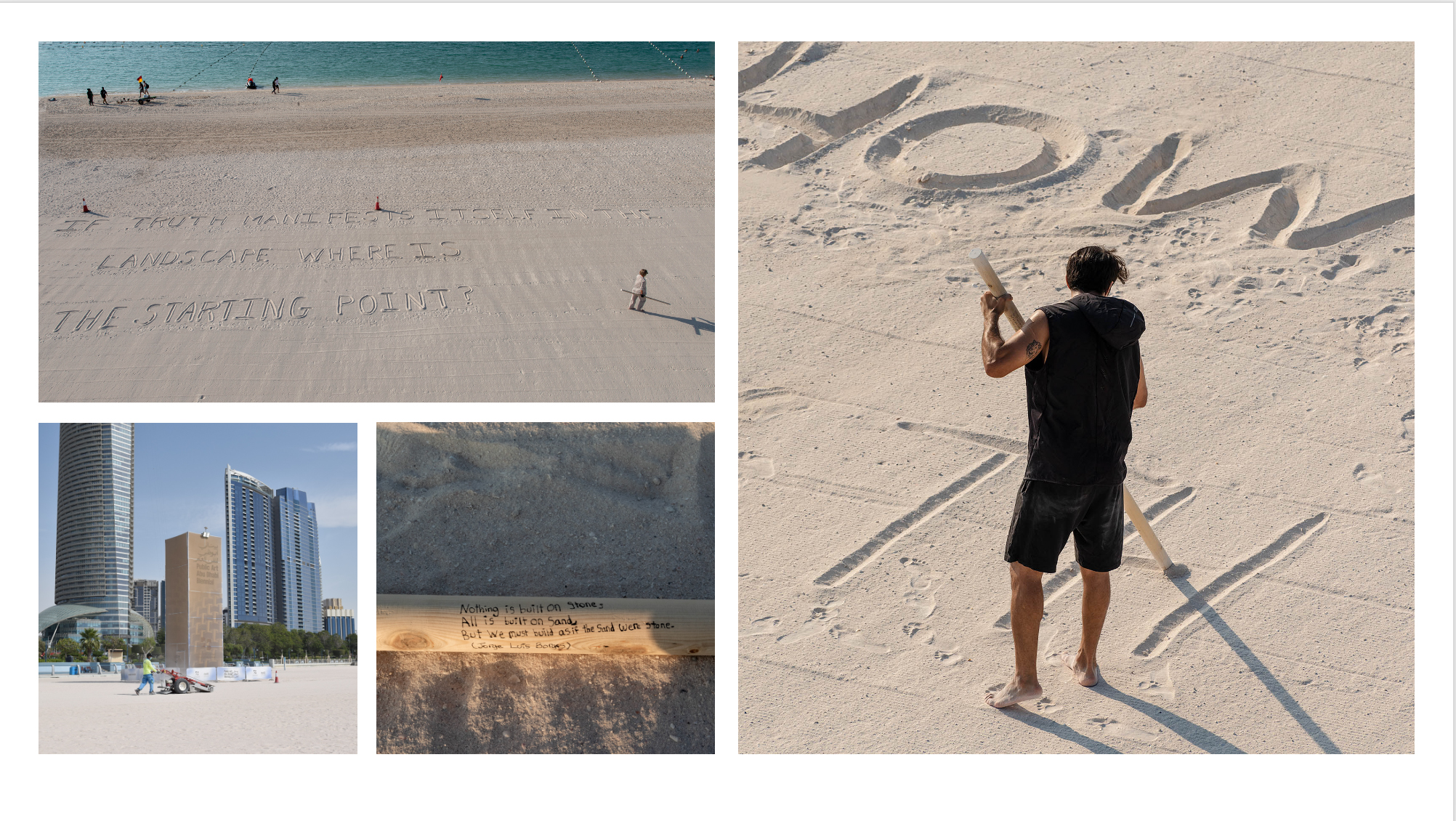
The Poem That Jumps The Fence -Public Art Biennale Abu Dhabi- 2024/25
The Poem That Jumps The Fence -Public Art Biennale Abu Dhabi- 2024/25 - What, how and where is poetry today? The poem that jumps the fence features weekly performances on Abu Dhabi public beach and a workshop series connecting words and sand as real and symbolic material that holds our world together. Every Sunday afternoon, part of the public beach is levelled to turn the beach into a blank page where poetry continuously appears, every week. A performer arrives with a 2 meter long stick to write a short poem on the sand, only for it to inevitably fade away. The weekly repeated ritual changes the site of rest into a site of activation through written language. During collective workshops in collaboration with local poets and writers, participants generate text for the performances. A public community is formed in language and ‘on the ground’. The project addresses modes and processes of distribution, and questions what establish public space today, from analogue embodiment to ‘high tech’ disembodied developments. Sand is capital. It is the third most-used natural resource after water and air, critical to modern civilisation yet rapidly depleting. It is taken for granted and extracted worldwide. Intense economic use disturbs processes that are in principle continuous but accelerate the end of sand rapidly, with scarcity and critical geo-political consequences as a result. Sand is a ‘building block’ in almost everything. Armies of sand have built our houses, our cities, paved our roads, created our beaches and entirely new lands, have shown us distant stars and subatomic particles, given birth to the Internet. It is a crucial material in oil fracking processes, it is in our computers and is the key component of our mobile phones that are the symbol and pillar of our digital age. It makes our way of life possible. Our civilisation depends on it. Sand is everywhere. We cannot do without. It is linked to everything. This public beach is symbol and reality. Artificially created, claimed land.
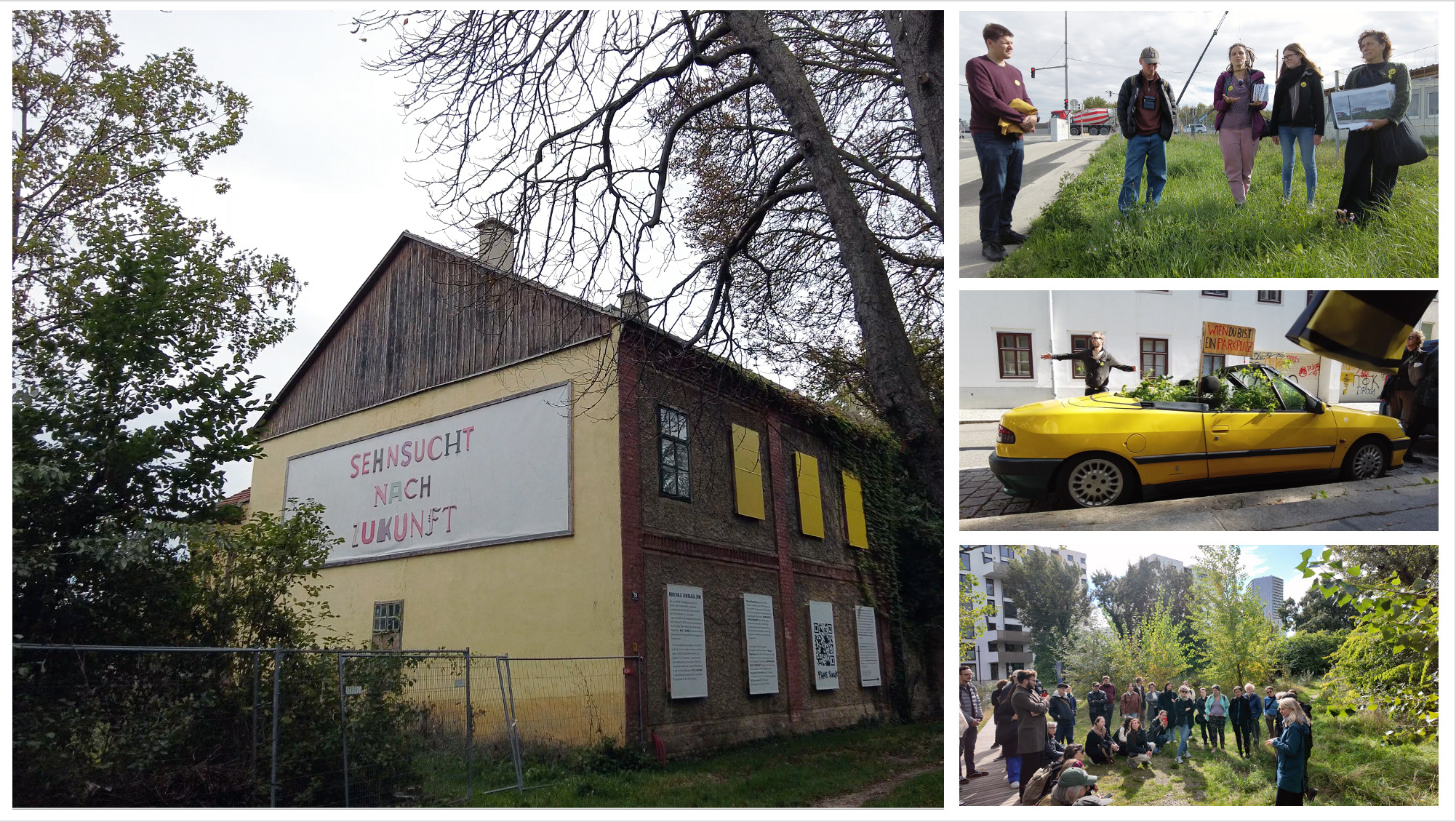
School of Walking Vienna
School of Walking Vienna 2024 - The School of Walking: Vienna investigates the potential power of walking as a form of deliberation brought together in an activity that is resilient, productive and progressive. As of October, Vienna has been voted Europe's most democratic city for a year. It is also seen as the most liveable city. What do these words mean in a city that is getting hotter and experiencing increasingly extreme weather conditions? Humanity is being challenged and forced into radical systemic change, with democracies also changing ‘en passant’ on the way to this common goal. The School of Walking highlights citizens' investments, pressing democratic questions and questions of law. Experts in these fields are invited to lead a walk to a location that harks back to these urgencies, taking into account promises embedded in language such as Zukunftshof, Freies Mitte, Klimarat and the potential meaning of ‘being grounded’. Bik van der pol invited Martina Handler and Laura Grossmann to lead a walk. As part of the organizing and facilitating team for the Austrian Climate Citizens' Assembly Klimarat they focused on Lobau, a contested site with ongoing protest for many years against a scheduled highway project. Architects and urban planners Lina Streeruwitz and Michael Klein led the group to the public park Freie Mitte, part of the master plan for the urban development area ‘Nordbahnhof’; a plan that claims free space for experimentation, unresolvedness and openness. As Vienna was voted as European Capital of Democracy of 2024, the district Alsergrund is part of the climate team. Democracy expert Tamara Ehs and researcher and activist Barbara Laa discuss the connections between democracy, participation and successful measures against the climate crisis. Is there a future for Zukunftshof? This walk, lead by snail farmer Andreas Gugumuck, curator and architect historian Karoline Mayer and Klaus Schafler, director of Kunsthaus Exnergasse, critically addresses the tensions and conflicts between the future of farming, and urgent housing needs in Vienna's urban development plans. School of Walking is commissioned by KÖR Kunst im öffentlichen Raum Wien (Public Art Vienna) in cooperation with dérive - Society for Urban Research and kex—kunsthalle exnergasse as part of Urbanize! Int. Festival for Urban Explorations, Vienna, October 2024. urbanize! 2024 explores the possibilities of an environmentally and socially just energy transition and its potential to democratise energy production and use.
School of Walking Casablanca 2021-2024
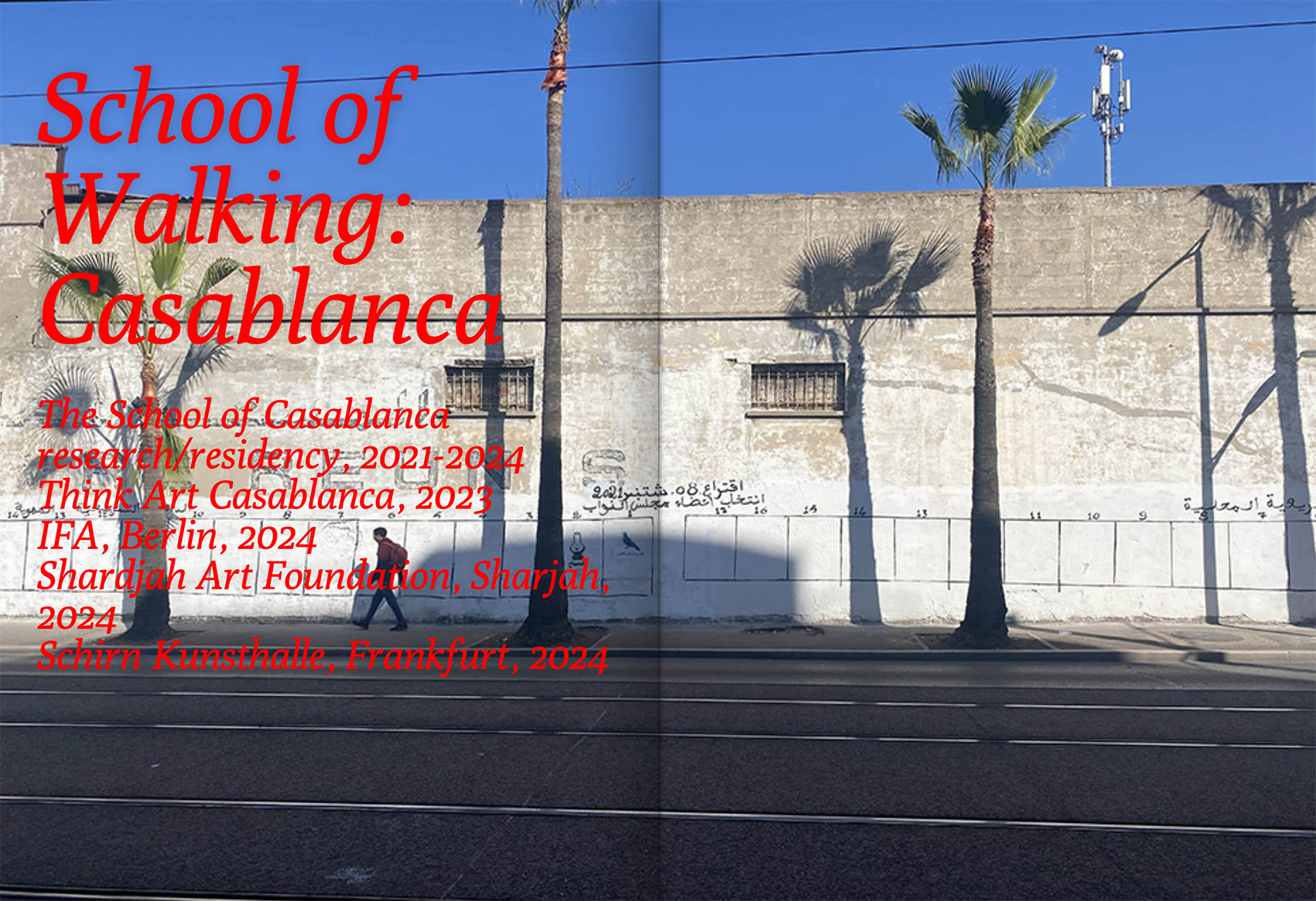
School of Walking Casablanca 2021-2024 - School of Walking s a series of walks, conversations, and a collection of audio and video recordings, developed as part of the research project School of Casablanca. The School of Casablanca is a collaborative project that takes as its starting point the legacy of the Casablanca Art School and its innovative pedagogical methods and exhibition strategies in 1960s Morocco. Walking is an act of resistance; a seemingly inconspicuous, neutral and everyday act of walking as a discursive act of freedom of thought. The process of walking cannot be controlled nor censored and carries the potential to weave relationships between urban texture and text in context of larger discussions of decolonization and modernization. The School of Walking is perceived as a dynamic curriculum that understands different narratives as (erased) parts of the archive of the city, and as the (re)materialization of old and new narratives. Point of departure are the connections between the Casablanca Art School and Souffles Magazine (banned in 1972), both associated with a revolutionary student movement at a time of sit-ins, strikes, and labour unrest. The School of Walking aims to create a political moment in exploring and opening perspectives in dialogue, on how ideas, concepts, and methodologies such as developed in the Casablanca Art School and Souffles can be re-activated and re-viewed today. What is the effect of revolutionary movements on education, when considering amnesia, the larger capitalist, extractivist drive and the urban modernization processes that produce ruins, ruptures and gaps while moving on to the next swath of land to develop? How to encompass simultaneous realities in movement, while experiencing the city as an environment, an ecosystem where citizens appropriate this ‘live tissue’ daily? The walks, marking moments in space and time, are developed in collaboration with different makers, thinkers, activists and citizens. Participants include students architects, artists, local experts and passers-by. Part of the research were meetings and discussions with various cultural actors: Bert Flint, Mamma Group/Lahbib El Moumni, Mohamed Rachdi, Kenza Sefrioui, Sabrina Kamili, Florence Darsi, Maud Houssais, Fatima-Zahra Lakrissa, Maria Karim, Mohamed Jibril, Mehdi Azdem, Eric Van Hove. So far, the School of Walking consists of videos of walks by Fatima Mazmouz, Hassan Darsi, Maria Daif, Manal Aziz & Hamza Boussedra, and Mohamed Fariji. In 2023/2024 new walks with filmmaker Nabil Qerjij and architect Imad Dhamani are added. Also in 2021, Bik van der Pol interviewed Bert Flint and created the film At the end of this long journey (November 2021, Marrakesh).
Beautiful, Beautiful,Beautiful He said- Kunstlerhaus Vienna, Art&CeZR Gallery, Zagreb.
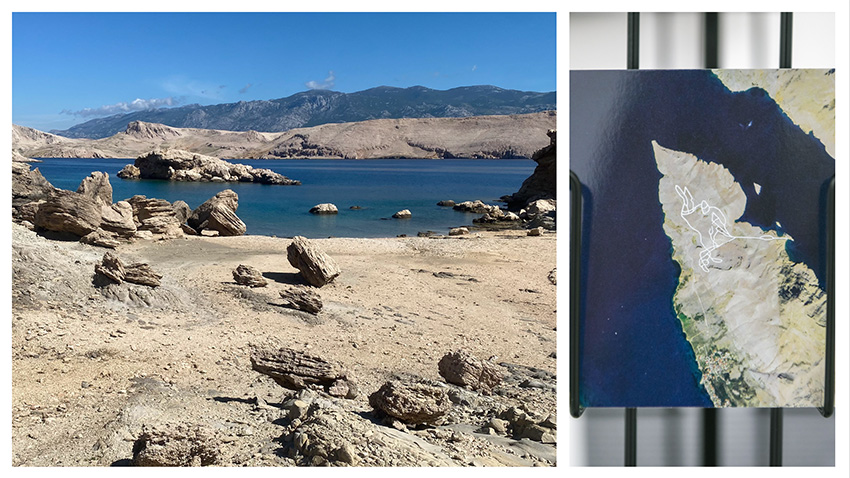
Beautiful, Beautiful,Beautiful He said- Kunstlerhaus Vienna, Art&CeZR Gallery, Zagreb. - Beautiful, beautiful, beautiful, he said, consists of a rack with postcards, video (duration 15 minutes) and walltext. Pag Island is located in the Adriatic sea. The island has a stark and otherworldly appearance, which is characterized by rocky, barren terrain, minimal vegetation, and a desolate beauty, which is often compared with a lunar landscape. This work draws a line between embodied experience of walking as a movement and the projection of a walk. Here the route Neil Armstrong walked during the first moonwalk in 1969 is projected onto Pag Island as a ground to walk on. Can we imagine these realities converging? Can conceptual models of reality be confused with reality itself? Polish linguist Alfred Korzybski argued that human knowledge of the world is limited both by the human nervous system and the languages humans have developed, and thus no one can have direct access to reality, given that the most we can know is that which is filtered through the brain's responses to reality. His best known dictum is "The map is not the territory" (source Wikipedia). He emphasized that we live in two worlds: in the world of language and symbols, and in the real world. He observed that the human mind is only able to respond to the formed map, and completely forgets -in the extreme case- the territory present. Seen this way, everyday access to satellite imagery of the planet via several apps on our cell phones have changed our emotional orientation and relationship with the world. Artist Robert Smithson stated that drawing a diagram, a ground plan of a house, a street plan to the location of a site, or a topographic map, is drawing a logical two dimensional picture. This picture rarely looks or feels like the real experience of a place. Being on the ground, in movement, on-site, is different from looking at a set abstraction of a site. While being immersed, the activity of walking triggers a resonance between the environment as a sensual experience and making sense of this experience. Yes, we can make a trip in our minds, in our imagination, meanwhile making meaning of cultural narratives, sites and objects. Through such lenses we can see the landscape, the world, and learn to understand it. Beautiful, beautiful, beautiful, he said is an invitation and insistence on walking the ground.
We swear we saw this.Shimmer Rotterdam-  2023-24
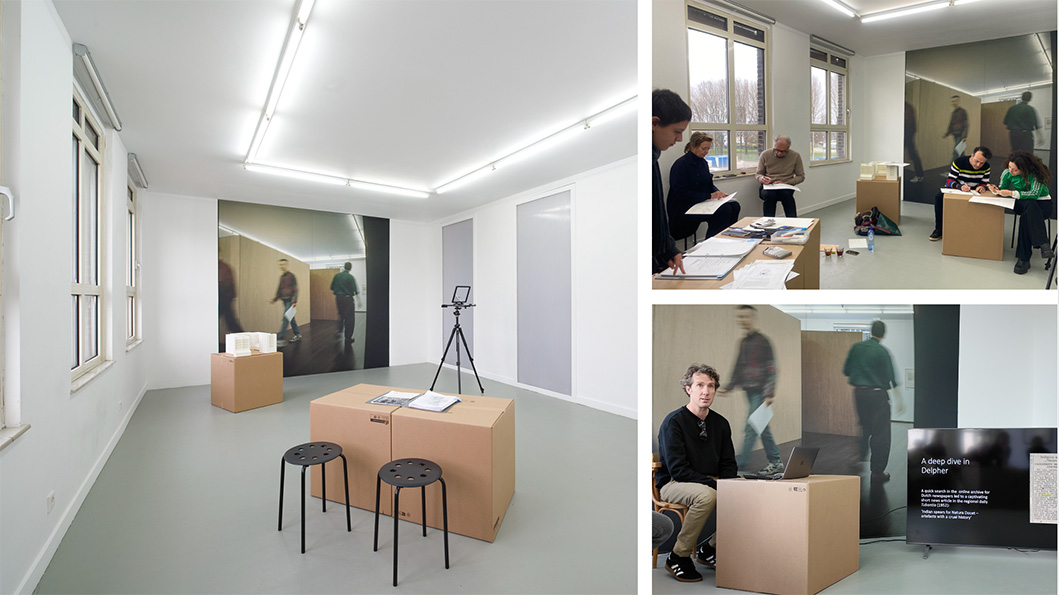
We swear we saw this.Shimmer Rotterdam- 2023-24 - For the fourth cycle of Shimmer’s exhibition program Sequins, Bik Van der Pol made a new work. We Swear We Saw This (in deference to Michael Taussig) is questioning the working of memory - of the individual as well as of the institution. With wallpaper print, teleprompter, model, carton boxes. At Shimmer one can see a large scale wallpaper of The Bookshop Piece installed at Boijmans van Beuningen Museum in 1996. It shows someone walking past the back side of the artwork that looks like a box. The right side of the image is black due to a technical mistake of the photographer. But we see a small part of a drawing, supposedly, as the artists remembered, by Dutch architect Ad van der Steur from the Boijmans van Beuningen Museum archive. It was installed right next to The Bookshop Piece. At the time, this drawing was brought to the artists by the conservator of the print collection of the museum, and it accompanied The Bookshop Piece for three months. Where is that drawing that Bik Van der Pol remember as a drawing of a conservator sitting behind his desk, amidst his exhibition? That image that shows how a museum may function if the desk is in the space, and the curator part of the show. Where is it? Does it really exist? Can we return to the memory of the institution, what traces are kept there? Obviously the drawing must have returned into the archive after the installation was taken down. Though it could not be located for many years, it surfaced during Bik Van der Pol’s investigations in the archives of the museum. But what was left of The Bookshop Piece in that archive other than in memory? For sure, dissemination of knowledge carried by bodies, memory of the project in the minds of many minds, traces of the 4000-5000 books (every book was stamped) on private bookshelves and in public and university libraries worldwide, as well as digital traces in texts and images referencing this project. Other than that there are not many traces left of this work, nor of any of the other time-based projects that happened, in the archives of the museum. A few documentation images, a bit of information, that’s all. What is the responsibility of a museum with regards to preserving their own exhibition history? What is the value of a collection that is also the fabric of society? Departing from The Bookshop Piece as a site which brings audiences together and while circulating knowledge through their active participation, Bik Van der Pol organised a drawing workshop and a conversation with Mariana Françozo and Merijn de Waal on loss of objects and what such a loss might mean for a shared understanding of collective histories and stories.They also dispersed the project as an insert in 4000 copies of Metropolis M magazine. The insert enters into the rhythm of circulation, keeping the exhibition continuously open and alive in memory and collective ownership. print Drawing Workshop Conversation with Mariana Françozo and Merijn de Waal. Following an article written in NRC by journalist Merijn de Waal on the restitution of two Ecuadorian spears in Natura Docet museum in Denekamp, The Netherlands, Bik Van der Pol invite anthropologist Mariana Françozo and Merijn de Waal in conversation on loss of objects and what such a loss might mean for a shared understanding of collective histories and stories. MARIANA FRANÇOZO is an anthropologist and a historian and works as associate professor of museum studies at the Faculty of Archaeology, Leiden University. Her research focuses on Indigenous Brazilian objects in European collections from the early cabinets of curiosities until present-day collaborative projects. She teaches and supervises students on topics in critical museology, museum and collection history, and collection-based research. MERIJN DE WAAL has worked at NRC since 2006. Covered the euro crisis in Southern Europe as a correspondent in Madrid (2009-'14) and followed the US presidential races of 2008 and 2020 as an editor. Reported on the
To Gather Up on the Mountain - Bergen (NO) 2023/ Framer Framed 2024
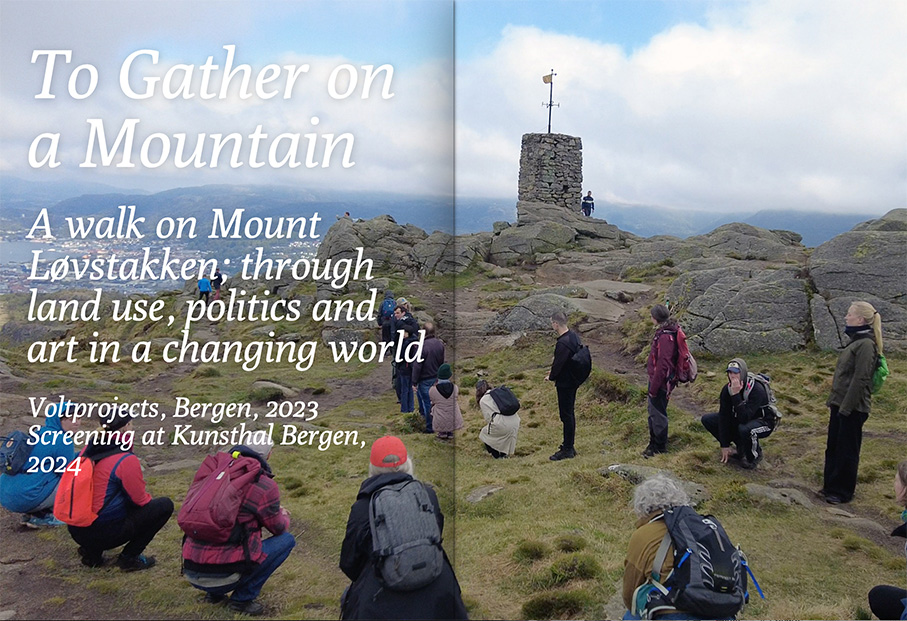
To Gather Up on the Mountain - Bergen (NO) 2023/ Framer Framed 2024 - Comprising a guided hike up Mount Løvstakken and a workshop led by Bik Van der Pol, curated by Volt To Gather on a Mountain (Å Samles på et Fjell) brings together a group of people to reflect on how we engage with the world – in particular, how we mine, excavate and otherwise exploit the ground on which we stand. One of the seven Caledonian Mountain peaks that surround the city of Bergen, Mount Løvstakken forms part of the Earth’s continuously shifting tectonic system and contains a high concentration of naturally occurring radioactive granite. Acting as an ‘earth-embodied record’, the mountain bears witness to events that have unfolded – and continue to unfold – over millennia. Hiking up, participants assemble to collectively form a 'point d’ironie' and engage in a discussion about the future of energy production. Interested in the potential of the Ancient Greek chorus – whose role in classical theatre was to speak collectively for past and future generations, giving voice to that which is keenly felt yet hard to articulate – Bik Van der Pol reprise this traditional theatrical device for the present day. Who is speaking for the past and the present? What future world do we imagine? To Gather on a Mountain unites the knowledge and experience of a broad range of people in an attempt to define what needs to be decided collectively for a future to be. Central to the Norwegian economy is the petroleum industry: crude oil and natural gas account for more than half of Norway’s annual exports and the country is currently ranked the third largest exporter of natural gas in the world. In 1971, the Norwegian government produced a white paper, the ‘ Ten Commandments of Oil’, serving to guide the country’s petroleum policy and to ensure that any income from the oil industry would be publicly owned. To Gather on a Mountain considers the energy industry in Norway, in the world. At a time when minerals are extracted from mountains and sea beds and oceans and wind farms are constructed on hillsides – projects often financed by international funds linked to tax havens – Bik Van der Pol aim to collectively generate ‘Ten Commandments for Earth’ that reflect humanity’s impact and men's responsibility for the planet that we share with other entities. During the 1950s and ’60s, the Situationist International movement drew attention to the fact that the situations we create for ourselves often also compromise us. Referencing this art-historical position, Bik Van der Pol ask: if we maintain that the ‘public good’ exists, then who exactly is that public, why is it good and for whom? How to take stock of the consequences of our actions? print
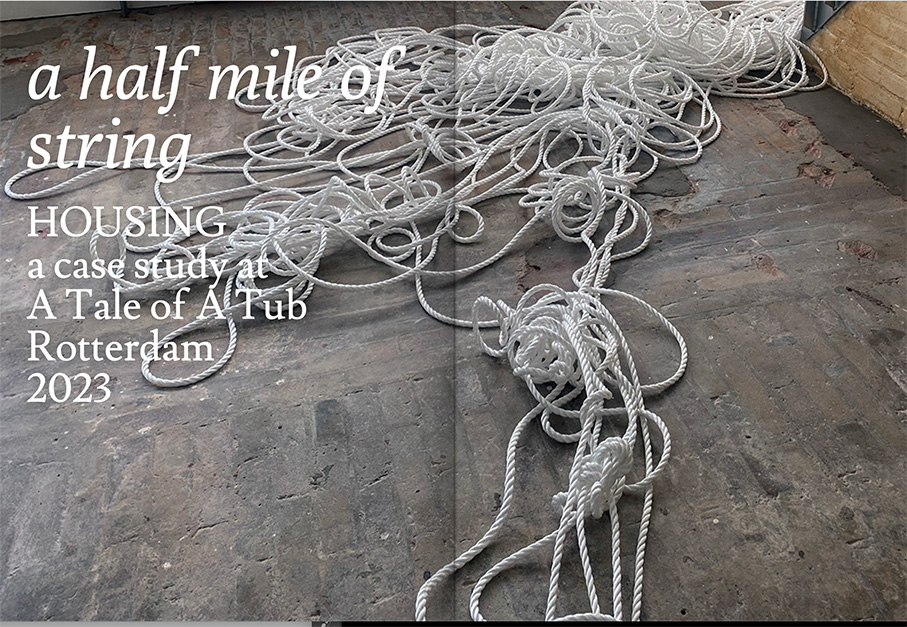
A Halfof Mile of String- Tale of A Tub 2023
A Halfof Mile of String- Tale of A Tub 2023 - A half mile of string is based on the 17th century satirical text Another world and yet the same by satirist and moralist Joseph Hall. The text describes two countries with the same latitudes and longitudes as England and Germany, where food and drink are the main industries. In one of the cities, all inhabitants suffer from tooth decay and bad breath, while in another full citizenship is granted only to those with a stomach size above a certain minimum. In yet another town, each man owns a special rope with rings spaced at intervals, leading from the marketplace to his home, to help find his way back after parties; sometimes these ropes get tangled, with all the complications that entail. a half mile of string is a work that may set the potential of the imagination in motion, inciting possible action. The work references the utopia and dystopia of modernity, often perceived as unfulfilled, which can result in great social discontent and disillusionment. The work raises questions about the notion of an ideal society, as well as about ways of living and coexisting, and our choices regarding what to possess, initiate or reject. 40 a half mile of string What invisible lines divide and fragment society, leading to an uneven distribution of collective values? Is it possible to create shared spaces, as originally intended by the architect of the Rotterdam social housing complex Justus van Effen complex, or does it remain a different world and yet the same? a half mile of string claims potential space for further thought and action. Housing, a case study curated by Remco Torenbosch consists of an exhibition and public talks and includes research on the history of (social) housing, accessibility and ownership.
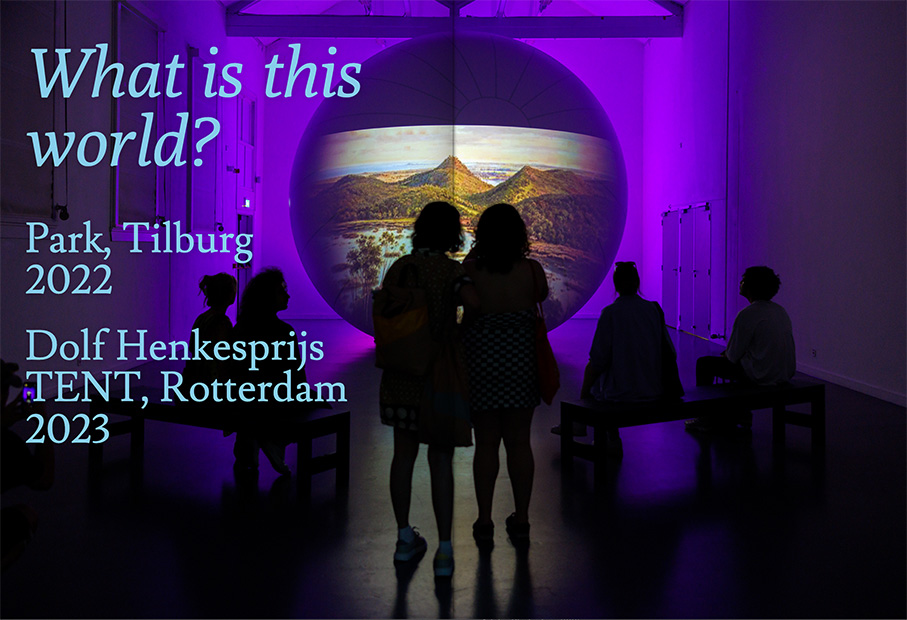
What is this World? Park, Tilburg. Dolf Henkesprijs TENT 2023 Rotterdam
What is this World? Park, Tilburg. Dolf Henkesprijs TENT 2023 Rotterdam - What is this world? is a project that is gradually taking shape. It explores and connects a multitude of perspectives on and of the world, in dialogue with the public and participants. A large 8 m inflatable ball filled the space at Park, to form a backdrop and background for discussion, and a stand-in for the 'world'. Participants and the public were invited to respond to the work in a series of informal workshops and conversations, and actively fill the space with their ideas and imaginations about the current state and future of this world. World as object and site in relationship to which the people need to negotiate their actions in a wise way to be able to speak at all in the future. What is this world? takes and makes time to listen to sounds and voices, to sense the space, hear each other, and talk back. On the ball, a new montage of the video work One to One is projected to reflect on abundance, discomfort, and loss. One to One is a case study of a andscape where remaking in terms of art is activated against the destruction of that landscape, as an ‘example' of colonial observations that usually and almost immediately mandated eradication of that very landscape. In 1855, landowner James Dawson commissioned painter, botanist and gold-digger Eugene von Guérard to paint Tower Hill, a volcanic area in Victoria, Australia. This detailed painting depicts the vegetation as the Aborigines knew it and just before intensive European settlement caused rapid degradation of the site. One century later, the land was systematically reforested with native flora with the help of hundreds of school children, naturalists and volunteers. Von Guérard's painting was used as a model, map, guide and botanical template. One to One reflects on what it means to see in detail. Alexander Von Humboldt believed that works of art provide important information and that artists can visualize aspects of the environment and uncover the complexities of the earth, in a way that scientists cannot. One to One speaks to that.
What Is This World? (2022) - What is this world? is a project that is gradually taking shape. It explores, connects and projects a multitude of perspectives on and of the world, in dialogue with the public and participants. A large ball, inflatable up to 8 meters, fills the space and forms a backdrop and background for discussion, and a stand-in for the 'world'. Participants and the public are invited to respond to the work in a series of informal workshops and conversations, to actively contribute against the backdrop of this decor and fill the space with their ideas and imaginations about the current state and future of this world. The world as object and site in relationship to which we, people, need to negotiate our actions wisely so that we will in the future be able to speak, and speak of ‘world'. While the current crises impact on a global scale, this question, has gained more and more momentum. What is this world? takes and makes time to listen to sounds and voices, to sense the space, hear each other, and talk back. Bik Van der Pol are interested in the potential of transposing the classical chorus into the present. Who is speaking, in the past, today, and for the future? What is this world? aims to be the arena for that multiplicity of voices that make up the chorus and deliberate with each other: How do we learn from what we see, or don't see, hear, or don't hear? Where is there room for change? What do you let go, what can we miss? And where do or should we head to?
Far too many stories to fit into so small a box (2019-2020) - The collection of Ujazdowski Castle Centre for Contemporary Art was created in relation to the program that CCA ran since the 1980s, and reflects the political and social events in Poland timely to its creation. It formed “a permanent context for temporary exhibitions, presenting attitudes and trends”. In the meantime, artistic and curatorial strategies have been re-evaluated and the format of the institution has changed. By inviting Bik Van der Pol, the CCA wants to bring different approaches towards the archive, to introduce a critical, outside point of view through the approach of an artistic practice, which would develop as ‘the collection as an artwork’. The collection is largely built on gifts, deposits, and works that ‘just stayed’. Part of the collection is ‘clandestine’, some highlights have an unclear or ambiguous status. Bik Van der Pol critically examine – from the vantage point of outsiders – the history of the CCA as well as take on board its founding myth. From the beginning CCA has been associated with theatre. The first director after 1989, Wojtek Krukowski, was also director of Akademia Ruchu (Academy of Movement), and the concept of process and movement is fundamental to the first 20 years of the CCA. The potential of collecting as a process is connected to not only it being rooted, here, in theatre and performance, but is also connected to Bik Van der Pol’s premise to understand process as an art practice and part of the production of work. The exhibition speaks about what is elusive and transitory and how such qualities relate to the complex mechanisms of remembering and forgetting. Bik Van der Pol aimed to understand the commonality of the archive and how we may include in the collection those stories that have been passed on only by the word of mouth. The artifacts, artworks, films, documents, snippets, and leftovers in the exhibition are connected through the ‘dynamic’ performative script, built of the complex history of the institution. Performance of the scirpt by Agnieszka Ayen Kaim, Mamadou Góo Bâ, Billy Morgan, Ania Nowak, Jagoda Szymkiewicz. Soundscape played on thirty speakers, activated and carried around by the public, by Wojtek Blecharz, Posters designed by Fontarte function as markers throughout the spaces. Curator Joanna Zielinska.
Take Part (2018-2020) - TAKE PART – IS THERE ROOM FOR SAN FRANCISCO IN SAN FRANCISCO? is a project by Bik Van der Pol that started as part of the Public Knowledge program on the invitation of SFMOMA and the San Francisco Public Library. The project was planned to take place in 4 stages: 1. Cleaning (2018), 2. Bringing the Neighborhood to Your Neighborhood (2019), 3. Making Room for San Francisco (2020) that would bring the model together as a whole, and a publication as a document that would shed light and reflect on the project. TAKE PART explores questions about public rights to space, changing communities, and how decisions are made. In a time when community is getting erased and dispersed by different dynamics and accelerating crises in our current times, all related to an untamed and uncontrolled capitalism, Bik Van der Pol sought with this project, to develop a way to think and discuss these dynamics. The project anchors these overwhelming and expansive issues – their past, present, and future—as performative dialogues on to the staging of a physical object: a 1000-square-foot model of the city built in 1938 by the Works Progress Administration (WPA) as part of Roosevelt’s New Deal. Can these issues be addressed through this model? Can this model be shown again as a whole, is there room for San Francisco in San Francisco? The different stages of the project involved the participation of a multitude of voices to infuse the model with their perspectives on and relationship to the city, opening perspectives on how cities like these could deal with the current rushes that generates loss and leaves only a few winners. From the gold rush in the 19th century to the abundant growth through private data and time as the main accelerator of global capital today, notions of civic participation and inclusion in San Francisco and in cities across the globe have undergone profound changes, prompting questions around how to make and protect space for ‘proper living’. San Francisco can be seen as a lens to reflect on global processes. Through creative civic participation, TAKE PART re-imagines the city by way of its people. The project addresses and involves audiences through open rehearsals and work-sessions where making, speaking and performance is brought together in forms of interacting with the model in spaces and sites in the city, countering social media and democratic deformation and misinformation through encountering, proposing to take matters in one’s own hands and to think aloud considering that what makes a city. Through different stages, moving slowly in accelerating times, TAKE PART is an exploration of the changing relationship between body, voice, and assembly, exactly what has currently disappeared from the public eye.
Czigane – not the whole story (2019) - This story starts with objects in a museum collection. A black and white photograph of a dog, a skull, a collar, on display in a vitrine, in a room. The skull of a dog. Its name: Czigane. He was one of the Siberian sledge dogs that took part in the British Antarctic expedition to the South Pole, called the Terra Nova Expedition. New Land. White, icy new land. Scott, the captain of the mission, never returned from this mission, but Czigane did. The race to the South Pole was high on the agenda of the British. Each of the 33 sledge dogs on the mission was officially named by a British school. To engage the public, through an early form of crowdfunding. Czigane died of old age. His portrait, his skull, his skin, and later his collar, were donated to the museum. Why would a museum keep a skull and a collar, and display it too? Taking the story of Czigane and the objects from the collection of the Royal Albert Memorial Museum in Exeter as point of departure, Bik Van der Pol developed a one channel video work in collaboration with the Met Office and the children and teacher of St David’s C of E Primary School in Exeter. The film explores and unfolds the complex relationship between objects, images, empire and language, ownership and naming, global trade and climate change.
Mama, was ist eigentlich Natur? (2019) - On the invitation of Kunstmuseen Krefeld Bik Van der Pol explored the museum's collection and vast archive of history of exhibitions, books, leaflets, documents, newspaper clippings, and recorded speeches. Departing from the Krefeld collection, Bik Van der Pol explore what shaped the 20th century and still shapes the present. As a result they curated this exhibition project, presenting a selection of more than 70 works from the collection that address the landscape in art, industrialisation, climate change and the disappearance of nature. Bik Van der Pol have also realized a sound and wall piece based on reviews from the museum’s archives. The soundpiece Gesammelte Stimmen - Gathered Voices is built from fragments from the archive's newspaper reviews from the 1970s: Krefelder Kurier, Westdeutsche Zeitung, Rheinische Post, Neue Rhein Zeitung, Vorwärts, Der Spiegel, Die Welt, Frankfurter Rundschau, Badische Zeitung, Deutsches Allgemeines Sonntagsblatt. The wall piece is made in collaboration with graphic designer and typographer Thomas Artur Spallek. His Saint Helena typeface was named after the Saint Helena olive tree that has been extinct since 2003. Here, an extinct life form is given voice and shape. Mama, was ist eigentlich Natur? is developed in collaboration with curator Constanze Zawadzky. With works of Andreas Gursky, Andreas Slominski, Heinrich Steinicke, Josef Albers, Abraham David Christian, Jan Dibbets, Robert Morris, Ulrich Rückriem, Yves Klein, Hans Haacke, Vito Acconci, Lothar Baumgarten, Mamma Andersson, Edith van Leckwyck, Christo, Michel Sauer, Robert Voit, Michael van Ofen, Bik Van der Pol, Dan Flavin, Jannis Kounellis, Bernd Becher/ Hilla Becher, Dieter Roth, Hein Engelskirchen, Arman, Christopher Williams, Peter Hutchinson, John Chamberlain, François- Marie Banier, George Segal, Haus Rucker Co., Thomas Ruff, Constant, James Webb, Martin Schwenk. The Umweltzentrum Krefeld, located on the grounds of a former cement factory, developed a public program inside the museum.
One by One (2017) - One to One takes the viewer through two case studies of landscapes where remaking in terms of art is activated against the destruction of that landscape, as 'examples' of colonial observations that usually and almost immediately mandated eradication of that very landscape. Von Humboldt believed that works of art could provide important information and that artists could visualize aspects of the environment and uncover the complexities of the earth, in a way that scientists could not. These case studies speak to that. In 1855, landowner James Dawson asked painter, botanist and former gold-digger Eugene von Guérard to paint Tower Hill, a volcanic area in Victoria, Australia. In almost photographic detail this painting depicts the vegetation as the Aborigines knew it and just before intensive European settlement caused rapid degradation of the site by the 1860s. By then, the vegetation on the sides of the volcano was cleared or burned to create land for livestock and crops, while most of the trees were taken for fuel or building material. In the 1960s, one century later, Von Guérard's painting was used as a model, map, guide and botanical template, when the land was systematically reclaimed, reforested with native flora, and made into a state park. About 80 per cent of the re-planting of trees and shrubs was done with the help of hundreds of school children, naturalists and volunteers. Today, Tower Hill resembles the painting of Von Guérard, though the landscape is still far from what it was before its destruction. “I can make more and better landscapes in this way than by tampering with canvas and paint in the studio”, wrote Frederic Church, the artist who made the famous painting The Heart Of The Andes in 1859, four years after Eugene von Guérard painted Tower Hill. So, Church stopped painting and created a one to one, life size landscape of 1 km2 at Olana on the Hudson River, now one of the most important surviving picturesque landscapes in the United States. Remaking the world as an earth sculpture. Both observational practices are privileging details and a mode of representation, on the page, on the canvas, in the world. The video One to One reflects on what it means to see in detail.
Eminent Domain (2015) - With Eminent Domain Bik Van der Pol investigate on the ways that human activity in the globalised age has a direct effect on (ecological) systems. The title references the concept coined by author Hugo Grotius in 1625. Eminent domain is understood as the power that the state may exercise over land within its territory, whereby the government or one of its agencies has the right to expropriate private property for public use through payment or compensation. By foregrounding this concept, Bik Van der Pol’s project alludes to the increasing privatisation of previously public goods including territory, property and the public domain at large. Using mirrored panels that follow the architecture of the space and reflect the texts woven into the carpet on the floor, Bik Van der Pol have conceived of an environment in the gallery that makes it possible to grasp the overwhelming collection of data related to ecology and species extinction figures. These data are derived from the IUCN Red List of Threatened Species, more specifically the archived list of extinct species as counted from the year 1500. Bik van der Pol collaborated with soundscape ecologist Dr. Bernie Krause, who contributes to the installation with a selection of sounds from his archive, more specifically those produced in the 1990s in previously healthy habitats in Borneo, Costa Rica, Sumatra and Zimbabwe. Since their original recordings, each of these habitats has changed drastically as a direct result of human intervention and natural disasters. Krause’s soundscapes coupled with figures affected by ecological changes results in a project that moves collections of data from abstraction to experience. By physically situating and mirroring the viewers amidst these statistics, they shift from spectator to immersed participant. During the exhibition, the space is regularly used as a site for discursive activities that examine both the re-articulation of public and private property and the threat of such activities on natural environments: No Reading After the Internet, by Cheyanne Turions and Extraction Empire, program of short films curated by artist Charles Stankievech.
Accumulate, collect, show (2011) - accumulate, collect, show is a full size live-scoreboard, an open framework with modular text-elements that can be changed and replaced, and that performs as a generator of constant activity, made on the invitation of Frieze Projects (Frieze Artfair London, 2011). It is animated live by assistants who constantly change the text to spell out a number of abstract idioms, quotes and maxims, presenting a narrative to visitors of the fair. Emphasising the temporary visibility of a continuous flow of language -as a form of capital so much part of any economy the work reflects on the value of buzz and the unfolding of language, as a perhaps futile fluidity that connects action and change. The work makes reverence to Cedric Price's Aviary designed for the London Zoo. This structure, as the architect envisioned, would be handled by its inhabitants. Flexible and impermanent, just like the Frieze art fair with its temporary tent structure for the art community gathering annually, the aviary was designed for a community of birds. The temporal and provisional aspect is important, but also the visual aspect is. The colors of the boards are inspired by Mondrian's last and unfinished painting [Victory Boogie Woogie; a work that reflects the rhythm of jazz and frantic and ongoing city movements. This living billboard is a sketch board, a test site; continuously changing, sometimes to the point, sometimes off the point, and always entertaining. During the 31st Sao Paulo Bienal, the scoreboard tkaes on a new mode. It accompanies Turning a Blind Eye, a public program of workshops, lectures and walks, conceived, organised and compiled by Bik Van der Pol. The scoreboard is animated by activators, and as such becomes a marker following the developments of the biennial, and invites the public to become participants. The temporaryness of the structure not only accommodates these voices but also renders them as language to be made visible and to be made heard; a space where learning, looseness, and focused experiences are anticipated in continuous changing dynamics. Educators together with the public changed the short statements on the live scoreboard on a daily basis. Increasingly these statements became more political, more critical, as well as more poetic.
Elements of composition [As above, so below], 2011 - For Living as Form, organised by Creative Time, Bik Van der Pol made a work in 3 parts: a site-specific public text piece on the empty parking lots adjacent to the Essex Street Market to be incorporated in Google Earth, daily walking tours in collaboration with NY citizens open to visitors, and a publication. The text piece, As Above, So Below, points towards the contentious (re)valuation of space in the neighbourhood, including vertical development and the issue of air rights, which apply to owning the space above plots of land and buildings as a capitalisation of space. The text, read as abstractions from the ground, is completely legible from above. While looking into the void of these plots that were once occupied by tenement houses, one may realise that this empty space - now a parking lot –also allows us also a glimpse of the future, to what will be. A look at the empty sky that at some point will crystallise and capitalise. In collaboration with Google Earth the textpiece is stored in Google's archive to immediately become part of history while this empty site will be developing in time. This empty space is filled up by the voices and imagination of NY citizens, who are invited to give public walking tours based on their personal knowledge and experience with the city and its urban developments. The publication contains the research gathered for this project through interviews with scholars, urban planners, activists, and organizers. This publication was available in the exhibition Living as Form in the historic Essex Street Market at the South side of Delancey Street, and is also published online. The tours consider not only what is visible at street-level but also those elements of the built environment that have been erased or are yet to exist in three dimensions. The tours are determined by the concept of the void, and potentially move both horizontally and vertically around the empty space, from the parking lot to an aerial view of the project and surrounding Lower East Side. The tours start inside the Essex Street Market, where the projectspace functions as information hub and starting point for the tours.
are you really sure that a floor can't also be a ceiling? 2010 - Increasing globalisation not only forces economies to become more and more dependent from each other; also the global ecological system is influenced by the continuous increase of all human activities. The complexity of this impact on the environment can be compared with the butterfly effect, a term used to describe the sensitive (inter)dependence of different actions on initial conditions, showing how tiny variations can affect giant and complex systems. The flapping wings of a butterfly - just a small change in the initial condition of the system - can cause a chain of events leading to large-scale alterations. Had the butterfly not flapped its wings, the trajectory of the system may have been vastly different. True or not, small actions can certainly affect change in complex systems in unexpected ways. Mankind is only slowly starting to become aware of their role. Changing direction not easy, when economic growth is the magic word. If we as a species want to survive, radical steps are needed to bridge the gap between growth and sustainability. Butterflies are indicator species for climate change, as they are particularly sensitive to environmental degradation. Their decline therefor serves as an early warning on environmental conditions. Also Mies van der Rohe's Farnsworth house (built in 1951, and considered one of the most radically minimalist houses ever designed, conceived as an indoor-outdoor architectural shelter fully intertwined with the domain of nature) can be seen as an indicator of man's impact on the environment. It can also be perceived as the transformation of the museum vitrine to the scale of a large glass bos-like-house, as something that renders something else visible. The actual house, located near Fox river, was built on poles and designed in such a way that high water would not reach the house. But, as a result of urbanisation and climate change, the river began to rise dramatically in the 1950s, and since the past ten years, the river regularly floods the house. Are you really sure that a floor can't also be a ceiling? brings these elements together in an architectural model loosely based on the Farnsworth house. But here the model-vitrine functions as the temporary home for butterflies - ultimate agents of transformation, change and recycling. Radical change is in their life cycle. Transforming from one state to another, they never are what they appear to be. Visitors can enter the house. The glass walls allow full view on the man-made greenhouse and its visitors inside, as actors on a stage-set. Also they are on view. The transparent walls protect the climate inside and create a membrane between interior - and museum space. Both nature and audience become a spectacle inside the confinements of the museum wall. With thanks to Enzo Moretto, ethymologist Butterflyarc, Padua (IT)

Beautiful, beautiful, beautiful, he said

Datum:
Locatie: Kunslerhaus Vienna,
In samenwerking met: kunstlerhaus Vienna, HUDLU kroatie

Video (duration 15 minutes) and walltext/postcards.
Pag Island is located in the Adriatic sea. The island has a stark and otherworldly appearance, which is characterized by rocky, barren terrain, minimal vegetation, and a desolate beauty, which is often compared with a lunar landscape.
Here the route Neil Armstrong walked during the first moonwalk in 1969 is projected onto Pag Island as a ground to walk on. Can we imagine these realities converging?

The Poem that jumps the Fence

Datum:
Locatie: U.A.E
In samenwerking met: PAAD

What, how and where is poetry today?
The poem that jumps the fence features weekly performances on Abu Dhabi public beach and a workshop series connecting words and sand as real and symbolic material that holds our world together.
See: https://paad.ae/

School of Walking Vienna

Datum:
Locatie: Vienna
In samenwerking met: Urbanize, KÖR Kunst im öffentlichen Raum Wien (Public Art Vienna) Society for Urban Research and kex—kunsthalle exnergasse

The School of Walking: Vienna investigates the potential power of walking as a form of deliberation brought together in an activity that is resilient, productive and progressive.
School of Walking is commissioned by KÖR Kunst im öffentlichen Raum Wien (Public Art Vienna) in cooperation with dérive - Society for Urban Research and kex—kunsthalle exnergasse as part of Urbanize! Int. Festival for Urban Explorations, Vienna, October 2024.

https://www.youtube.com/watch?v=KiAnycYRih8&list=PLNnmozDXm3Twol51e7oH8IncEod0AAXWM

Beautiful, beautiful, beautiful, he said

Datum:
Locatie: Vienna, Zagreb, Bucharest
In samenwerking met: Kunstlerhaus Vienna Art&CeRZe Gallery, Zagreb 2024

Beautiful, beautiful, beautiful, he said, consists of a rack with postcards, video (duration 15 minutes) and walltext.
Pag Island is located in the Adriatic sea. The island has a stark and otherworldly appearance, which is characterized by rocky, barren terrain, minimal vegetation, and a desolate beauty, which is often compared with a lunar landscape.
This work draws a line between embodied experience of walking as a movement and the projection of a walk. Here the route Neil Armstrong walked dur

School Of Walking Casablanca

Datum:
Locatie: meerdere
In samenwerking met: IFA Berlin, Sjarjah Art Foundation, KW Berlin, ThinkArt Casablanca

School of Walking:
Casablanca

The School of Casablanca research/residency, 2021-2024
Think Art Casablanca, 2023
IFA, Berlin, 2024
Shardjah Art Foundation, Sharjah, 2024
Schirn Kunsthalle, Frankfurt, 2024

We swear we saw this

Datum:
Locatie: Rotterdam

Sequins Cycle 4 Shimmer, Rotterdam 2023-2024
For the fourth cycle of Shimmer’s exhibition program Sequins, Bik Van der Pol made a new work. We Swear We Saw This (in deference to Michael Taussig) is questioning the working of memory - of the individual as well as of the institution. With wallpaper print, teleprompter, model, carton boxes.

To Gather on a Mountain A walk on Mount Løvstakken; through land use, politics and art in a changing world Voltprojects, Bergen, 2023 Screening at Kunsthal Bergen, 2024

Datum:
Locatie: Bergen
In samenwerking met: Volt Projects Bergen

Comprising a guided hike up Mount Løvstakken and a workshop led by Bik Van der Pol and curated by Volt To Gather on a Mountain (Å Samles på et Fjell) seeks to bring together a group of people to reflect on how we engage with the world – in particular, how we mine, excavate and otherwise exploit the ground on which we stand. One of the seven Caledonian Mountain peaks that surround the city of Bergen, Mount Løvstakken forms part of the Earth’s continuously shifting tectonic system and contains a h

https://v-o-l-t.no/en/

TAKE PART Is There Room For San Francisco In San Francisco?

Locatie: San Francisco
In samenwerking met: SFMoma in partnership with SF Public :Libraries

Take Part, a project by Bik Van der Pol, seeks to create a shared public vision of the city by anchoring discussions about its past, present and future, to a tangible object: a 1000 square foot detailed wooden scale model of the city built in the late 1930s by the WPA under the New Deal program. It was displayed in sections in 1939, and as a whole in 1940-1941 in City Hall.

https://publicknowledge.sfmoma.org/take-part/guesswheresf-then-and-now/