Matteo Bettini

Media , Grafiek , Ecologie , Archieven , Analytisch

Matteo Bettini is an independent visual artist focused on geo-spatial dynamics and narratives surrounding information. Throughout his career, he has cultivated a fascination with cartographic and diagrammatic representations, delving into their capacity to bridge language, imagery, and the intricate realities of territories. Matteo's practice centers on unraveling the hidden narratives embedded within data, engaging with the ethical and political implications of their collection, visualization, and dissemination. His approach emphasizes the need for critical reflection on how data shapes perceptions of space, culture, and power structures. With a focus on design and storytelling, his work aims to not only make information accessible but also inspire conversations about the societal and environmental dimensions of data visualization and representation.
Viewing Conditions
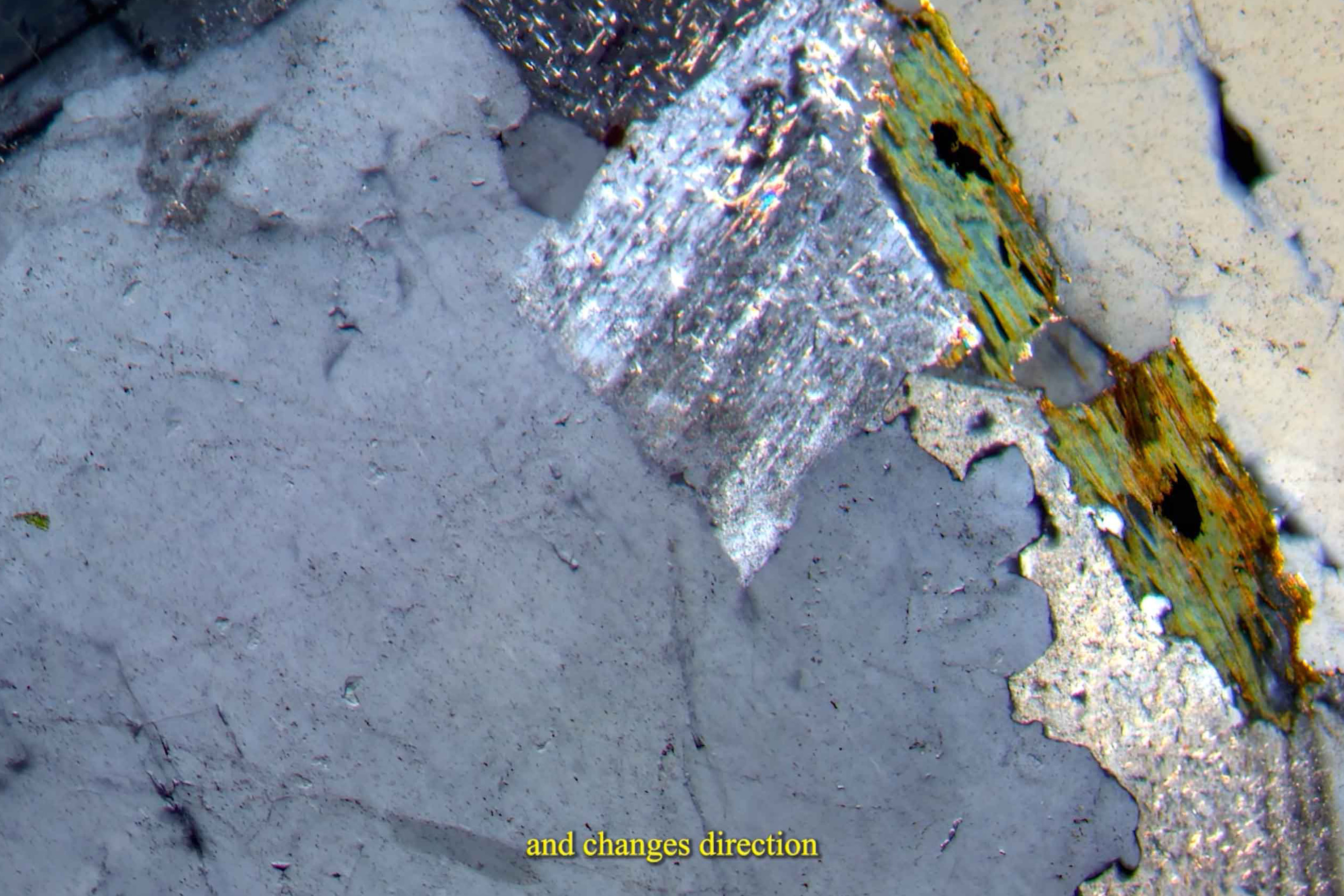
Viewing Conditions (2026) - Viewing Conditions" is a video installation deconstructing the history of an erratic stone located in the north-western Italian Alps through one of its few surviving fragments. Once a natural landmark and spiritual site, the boulder was gradually dismantled over the last century for the extraction of its valuable pink granite. Today, only its name on maps, fragments from the cutting process, and traces within local memory remain. Microscopic images examine the granite at a crystalline scale. The work reflects on the parallel between cutting stone for extraction and cutting it for observation, considering seeing and measuring as preconditions for different forms of value production. While one produces material value and the other scientific knowledge, both transform the stone through acts of division. Rather than recovering the lost landmark, "Viewing Conditions" proposes another image of it, treating the stone as an optical interface through which its hidden structures become visible. "Viewing Conditions" was developed together with Sonia Górecka during Nieuwe Instituut\'s -1 residency in spring 2026. It is part of "22.86 × 11.43 × 11.43", a larger initiative by the two artists investigating the relation between image production and earth extraction.
I was sure I would find it here
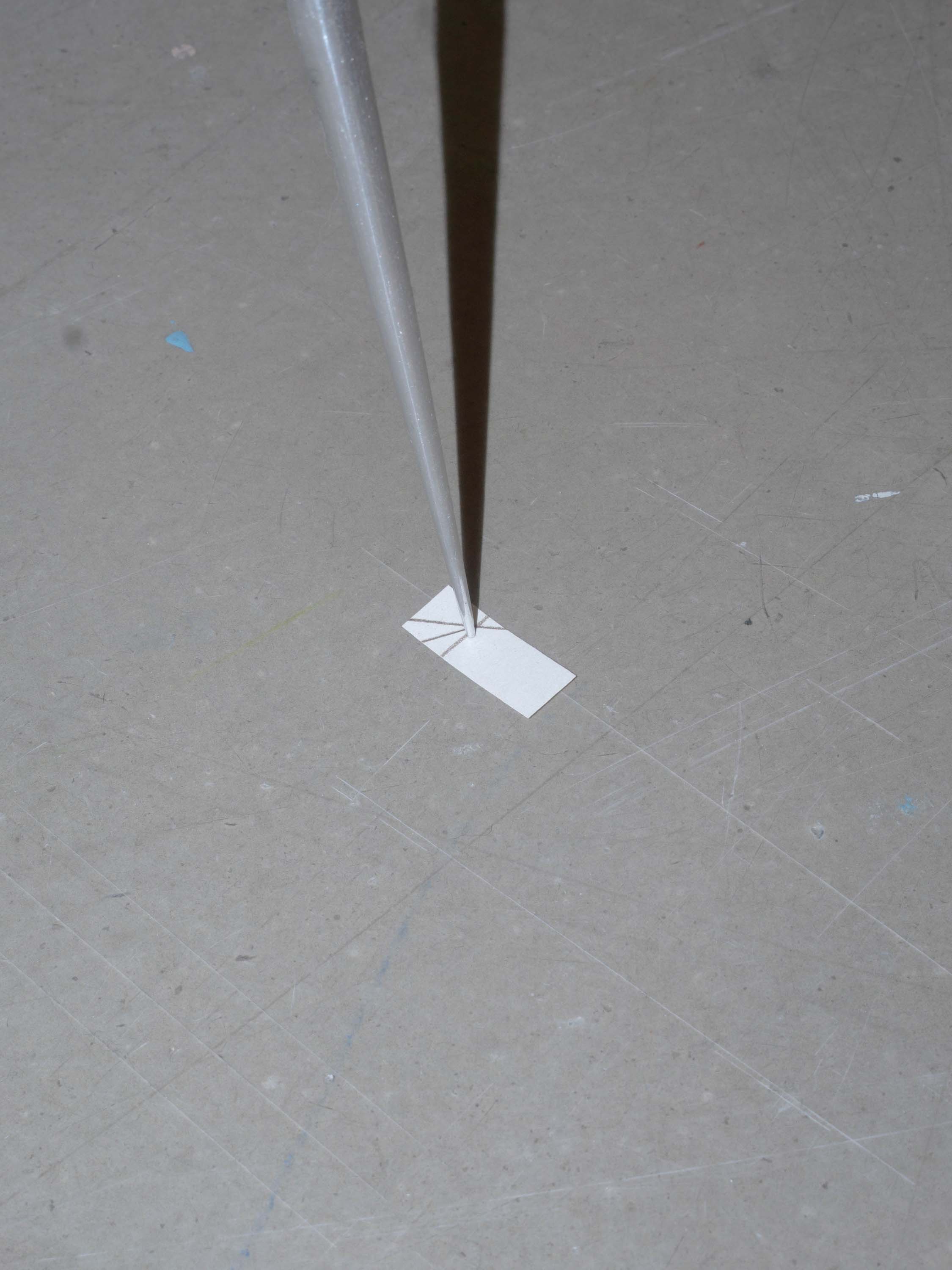
I was sure I would find it here (2026) - I was sure I would find it here, or at least there. Instead, it was only a drawing, visible in fragments and larger than the Earth itself. "Pipelines [...] made travel faster, cheaper, and completely unaffected by local interference: no slope, mud, or snow would stop the movement of matter. Its location would be neutralized and flattened into departure and arrival; the human body that once carried the matter would never grow tired again." Aluminum pipes, survey markers, and improvised measuring tools: precise, directional, indifferent to terrain. They pin fragments of paper to the floor, each scrap pointing to its smallest colored spot, and towards a place presumed to lie exactly beneath it. The installation repurposes research and knowledge gathered in 2023, when Matteo Bettini traveled for several weeks along a natural gas pipeline in Europe, following the poles that mark its buried route: cartographic remnants left behind so that mapmakers could relocate what had first been drawn on paper. The path stretched roughly the distance between his home country and the one where he now lives. The work belongs to a longer inquiry into geographical accuracy, infrastructure, and invisibility. Pipelines transformed transport by moving matter underground, beyond weather, terrain, and human labor. Unlike trains, they carry only things, never people: a frictionless system built for speed and efficiency. Early resistance from transport workers even forced companies to bury the infrastructure, hiding the movement of matter from sight. Today these vast underground networks remain visible only through scattered stakes and coded markers, unreadable to most. Cutting across mountains, rivers, and cities in straight lines, pipelines follow the logic of the map rather than the ground itself. What they leave behind is purely cartographic: coordinates, symbols, traces. The poles become physical fragments of the map, ruins of the drawing that came before the landscape. "I was sure I would find it here" was shown at MaMA Rotterdam from March to May 2026, as part of the group exhibition "Shadow Circuits", curated by Ruby Reding.
Fragments of Democracy II (2025)
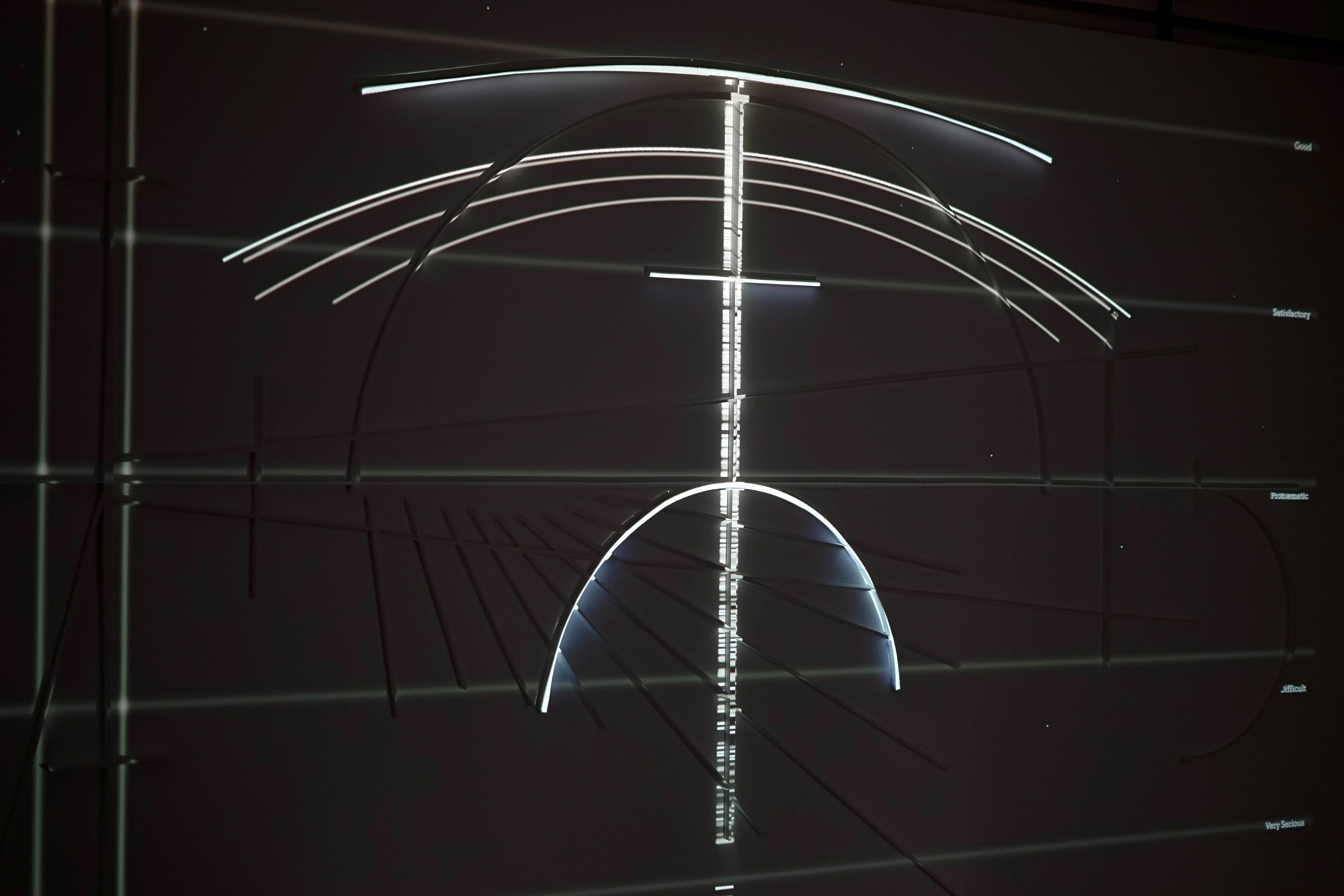
Fragments of Democracy II (2025) - A diagram is an outline, a structure that holds potential meaning. "Fragments of Democracy II" is a sunless sundial, built together with Studio Folder in June 2025: an architectural diagram on the walls of Circolo del Design. On this structure, not with the sun but with the projector's light, several datasets on press freedom in Italy emerge. The light falls on 3D-printed reliefs, while a video essay below animates the structure, tracing how visualisation turns something abstract and hard to hold, the state of information itself, into an image. The data span the period before and after the 2022 general elections, when a run of pressures pushed press freedom back to the centre of attention. They include several indices: the number of government bills that actively limit press freedom; the Media Concentration Risk, which measures how few people own the country's TV, newspapers, and radio; documented violations, including verbal and physical attacks on journalists; and more. Sources include the European Centre for Press and Media Freedom (ECPMF), the Centre for Media Pluralism and Media Freedom (CMPF), Reporters Sans Frontières (RSF), and AGCOM. Rather than the headlines, the work looks at the slower forces that decide what can be seen and said. On the wall, the data overlap and are left open for the audience to interpret. Reading a picture together, out loud, is the argument: it is one of the small ways a democracy keeps hold of itself. "Fragments of Democracy II" was made at the invitation of Vera Sacchetti for the group exhibition "Where To From Here?" in Turin (IT). It is the second iteration of an ongoing line of research into democracies, information, and their image production, developed together with Studio Folder.
22.86 x 11.43 x 11.43 (2025)
22.86 x 11.43 x 11.43 (2025) - "22.86 x 11.43 x 11.43" is a project and ongoing research that materialized in 18 jaquard-weaved textiles of different sizes. The research behind these pieces focuses on a rock formation in northeastern Piedmont, measured in "22.86 x 11.43 x 11.43". This rock vanished from the landscape at the end of the last century after it was cut to extract its valuable material. Today, it exists only through dispersed urban artifacts and as a name on a map, marking where it once stood. Through retracing the rock's existence, the project aims to reinterpret the complex relationship between local inhabitants and nature, its capturing layered significance: from an untouched natural artifact to a sacred monument, and its transformation into an exploitable and measurable resource. The tapestries preserve and reinterpret the story through new interpretations of archival materials, local legends about the rock, its Google Maps location, panoramic views and other elements. This is a self-initiated project that I developed together with Sonia Gorecka. Together with her I developed the concept, researched the archive material, went on field research and finally designed the textiles. The project have been supported by crowdfunding and matchfunded by Het Cultuurfonds.
Fragments of Democracy - All-In, Bonn Exhibition (2024)
Fragments of Democracy (2024) - Fragments of Democracy is a series of diagrammatic sculptures that explore the role of data visualisation in today's political and environmental discourse. Using hundreds of open-access datasets, the works transform complex information into layered, physical forms–objects that resemble tools, relics, or speculative tchnologies. Rather than aiming for clarity, there sculptures evoke ambiguity, inviting viewers to question how data is framed, interpreted, and deployed.
Il signore che viene da lontano [part of The Gas Route]
Il signore che viene da lontano [part of The Gas Route] - For decades, natural gas in Europe has been an invisible yet essential part of everyday life—arriving in homes from an undefined elsewhere, its infrastructure largely hidden from view. While recent political tensions have made aspects of this network more visible, much of it remains abstract and out of sight, despite its deep impact on landscapes, borders, and economies. This project investigates the historical process through which gas infrastructure has been both physically embedded and symbolically erased from public consciousness. Using cartographic and promotional materials released by ENI—one of Europe's largest state-owned oil and gas companies—the project traces shifting narratives around gas, from its early celebration as a clean alternative to coal, to its current role as a politically frail and environmentally outdated resource. The research developed through three main components: A book combining archival imagery and cartographic analysis with a written history of the infrastructure's emergence and disappearance. A two-week field trip following parts of the gas network across different regions, documenting its traces and absences in the landscape. A short film weaving together footage from the journey, maps, and historical materials to reflect on how energy infrastructure shapes perception, territory, and political imagination.
The Gas Route (2023-2024)
The Gas Route (2023-2024) - For decades, natural gas in Europe has been an invisible yet essential part of everyday life—arriving in homes from an undefined elsewhere, its infrastructure largely hidden from view. While recent political tensions have made aspects of this network more visible, much of it remains abstract and out of sight, despite its deep impact on landscapes, borders, and economies. This project investigates the historical process through which gas infrastructure has been both physically embedded and symbolically erased from public consciousness. Using cartographic and promotional materials released by ENI—one of Europe’s largest state-owned oil and gas companies—the project traces shifting narratives around gas, from its early celebration as a clean alternative to coal, to its current role as a politically fraught and environmentally outdated resource. The research developed through three main components: A book combining archival imagery and cartographic analysis with a written history of the infrastructure’s emergence and disappearance. A two-week field trip following parts of the gas network across different regions, documenting its traces and absences in the landscape. A short film weaving together footage from the journey, maps, and historical materials to reflect on how energy infrastructure shapes perception, territory, and political imagination.
A great place for a ride (2022)
A great place for a ride (2022) - A Great Place for a Ride is a short film centered around a fictional character—Miguel, a motorbike enthusiast raised near the National Forest of Leiria in Portugal. Combining staged footage with a narrative constructed from Google Maps comments and an offline interview, the work follows Miguel as he rides his quad through the forest, casually sharing his personal knowledge of the area. Leiria's forest is often celebrated for its natural beauty and national importance, yet Miguel's account reveals a more complex and layered landscape. His narrative unfolds in three chapters, each rooted in a recurring theme: [the sand – the greatness], exploring the forest's origin as a man-made barrier planted by royal decree to protect inland regions; [the fires – the beauty], referring to today's recurring wildfires, which Miguel sees as inevitable consequences of political corruption; and [the wood – the pride], highlighting the historical role of the forest in providing timber for Portugal's naval expansion. While these narratives echo broader ideas of national pride and ecological significance, Miguel ultimately sees the forest in more personal terms—a space for leisure and escape, shaped by memory, hearsay, and his own lived experience. A Great Place for a Ride reflects on how landscapes are framed by storytelling, shifting between fact and fiction, history and present use, pride and neglect.
Strategic Futures (2022)
Strategic Futures (2022) - By strategic futures, also referred to as critical futures, is meant future prospects and narratives essential for economic and national security, but based on a limited supply with no known alternatives. A series of documents recounts the procedure undertaken by the company Strategic Minerals to obtain authorisation to search for cobalt-silver and associated minerals at the former ‘Punta Corna’ mine site in north-western Italy. Through a comparison of the presented contents of the company, oriented towards sustainability and so-called green energy, and those of a number of local archaeological and environmental protection associations that would like the work to be suspended, the current European strategy regarding the extraction of critical minerals and a broader reflection on global mining exploitation are presented. The use of a wood board, a tipical comunication media present in the alps area to release official information to citizen and general public, remind the geographical and cultural context this story is taking place and exist as an hybrid between an hiking informative board (side with map) and an official burocratic wall to hang documents.

-1 Digital Lab

Datum:
Locatie: Nieuwe Instituut
In samenwerking met: Sonia Gorecka

To the Horizon

Datum:
Locatie: Aspekty Gallery
In samenwerking met: Sonia Gorecka

Fuori Pista (Off-Track)

Datum:
Locatie: Gres Art 671
In samenwerking met: Studio Folder
https://gresart671.org/2025/11/12/fuoripista-arte-sport-e-inverno/

Where to, from here?

Datum:
Locatie: Circolo Del Design
In samenwerking met: Studio Folder

Using data visualisation as a tool to stimulate deeper reflection on the state of information in Italy, the project "Fragments of Democracy II" made in collaboration between Studio Folder and Matteo Bettini, explores the role of design in making complex phenomena visible and focuses on a crucial issue in any democracy: freedom of the press. The project consists of a video-essay, a sound installation and a 3d printed structure on the wall. During opening the project had been presented publicly.

Ultra Paesaggio Continuo [Workshop]

Datum:
Locatie: Circolo Del Design
In samenwerking met: 4KHD

Ultra Paesaggio Continuo is a two day bike-based workshop format investigating the intertwined relationship between images and space. During this specific workshop we slowly explored and critically observed the urban structure of Turin and various problematic aspects related to traffic and mobility. We did it by using several video manipulation tool created on purpose for the workshop and created different images to better understand the city.

https://circolodeldesign.it/evento/ultra-paesaggio-continuo-photo-finish-e-osservatori-mobili/

Emergence [Exhibition]

Datum:
Locatie: Palazzo Bronzo
In samenwerking met: Sonia Gorecka

"Emergence" is a group exhibition curated by Luca Conte and Martina Montagna, held at the independent cultural center Palazzo Bronzo in Genoa. The exhibition brought together a range of artistic practices exploring the complex relationship between place, history, and cultural intersectionality. I participated with the project "22.86x11.43x11.43" – a series of textile works created in collaboration with artist Sonia Gorecka.

https://readymag.website/palazzobronzo/home/

Ultra Paesaggio Continuo [Workshop]

Datum:
In samenwerking met: 4KHD

Ultra Paesaggio Continuo is a two day bike-based workshop format investigating the intertwined relationship between images and space. During this specific workshop we slowly explored and critically observed the heavily exploited agricultural landscapes of Prosecco's hills. We did it by using different cameras and video manipulation tools created on purpose for the workshop and experiment other ways to collect images of landscape while slowly moving.

All in! Re-Designing Democracy [Exhibition]

Datum:
Locatie: Bundeskunsthalle
In samenwerking met: Studio Folder

I took part in "All in! Re-Designing Democracy" in collaboration with Studio Folder for the creation of the work "Fragments of Democracy".

https://www.bundeskunsthalle.de/en/demokratie

Anti-Navigation Tools [Workshop]

Datum:
In samenwerking met: EKA - Estonian Academy of Arts

We created a series of paper maps and annotation sheets designed as low-tech navigation tools for exploring Berlin. Moving away from GPS dependency, these materials invite participants to read and move through the city based on personal interpretation, curiosity, and sensory orientation. The project encourages a slower, more subjective experience of urban space, offering an alternative to standardized, goal-oriented navigation.

https://stand-in.eka-gd-ma.ee/

Racconti dai margini dell’urbanizzazione [Symposium]

Datum:
Locatie: Università Statale di Milano
In samenwerking met: Società Studi Geografici

I participated in the "Racconti dai margini dell’urbanizzazione" session at the Political Ecology and Geography Conference held at Università Statale di Milano in June 2023. I presented "The Gas Route" with a 12-minute lecture and a preview of the short film. The project examines the historical and spatial disappearance of gas infrastructure in Europe, using archival materials and field research to explore its political and geographical implications.

Deze kunstenaar heeft nog geen toekenningen.