Reinier Vrancken (°1992, NL) lives and works in Rotterdam, the Netherlands. In his artistic practice, he moves in and out of material and immaterial worlds through oblique connections and poetic leaps.
His installations, interventions, objects and artist books test with lyric attention the vague contours of physical and conceptual bodies—their diffusion and plurality in particular forming the subject of artistic address—and become entry points for articulating their underlying kinships.
Source: WIELS, Contemporary Art Centre, Brussels — wiels.org
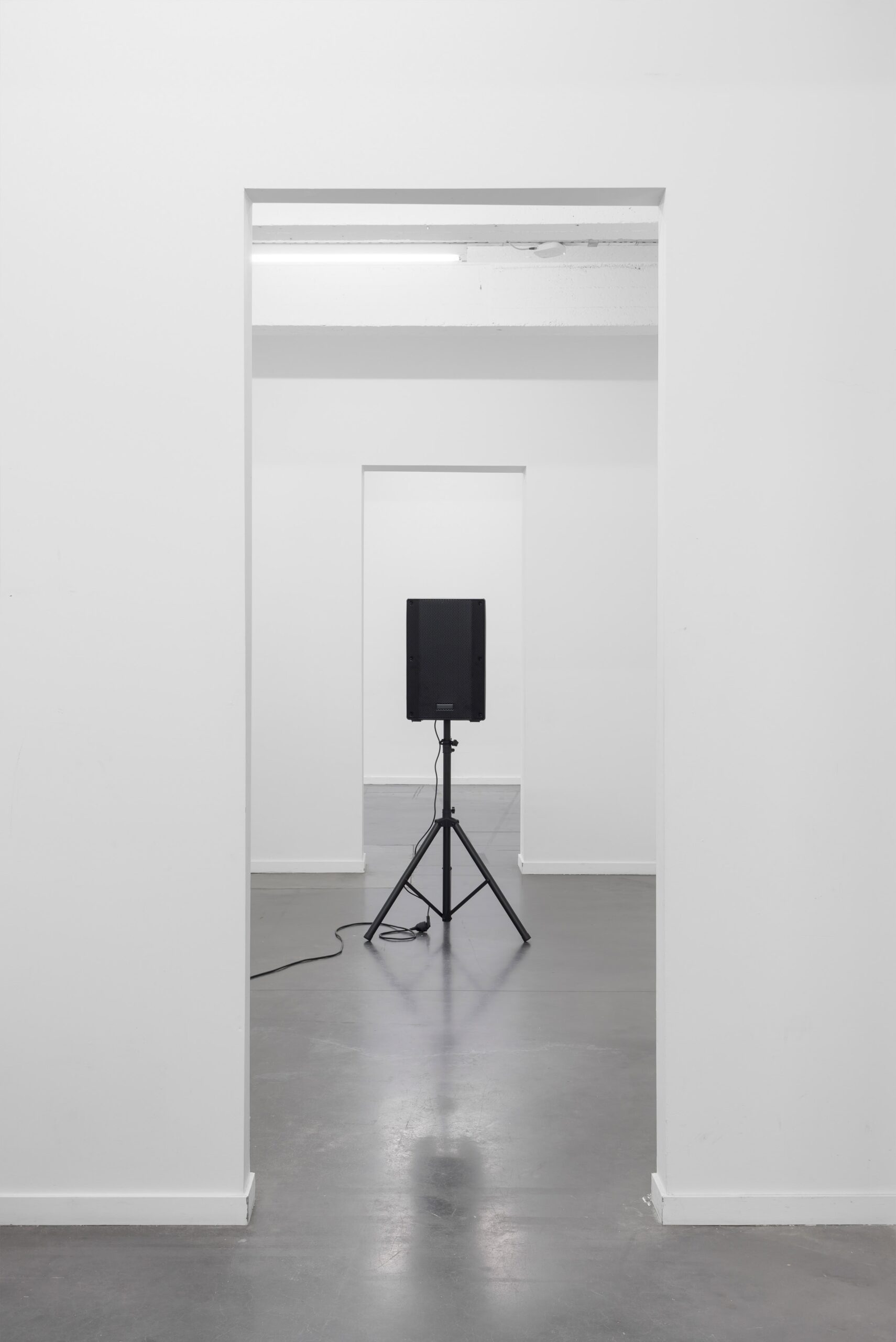
II, 2025, 'Ideale' by Alessandro Moreschi, paused, dimensions variable - (…) roughly the size of a torso. (…) the recording (…) paused (…) two capitalised i's together guising as a caesura—a mark indicating metrical pauses in poetry and music (…) paused (…) Alessandro Moreschi (…) the last known castrato (…) Since the 16th century, generations of Italian youth were subjected to castration in the hope of preserving their prepubescent singing voice—and often lifting their families out of poverty. The practice was encouraged by powerful institutions of the time—castrati were a fixture in the Vatican's choirs and in Italian opera (…) The prepubescent voice, thrown with the power of matured lungs, occupies the liminal space between typically male and female registers, yet resists fitting neatly into either (…)
—Alicja Melzacka, 2025
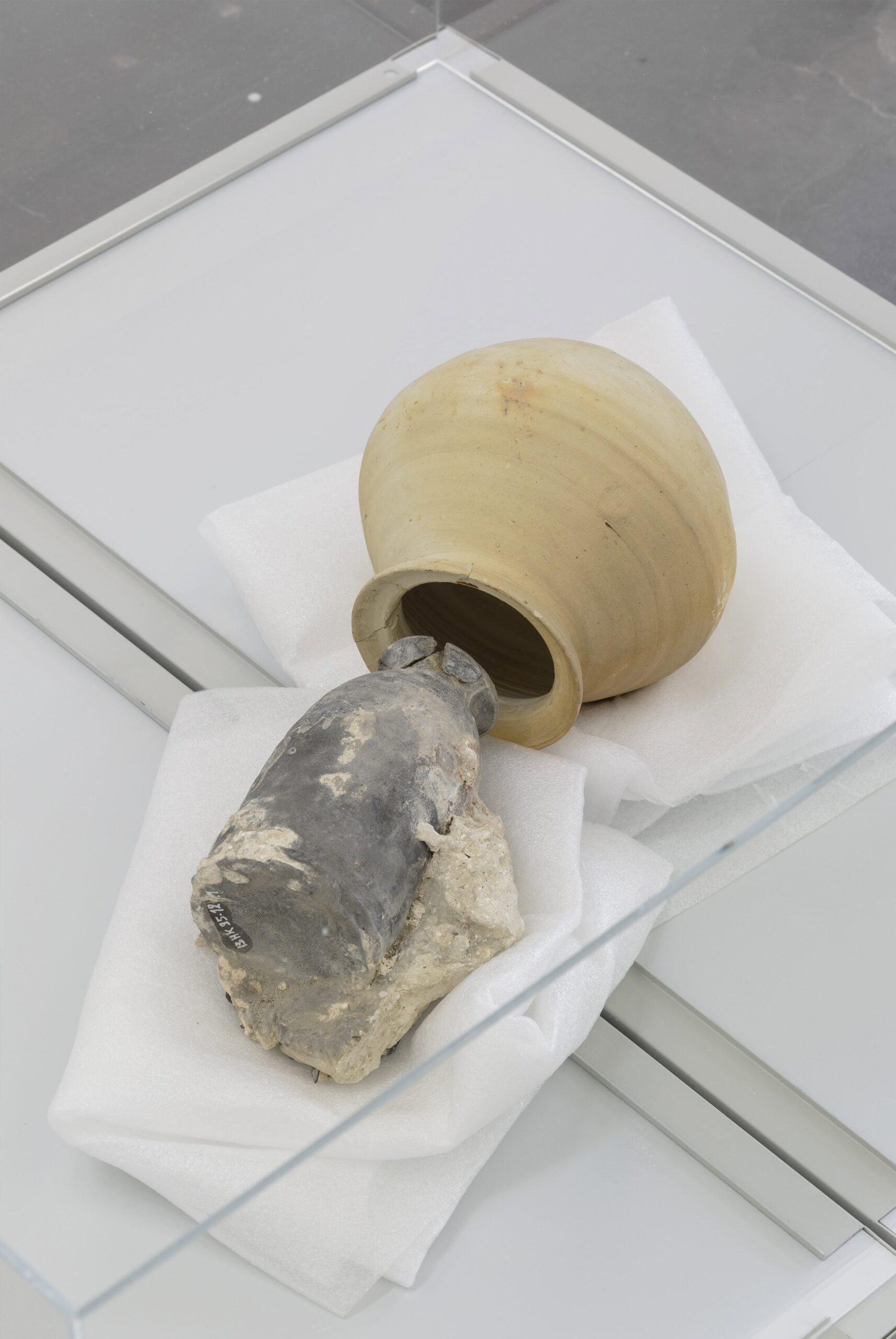
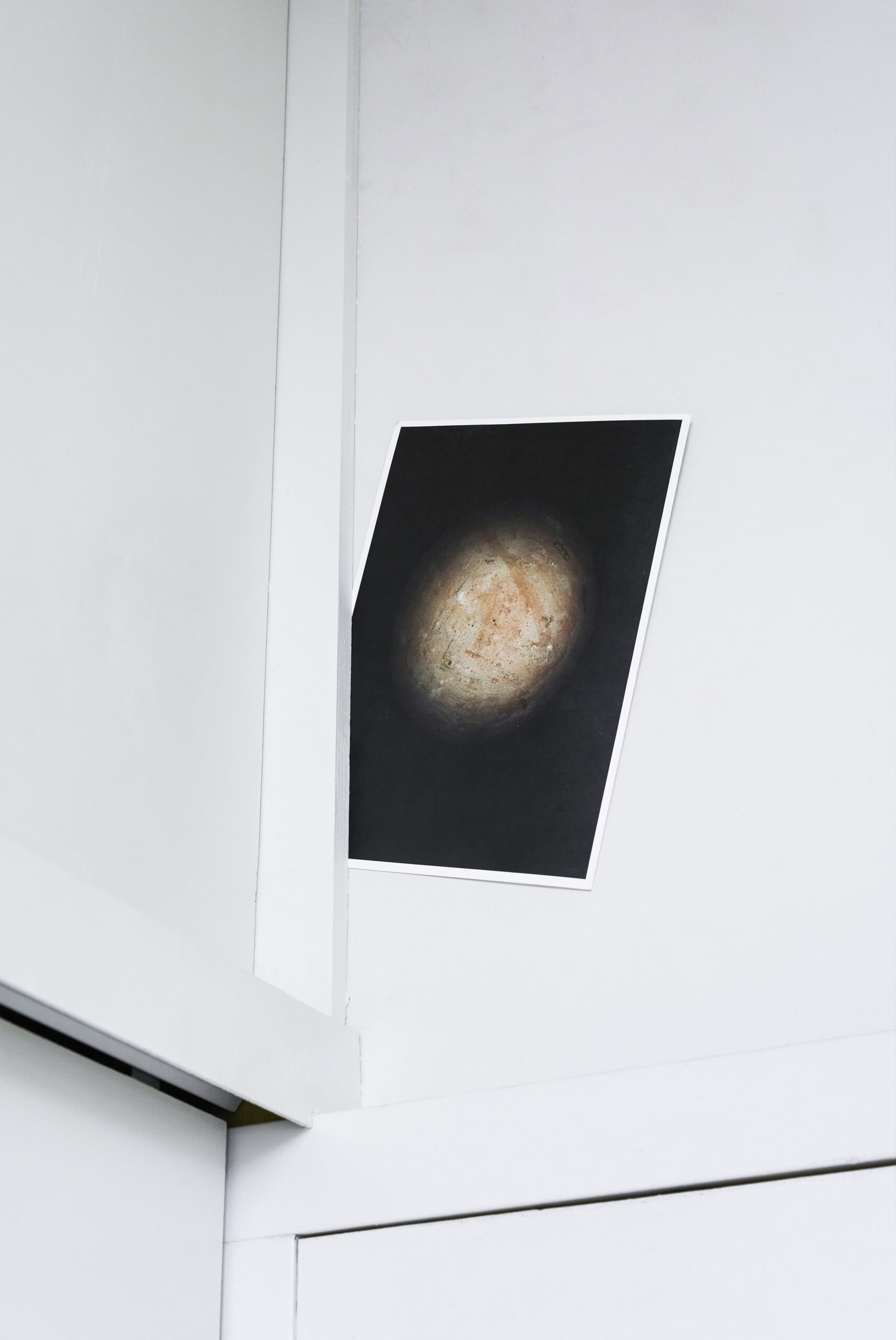
Acoustic jars from the collections Gallo-Roman Museum, Tongeren-Borgloon and Archaeology Collection - (…) their mouths almost touching. The vitrine has a base of recovered metal frames and a plexiglass cover. (…) acoustic jars, also known as sounding vases, which would be immured in walls, particularly in churches, to enhance the acoustics. In some cases, their openings were visually incorporated into murals or frescoes as gaping mouths to a body. (…) on loan from the Gallo-Roman Museum in Tongeren-Borgloon and the Archaeology Collection of the City of Ghent. The arrangement of the jars is inspired by 'rekuhkara', a now-extinct singing game in which two women—a giver and a receiver—face each other and form a tube with their hands, through which one produces a guttural sound, channelling it into the other's mouth cavity. The receiver then modulates the volume and quality of the sound, by closing her glottis and simulating articulation—as if speaking with the other's voice (…)
—Alicja Melzacka, 2025
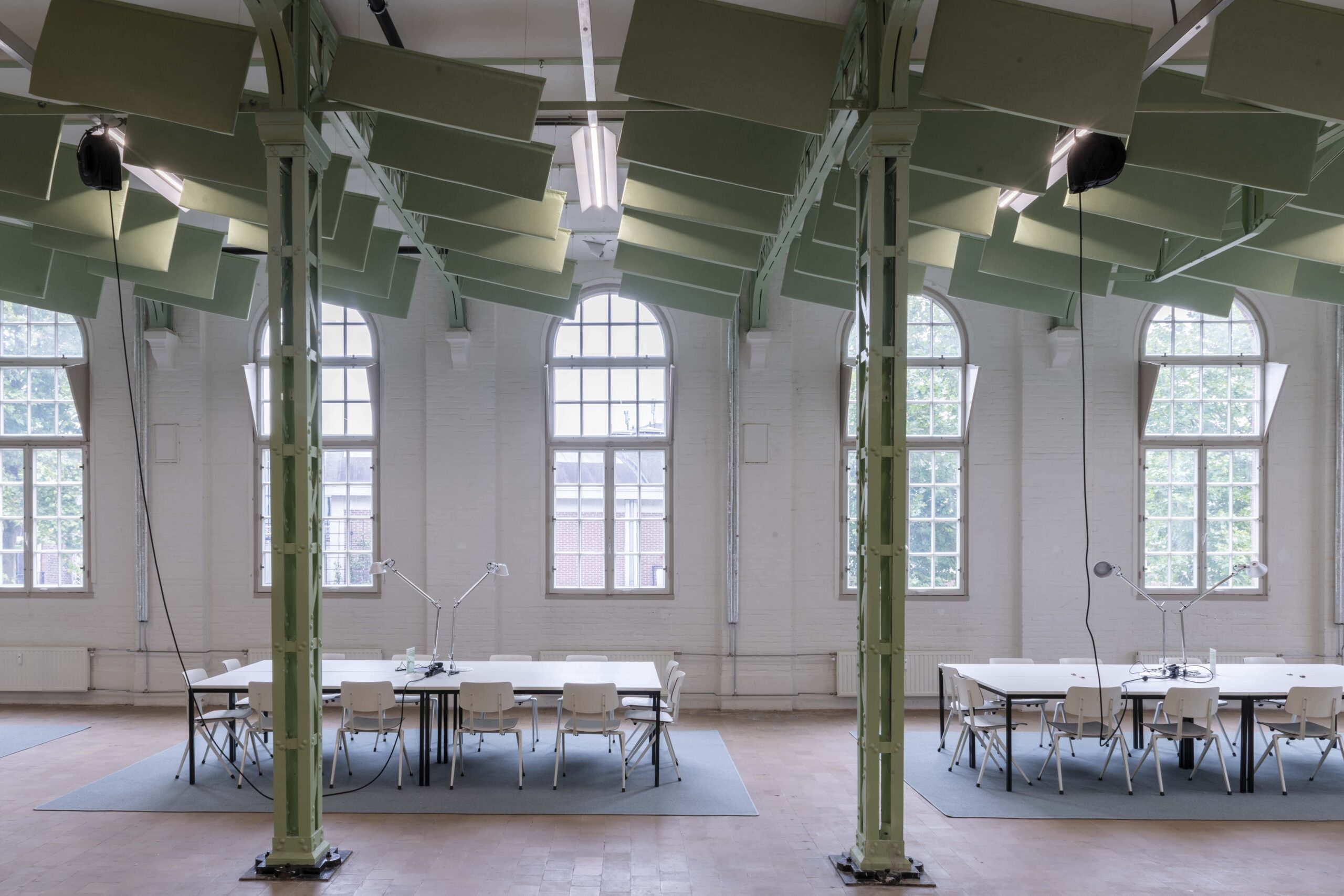
In Obliques, 2024, acoustic ceiling panels tilted 14 degrees, dimensions variable -
(…) this making and unmaking of meaning (…) slides from a critique of meaning-making in art at large down towards the artist's particular affinity with art's poetic dimension (…) the panels appear to mark both the institution's various functions as a hybrid cultural centre that caters to various activities, disciplines and audiences, and, I would argue, more generally the place of art in society at large today, where it is increasingly forced into registers of efficiency, consumerist decor and fragmentary work ethics. (…) The tilting of the acoustic panels (…) sets out to place particular (…) italics (…) as you try to adjust your orientation to untilt the panel back to its imagined horizontality, you will find that now not the panel is tilted, but your head, neck and the perspective of the world around you (…) ghostly stillness (…)
—Timo Demollin, 2024
isn't here is here wood, 2024, plexiglass, paint, glue, 55 x 55 x 28,3 cm -
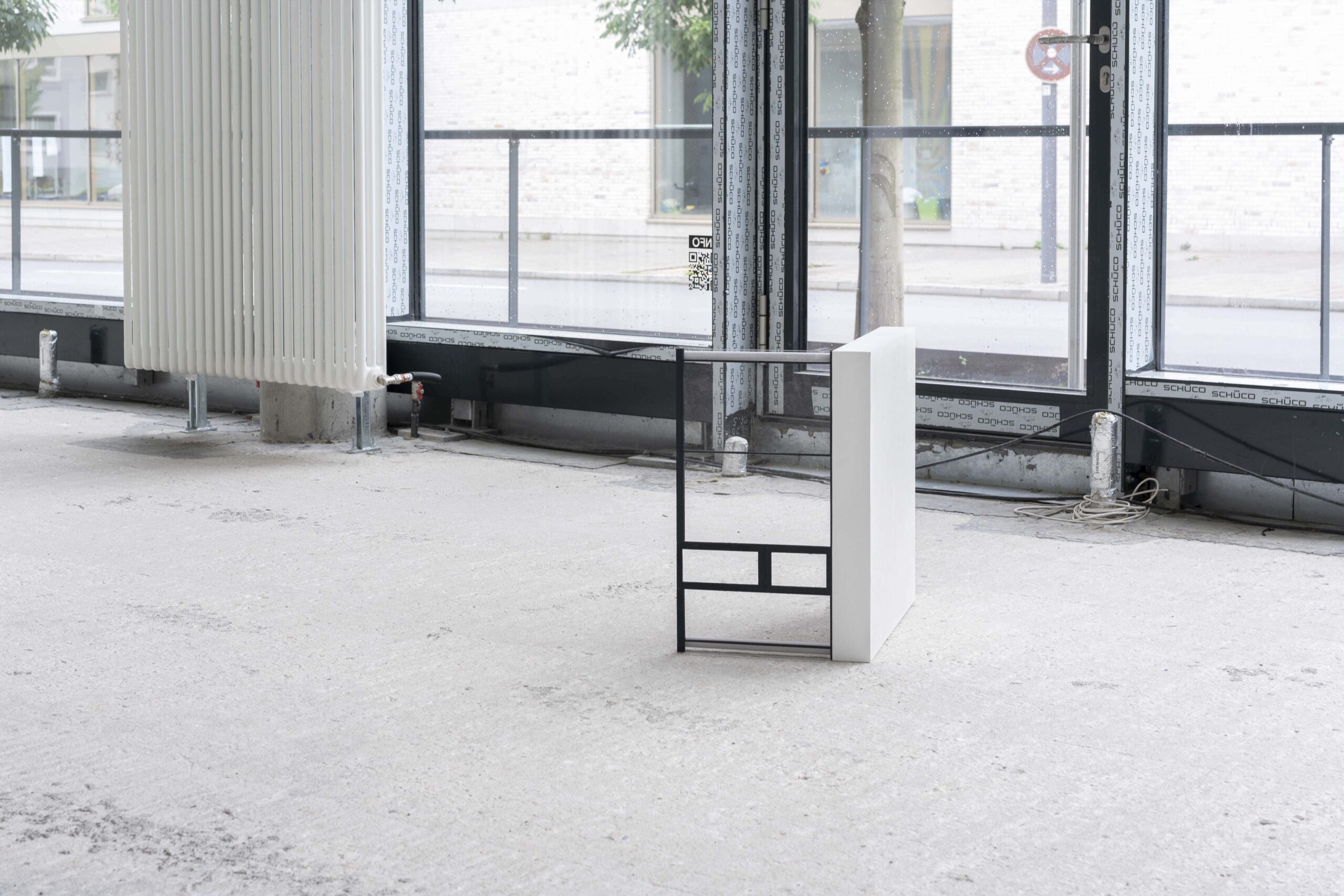
(…) a decidedly critical look at the exhibition's methodology and the artistic intervention it entails by developing it further. While the curatorial team decided for aesthetic and pragmatic reasons to leave out the window front and the ceiling (…) in the models, he had these missing spatial elements manufactured by the curatorial team for his work isn't here is here.
—Anna Marckwald, 2024
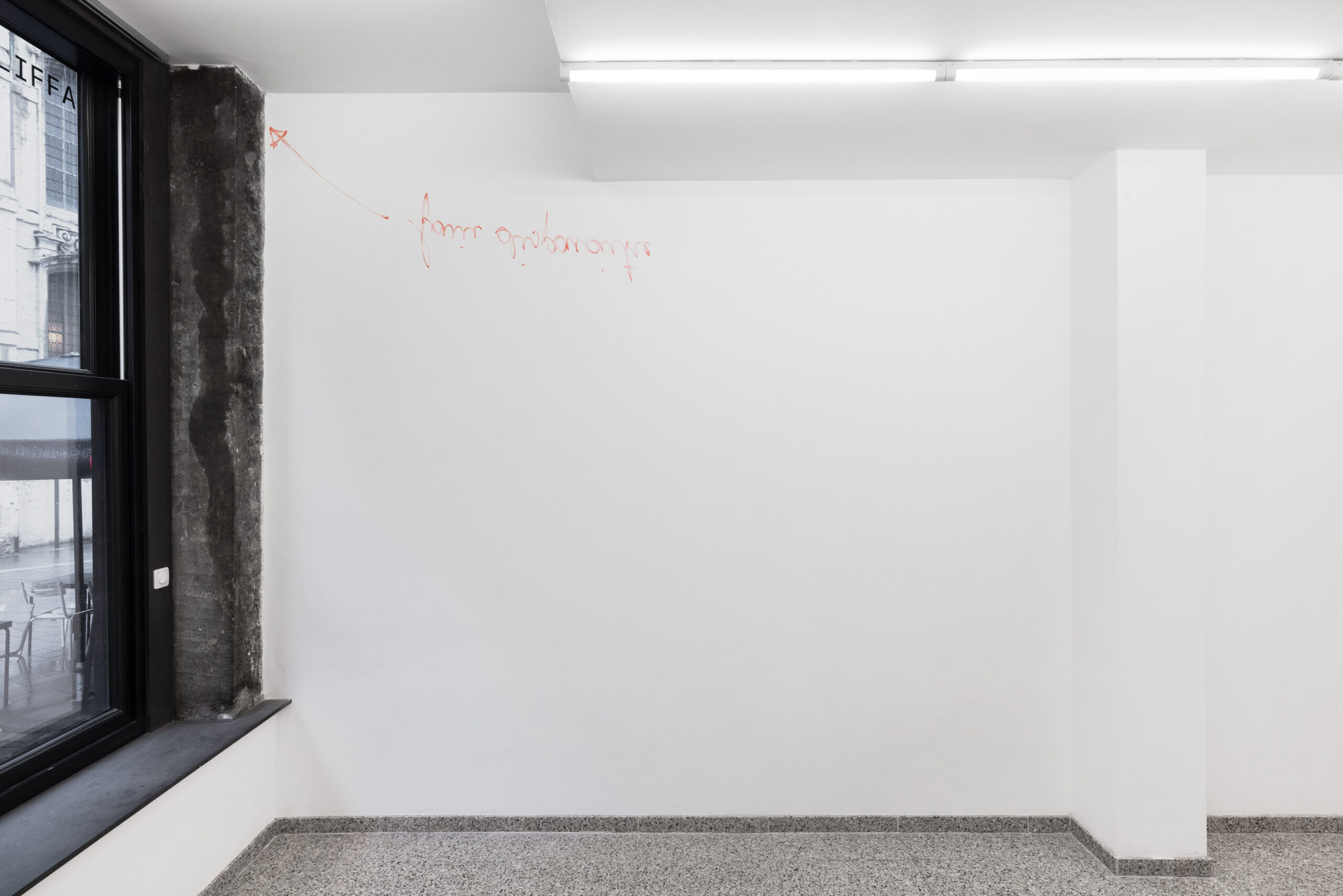
Noting No Thing (2), 2022, the architect's writing scaled 1:1, red BIC ink, 204 x 34 cm -
(…) Instead of presenting two separate exhibitions following their residency at WIELS, the artists merged the periods into a single, two-part exhibition (…) have two, the second part of the exhibition pairs Vrancken's work, Participating in the exhibition as Raniero, with TLSD's Noting No Thing (2) (…) “verso” (…) “recto” (…) a shared process in which the works intertwine (…) the information about the work—translated from English into Italian—can be read. But one word, “Raniero” remains untranslated. The name appears like a shadow, a negative space within language. (…) Noting No Thing, TLSD's title, reinforces the sense of absence onto which to project Raniero's virtual presence—the necessity of a void to feel this apparition. (…) If we join the titles, On the other, I only / have two, what has disappeared are the “hand(s)”: On the other hand, I only have two hands. The hands that write an exhibition. That translate. (…)
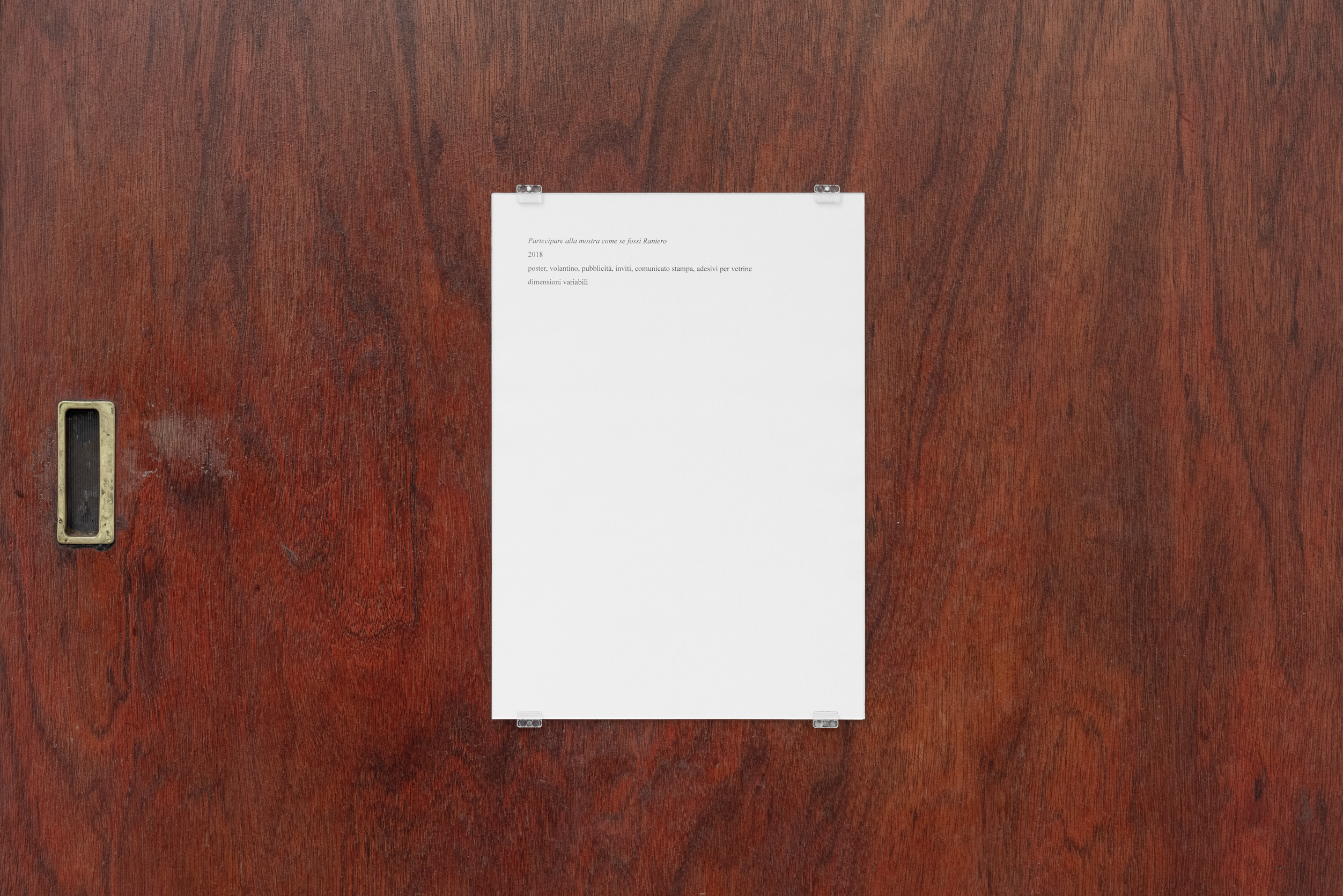
—Yann Chateigné Tytelman, 2026 Participating in the exhibition as Raniero, 2018, poster, flyer, advertisements, invitation .. -
(…) the shared work. (…) interrogates constitutive doubts, the constant redefinition of self (…) Within the folds (…) a system of institutional conventions. (…) written in mirror-image (…) By associating the title of this piece, Participating in the exhibition as Raniero, with the drawing, Vrancken and TLSD both unite and fragment the meaning and identity of their works (…) error, corrections, and the misunderstandings that generated them, the different parts—brought together in two exhibitions forming the hypothesis of a new shared work (…) Vrancken and TLSD highlight the contradictions and tensions inherent in the identity of a work, in the fixity of its definition by a name or a form. Like a mirror of the unconscious, their almost therapeutic device explores the desires for introspection, the projections, and the fears triggered by the encounter with the other (…)
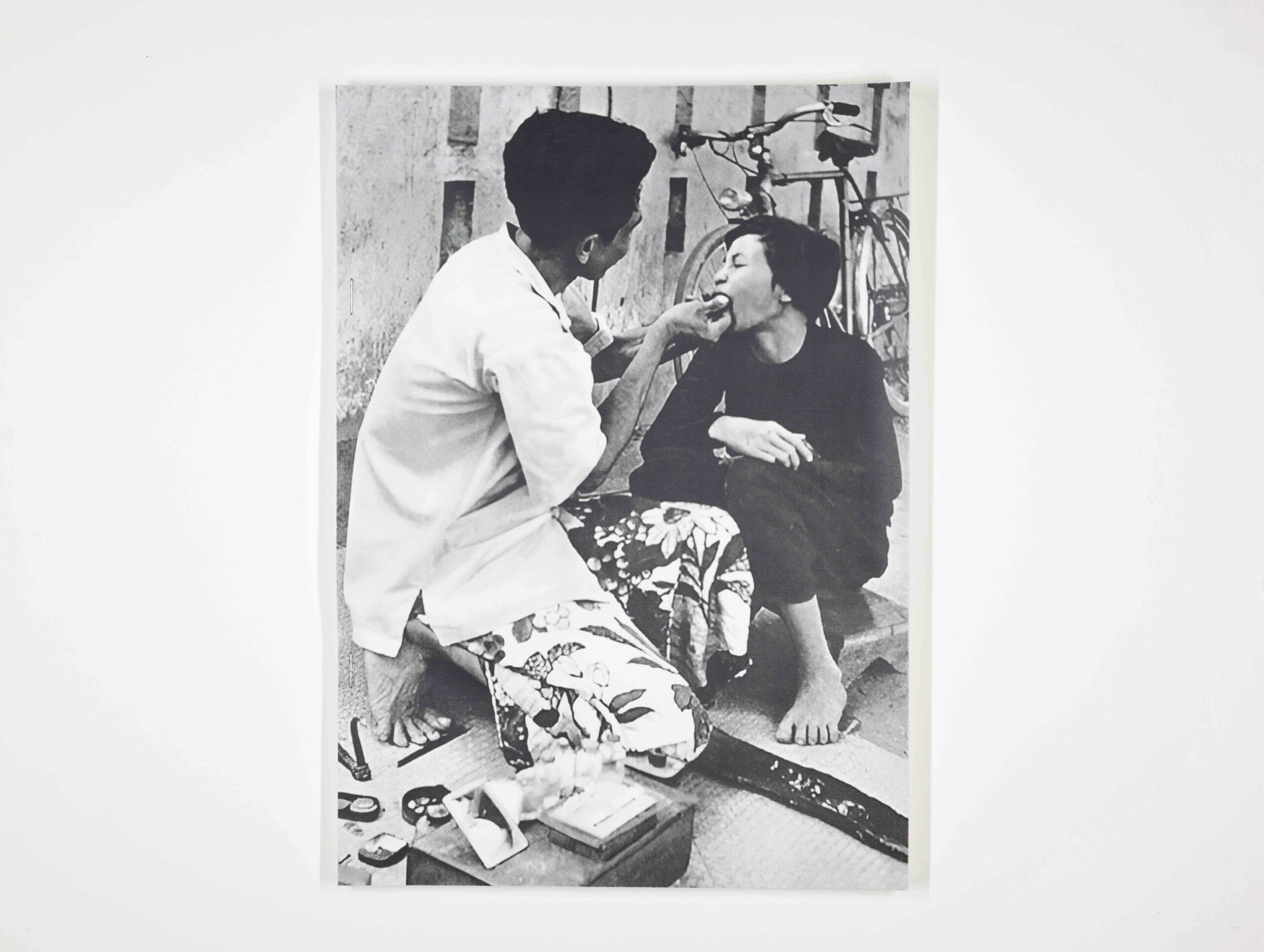
—Antoinette Jattiot, 2026 Teeth Surrounding a Flower in the Meanings, 2023, artist book, 29,7 x 21 cm, 98 pages (b/w ill.) - (…) sixteen curatorial and critical texts, written (…) in response to Vrancken's work, are used as material for sixteen erasures. (…) electrifies a network of relations: between the artist (…) the writer (…) the curator (…) the work (…) the text, and so on, leaving all of these parties feeling slightly off-kilter. And while, at first, this process may strike one as a mere exercise in turning tables—a voltage change in a closed circuit—it ultimately shapes the conditions for public reception. (…) an unconventional 'companion reader' to Vrancken's works—the great absentees of the book, evoked only by the epigraph 'Works 2016-2023'—in that each poem has one of Vrancken's pieces as its counterpart. (…) a commentary on institutional ventriloquism (…) Tellingly, Vrancken chose this image of dyeing, as if erasing, an element of the body, transforming a barrier into an opening. A hole within the hole in the well where words resonate doubly.
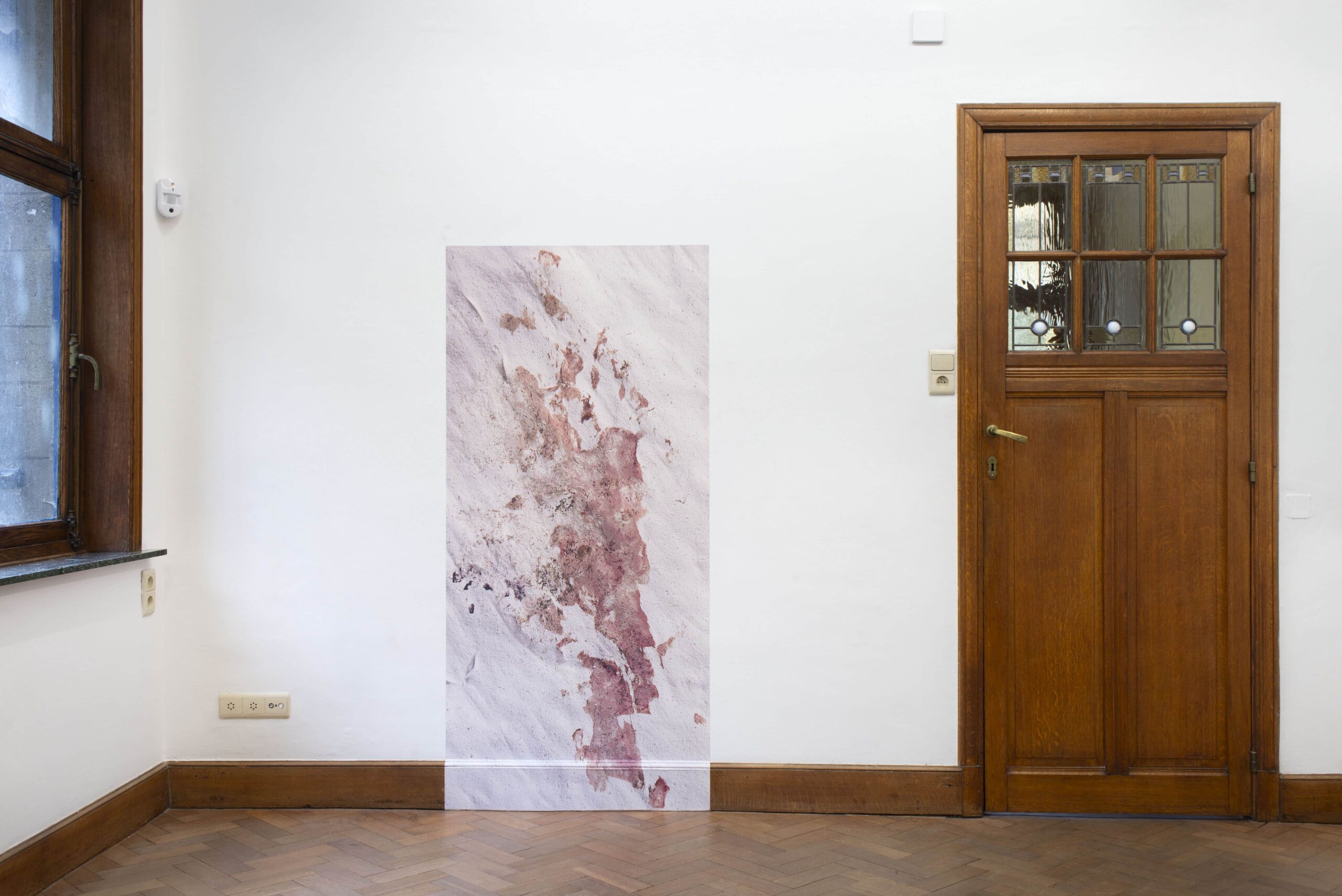
—Alicja Melzacka, 2024 The bleeding into and the bleeding out of, 2021—ongoing, vinyl decal, 180 x 83-107 cm -
(…) bleeding from another body. Flattened on the wall, the artist cut the speck out of the wallpaper. The piece was reproduced and resized to match the artist's stature. It sounds like magical thinking: the transformation of identity through a wall, by means of the combination of blood and mosquito. By enlarging the bloodspot, Vrancken reappropriates himself. Consequentially, the lack of physical volume of the vinyl sticker barely enables us to define it as a spatial object. A conscious choice, for Vrancken, who situates this merger in an architectural context, one in which the measurements and proportions of the blood spot find new resonance.
—Machteld Leij, 2021
Acoustic jars from the collections Rijksmuseum van Oudheden, Leiden and Gemeente Schouwen-Duiveland -
Why would one put a jar into a wall, only its hole sticking out? Is it for pocket cash donations? It's in a church after all. (…) deeper (…) The holes of these jars, encrusted in the walls, are ways to control acoustics. Reverb, echos, distortion, etc. Music is played in churches, words are spoken (…)
—Piero Bisello, 2024
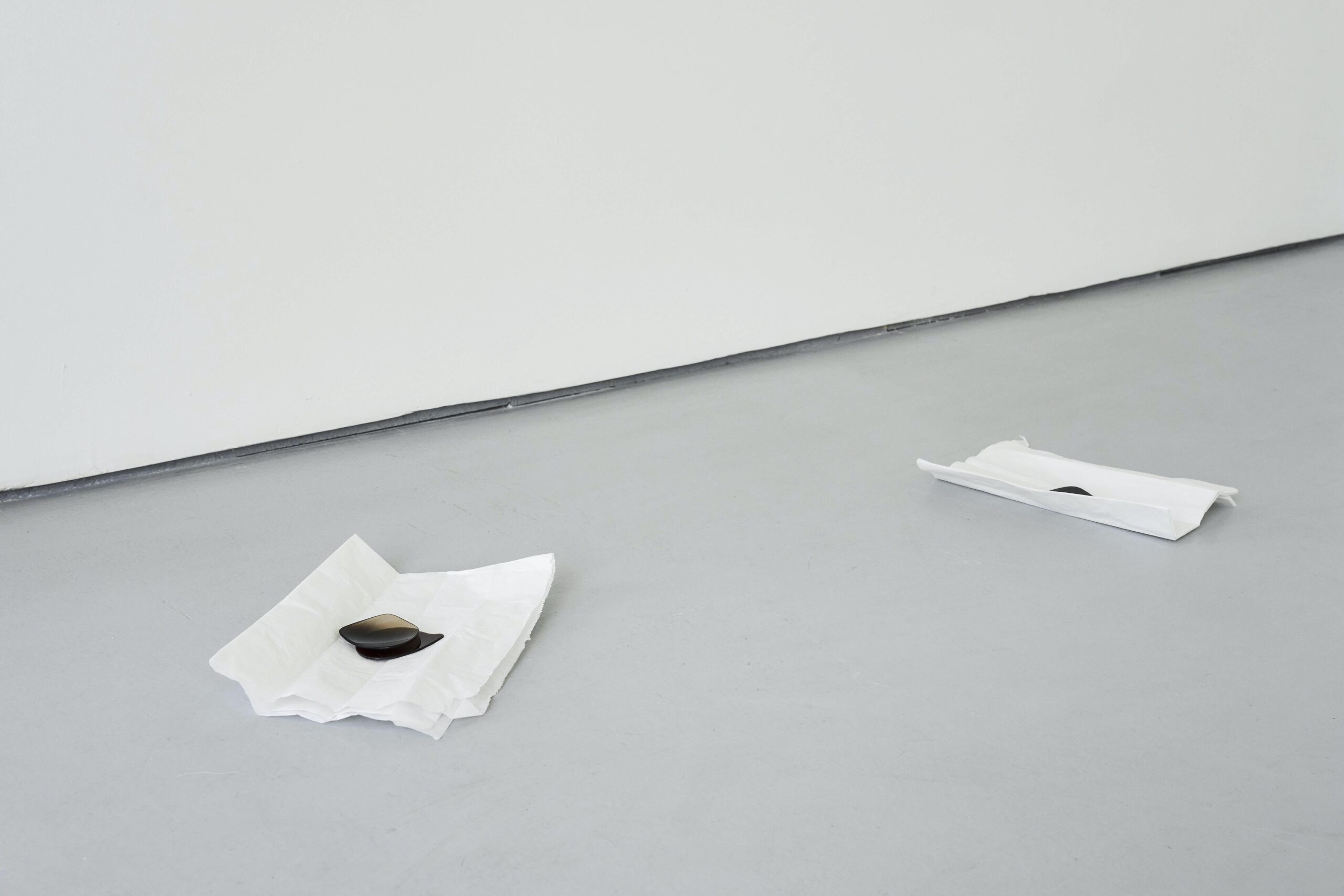
found left and right sunglass lenses (Tokyo/Bruxelles), 2023, 5 x 5 x 0,5 cm -
Two different lenses (...) put together (...) separate people, glasses, places, and moments — coincidence dictates they are a thing in itself now.
—Piero Bisello, 2024
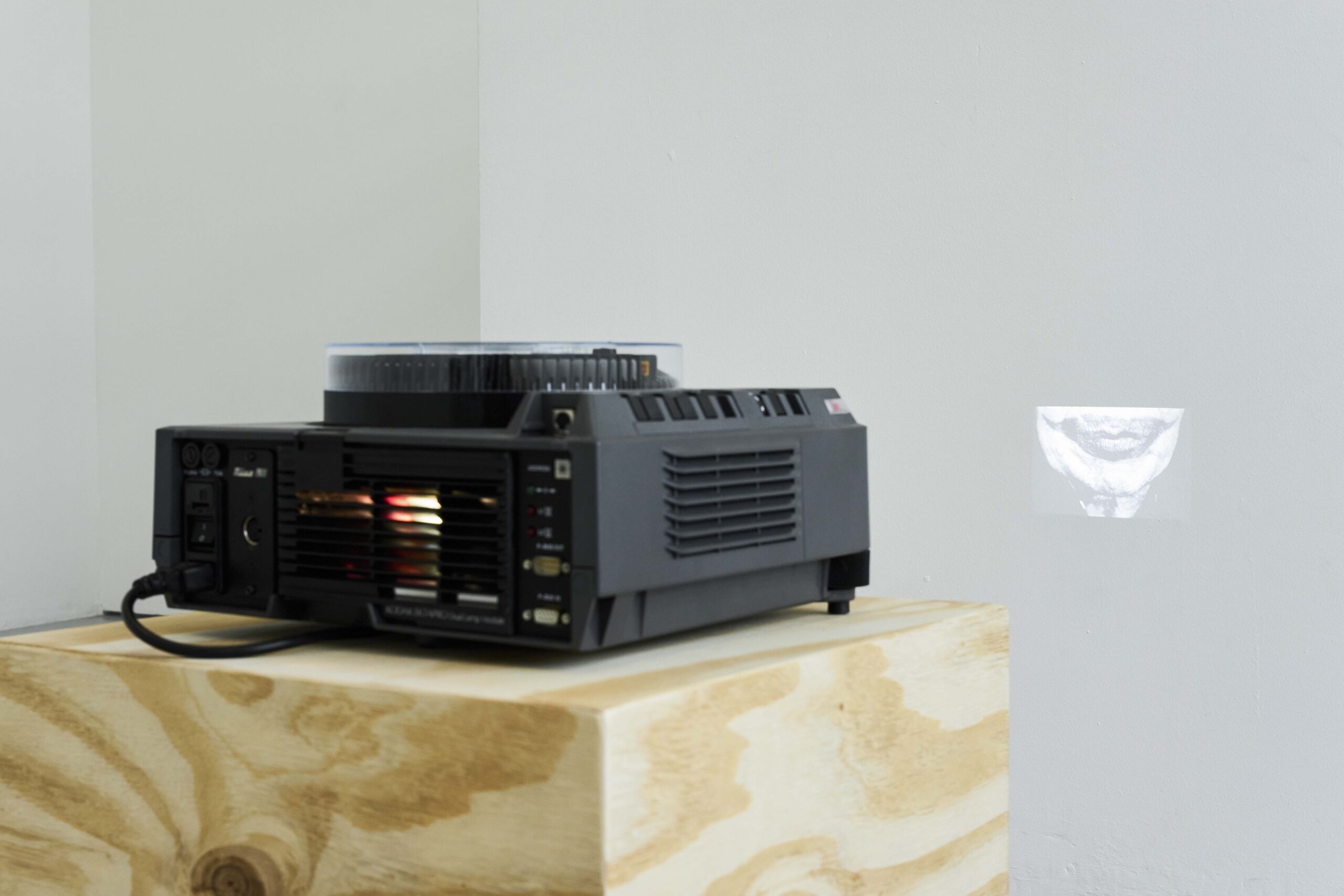
One and Two Mouths, 2024, 20slides of found images and 20 slides of blank film, dimensions variable -
(…) slide show paced as breath projects two mouths at once: one is represented, the other one real. (…) holds the machine together, laying low, down to the ground, rather (…)
—Piero Bisello, 2024
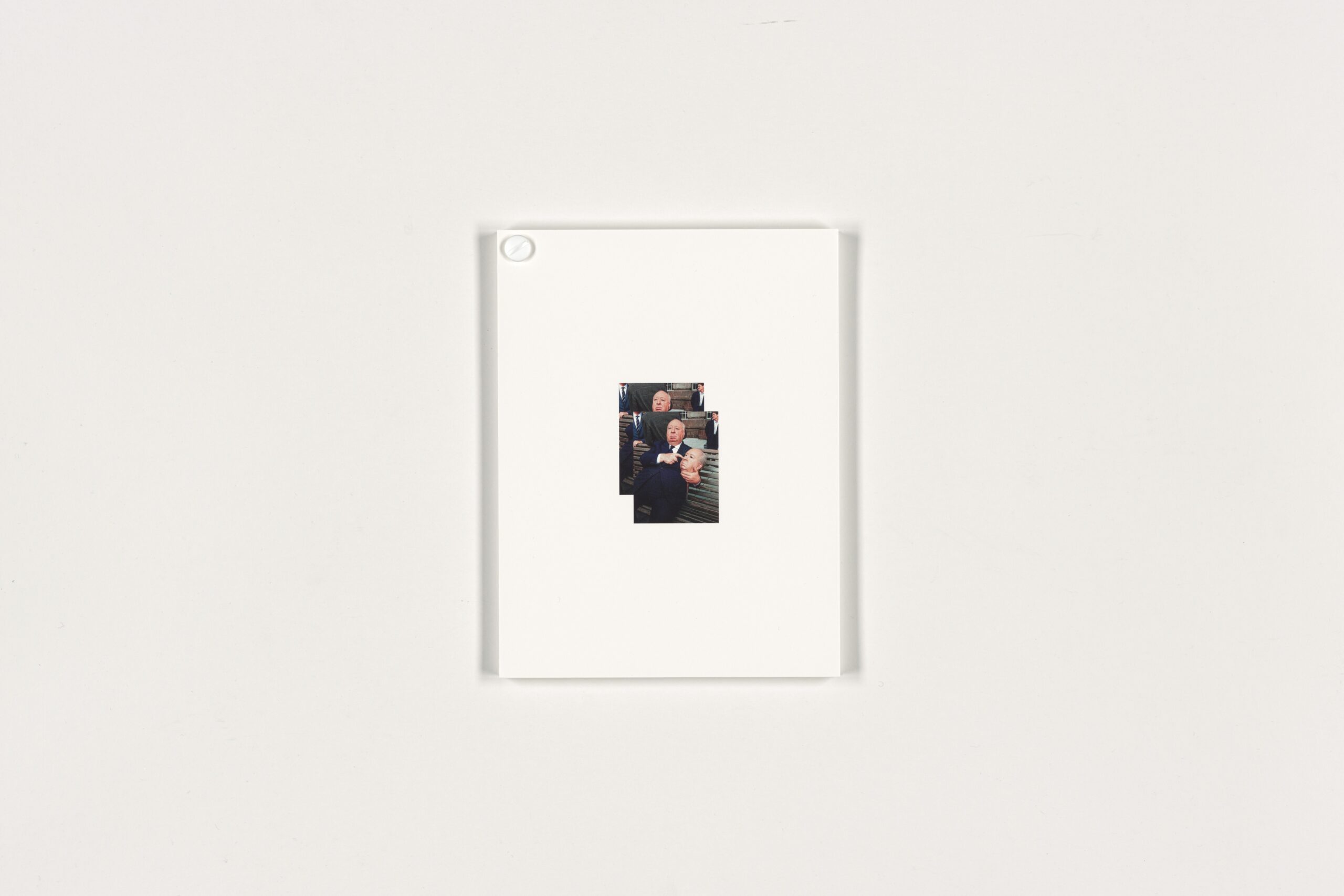
Descending Catalogue, a rearrangement of the poem L'Union libre (1931) by André Breton, 2022 -
(…) the conventions of blazon: a type of catalog verse in which the poet lists the physical attributes of a (usually female) subject (…) strains the relation between the subject and her metaphorical body (…) re-organizing the poem, he proposes a headless subject who carries her head in her hands. We encounter the body of the text at the shoulders, after which we descend. Her head is placed in between her hands, as she touches and holds her head, and thereby her own textual representation. (…) authoring and not: he appropriates the poem (…) without taking the helm completely, thereby leaving a “headless” production with its meaning unfixed and unsettled.
—Pia Louwerens, 2023
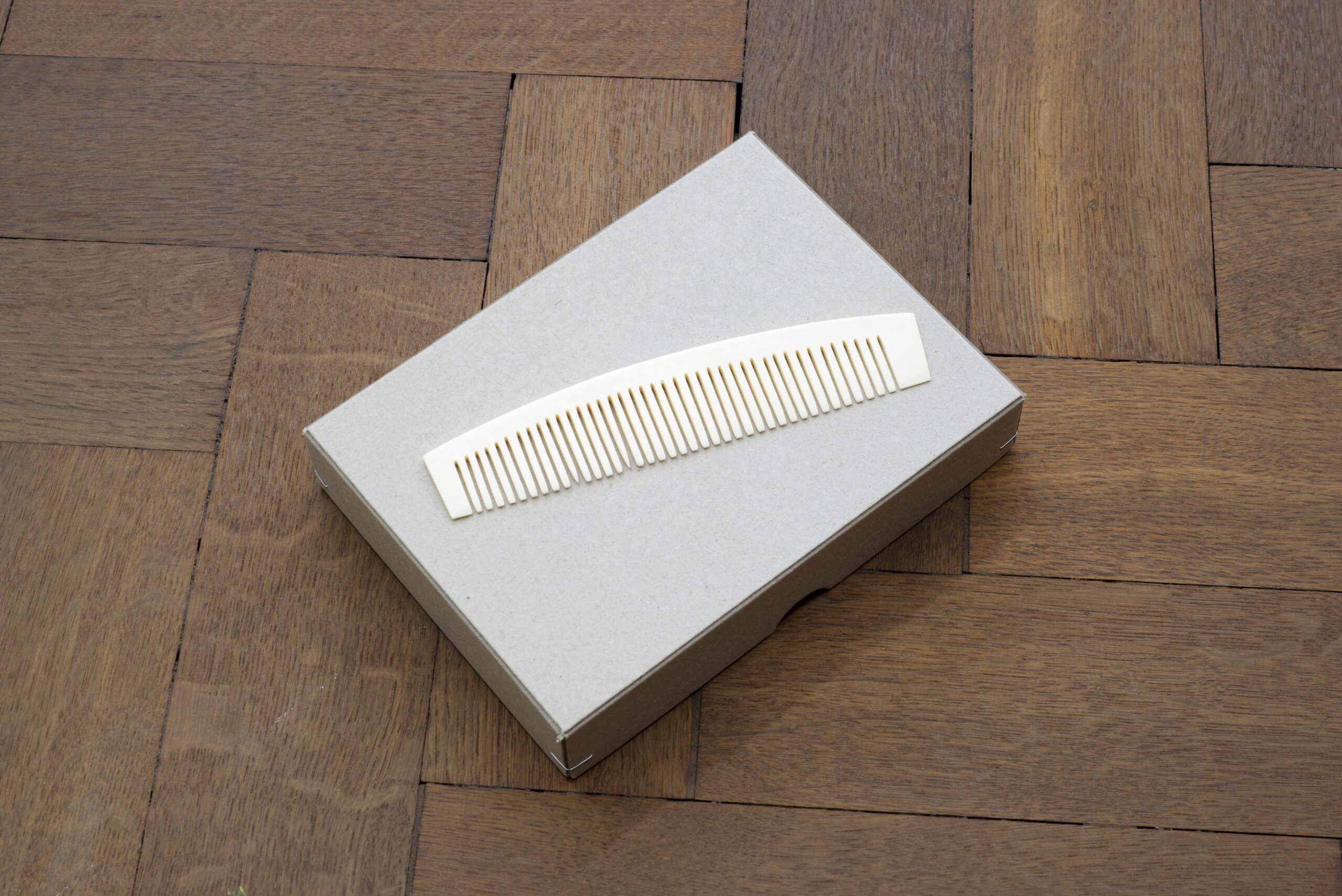
Flower, dew, 2021, two sharpened teeth on a comb, 15 x 3,2 x 0,5 cm - (…) a bone comb with two teeth sharpened to points. The work alludes to the many versions of the myth surrounding Cleopatra's alleged suicide. (…) about how leaving a snakebite on your body, real or fake, is a guarantee to a next life. The comb negates the image that the title suggests. We don't see a dew covered flower at all. (…) Vrancken is not only invested in the meanings to which he wants to refer, but also with how he wants to refer to them. Flower, dew (2021) is a complex dance in which Reinier challenges us to search for meanings in all layers of the work.
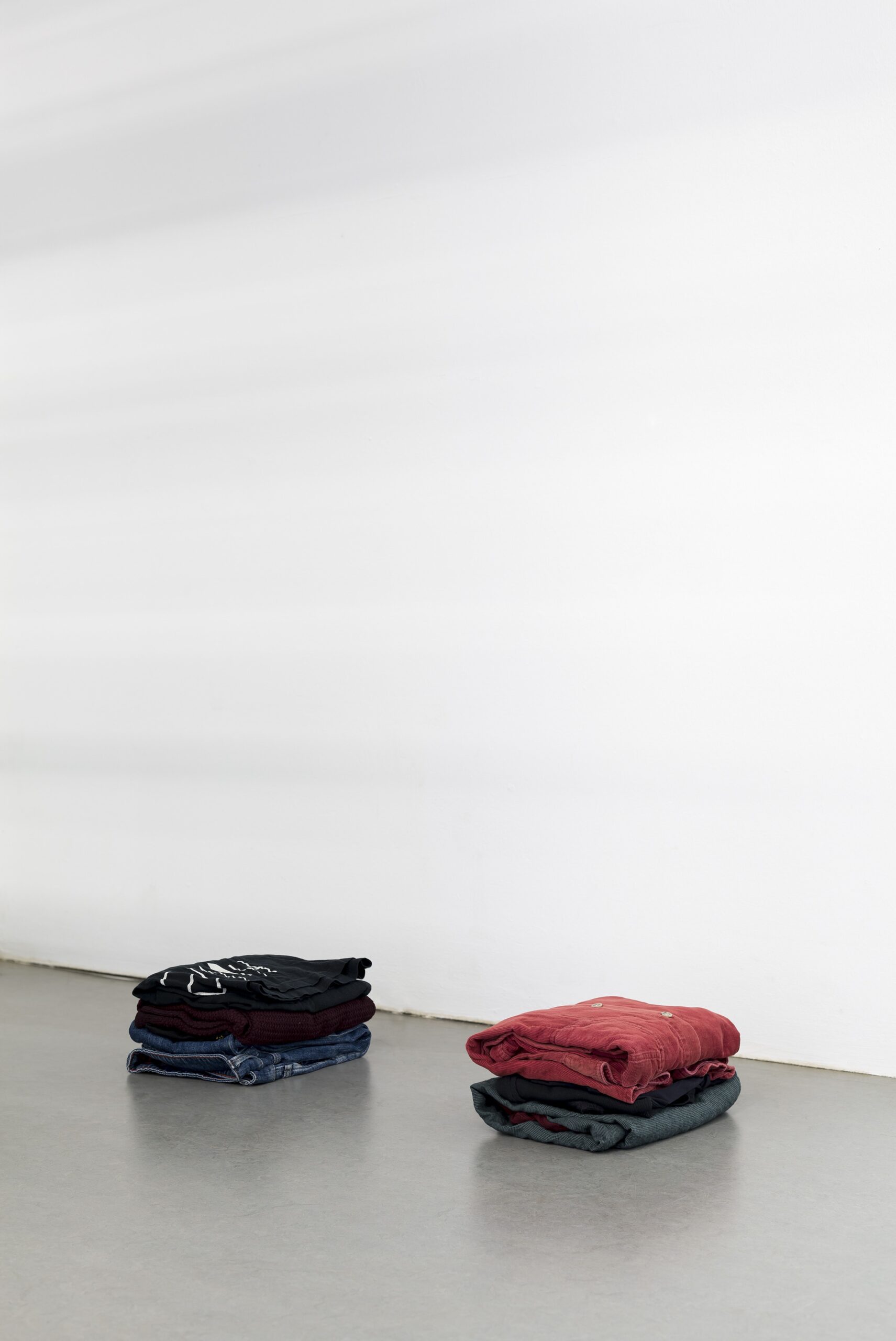
—Linda Köke, 2021 Rob's clothes and Emma's smell, Emma's clothes and Machteld's smell, 2021, 25 x 20 x 15 cm - (…) is part of an ongoing work in series. The piles of clothing on the floor are on loan. Each pile carries a smell other than its owner's. Emma's smell is in the pile to the left, and her clothes are in the pile to the right. Identity shifts, but only half a place. Every outfit is passed to another individual to be washed, who in turn lends out his or hers, establishing a chain of passed-on clothing and changing smells. A relay of appropriation and expropriation. In Everybody becoming everybody else, Vrancken redefines the borders between one individual and the other. In doing so, he creates the opportunity to propose new wholes. (…) are always strangers to one another, who (…) have the silhouetted Vrancken as their common factor.
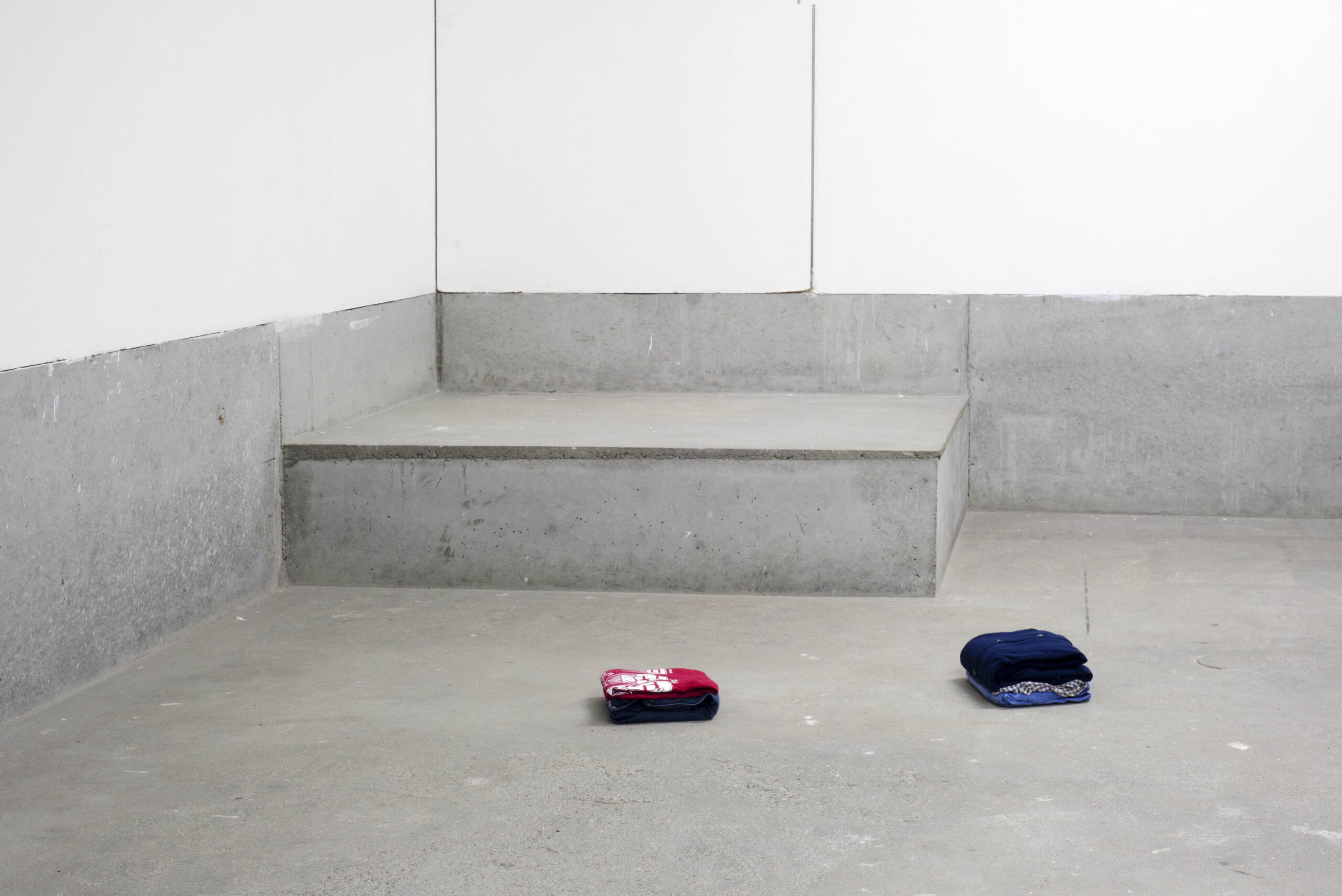
—Machteld Leij, 2021 Machteld's clothes and Émile's smell, Émile's clothes and Marjolein's smell, 2022, 25 x 20 x 15 cm - (…) is part of an ongoing work in series. The piles of clothing on the floor are on loan. Each pile carries a smell other than its owner's. Emma's smell is in the pile to the left, and her clothes are in the pile to the right. Identity shifts, but only half a place. Every outfit is passed to another individual to be washed, who in turn lends out his or hers, establishing a chain of passed-on clothing and changing smells. A relay of appropriation and expropriation. In Everybody becoming everybody else, Vrancken redefines the borders between one individual and the other. In doing so, he creates the opportunity to propose new wholes. (…) are always strangers to one another, who (…) have the silhouetted Vrancken as their common factor.
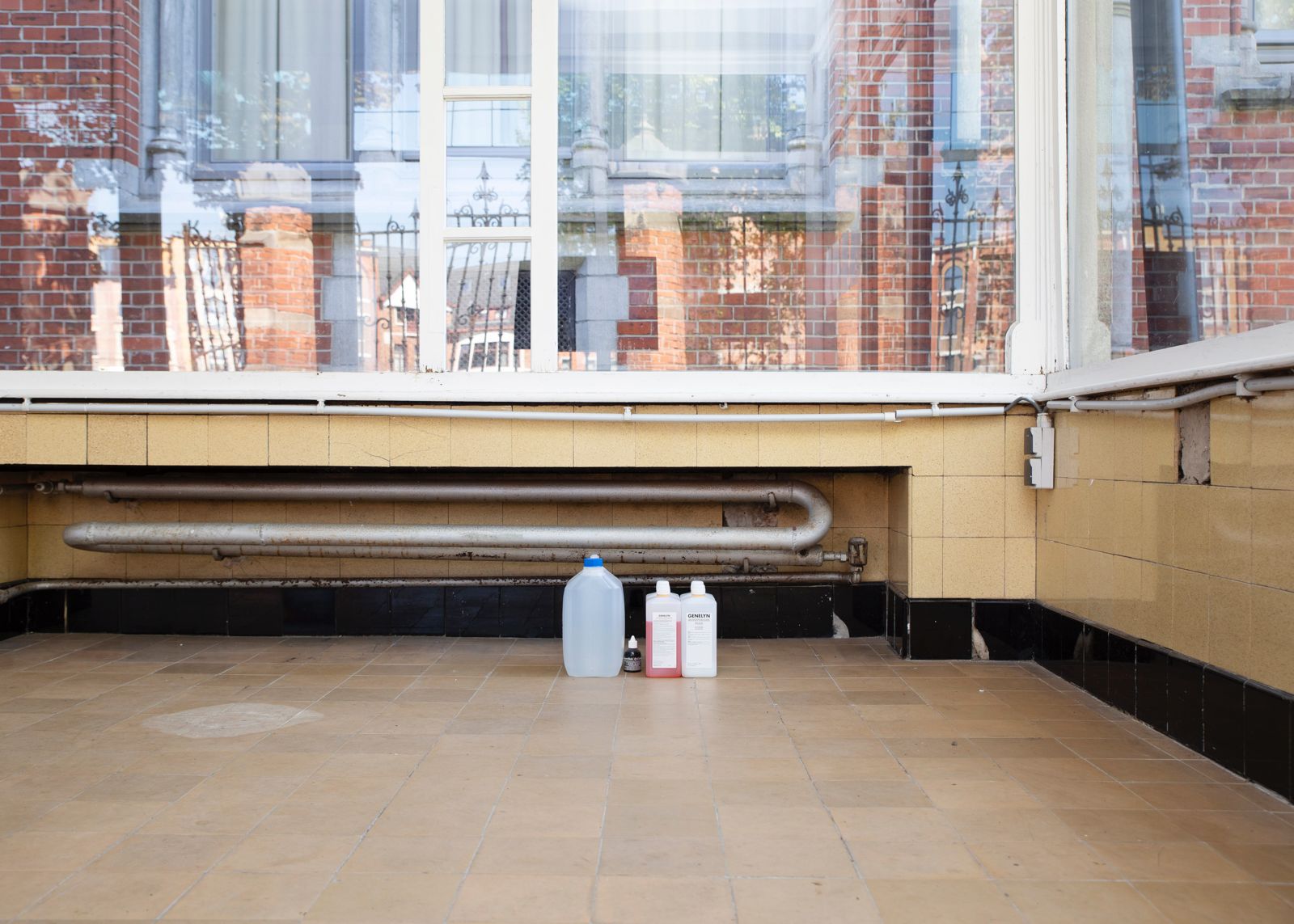
—Machteld Leij, 2021Embalming formula composed to give appearance of marble, 2021, dimensions variable -
(…) Vrancken's works are propositions to interpret the amalgamation of conceptual, semantic and poetic leaps and conceptions that are ascribed to seemingly autonomous objects and words around us. (…) The title is borrowed from the final line of Thomas James' poem Room 101 whereby the protagonist narrates how he is slowly turned to stone. Notions of preservation and transfiguration are pushed further when the title is juxtaposed with what is on display: different bottled fluids Vrancken obtained after working with a professional embalmer. (…) the look and feel of marble.
—Christina Li, 2021
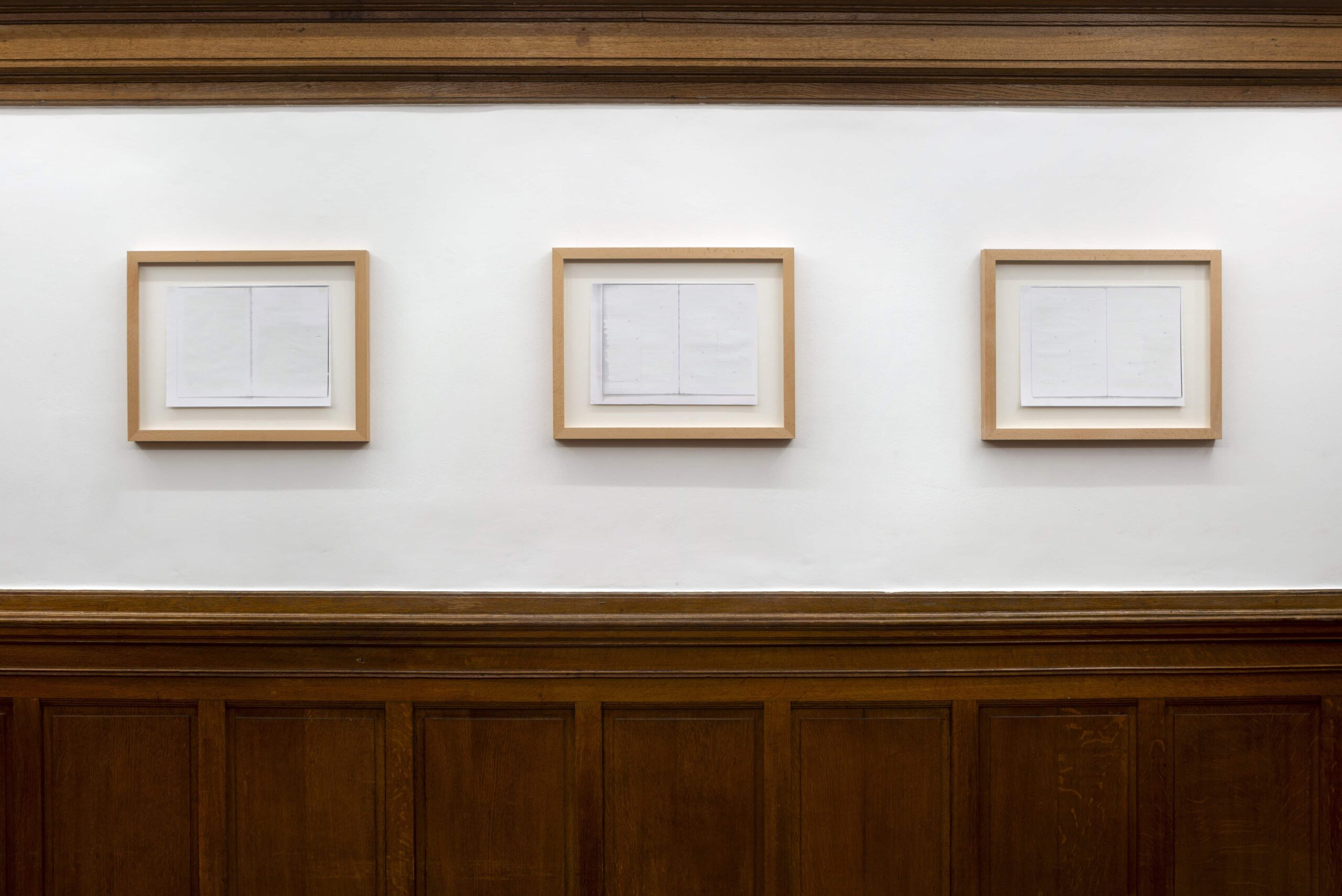
Bas Jan Ader's marks in The Boy Who Plunged Over Niagara (Elliott, 1962), 2019, corrected photocopy - Sitting on a chair, legs crossed (…) Reader's Digest open in his lap, he reads. At specific moments in the performance, he sips from the glass of water on the table beside him. Ader marked 26 moments in the text at which he would drink his water. In Te lezen vallen, Vrancken used correction fluid to remove all except for the notations from a copy of Bas Jan's original Reader's Digest. The text ends up in a liminal space between reading and seeing. (…) crosses (…) x's (…) Falling (…) fall (…) fall (…)
—Manus Groenen, 2022
We gebruiken functionele cookies om ervoor te zorgen dat onze site zo soepel mogelijk draait. Daarnaast gebruiken we cookies om de bezoekers van de website te analyseren.