Santiago Pinol

Educatie , Dekolonisatie , cross-over , Conceptueel , Artistiek onderzoek

I work as an undisciplined artist, situating my practice on the shore between art and education. In my work I explore the logic of social and political power and its effects, focusing especially on processes of (in)visibility and (in)materiality; in language, visual culture, work, architecture, everyday life. Responding to my immediate context, I create installations, interventions, cultural platforms and ephemeral schools. Since 2010 I alternate between my individual practice and work in collaboration with the garage school and CARNE Gallery.
The international day of non-abstraction
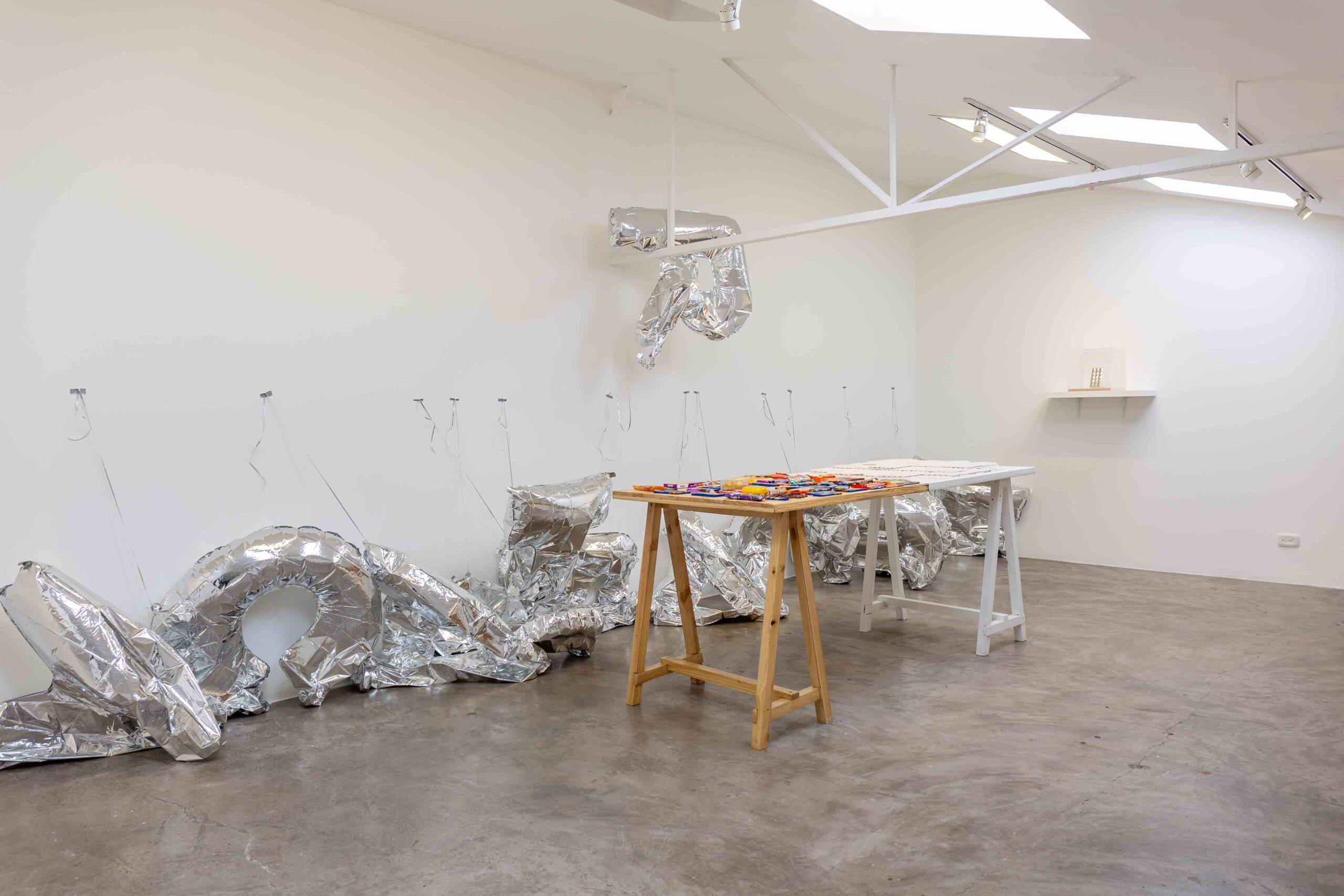
The international day of non-abstraction - The international day of non-abstraction. SGR Gallery, Bogota, 2024. Imagine a world where a holiday with this name would be possible, where for one day it would not be possible to exchange with money, but only by barter. Where money would be worthless. It would be a holiday to reflect on the value and abstraction of the economy, making evident the fragility of monetary systems and the transactions we take for granted. Even if only for a day. In this exhibition some “chocolate bars” were not what they seemed: made of plaster, these pieces were an invitation to barter: in exchange for a real chocolate bar, you could take one of these sculptures. With some humor, the exhibition played with the irony of assigned values, reflecting that abstraction is not only a matter of art, but of our economies and historical narratives. From sphere to bar Cocoa has been consumed in Abya Yala for at least 5,000 years. The cocoa tree is native to the Amazon, from where it began its journey to other territories, passing through many hands and cultures. For the Mayas and Aztecs, cocoa that was not immediately used to make a beverage was turned into a solid for transportation and storage in spheres. In this form it also served as currency, one that could perish. Circulation on accumulation Cocoa was introduced in Europe at the beginning of the 16th century, possibly already in its solid form. At first it was consumed mainly by the aristocracy for its aphrodisiac properties. It is not known with certainty when and by whom the first chocolate bar was made, but it was around the 19th century. The manufacturing processes of a modern chocolate bar were developed independently by chocolate manufacturers in different countries. At that time cocoa goes from liquid to solid, from sip to bite, from sphere to flat, from cocoa to chocolate. A process of abstraction. Likewise, a fundamental part of modern chocolate bars is the aluminum that protects/suggests them. It represents that promise of “something more” that objects hide, of an unfathomable enjoyment whose true location is fantasy.
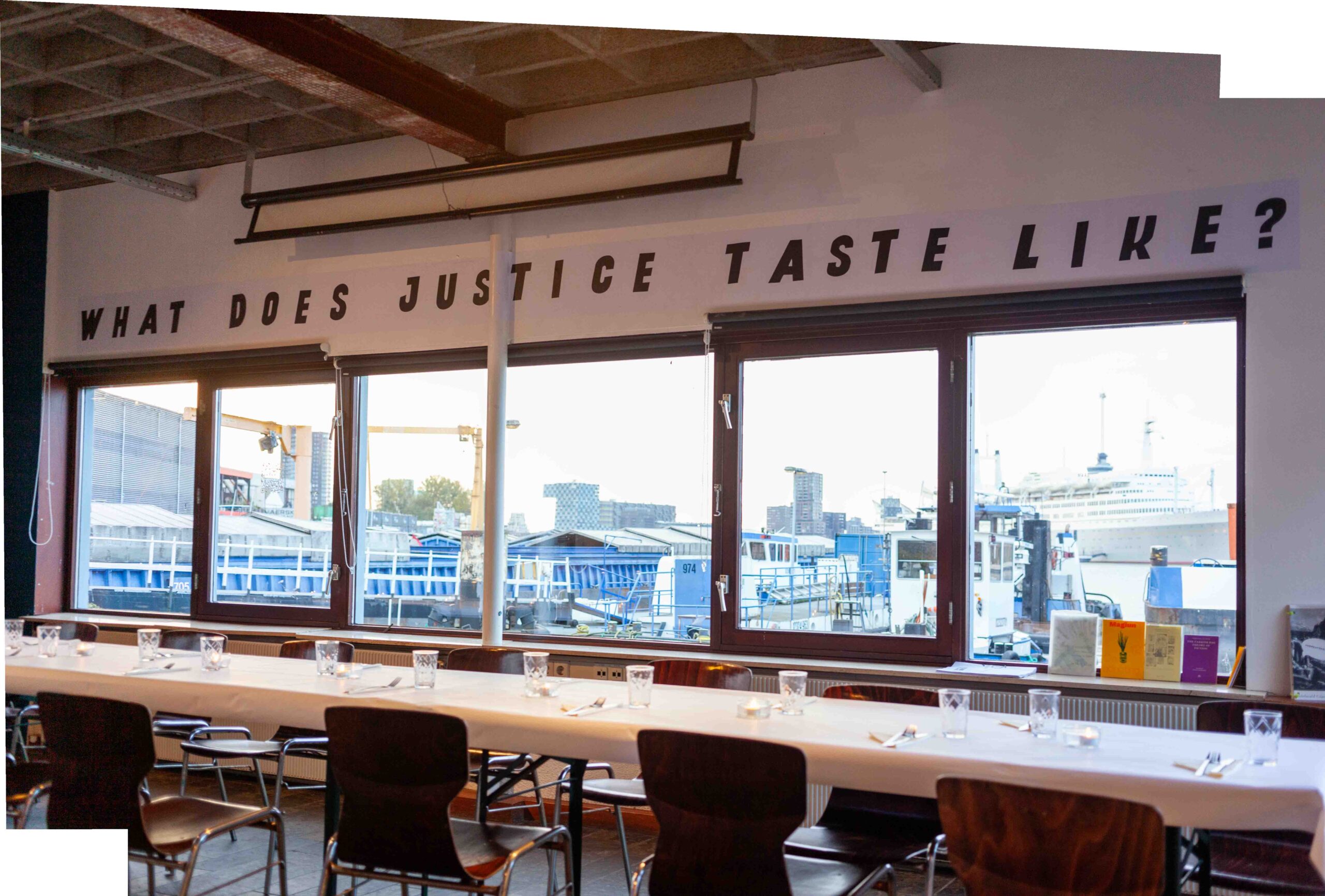
What Does Justice Taste Like? Garage School of Medicine at Paviljoen aan het water
What Does Justice Taste Like? Garage School of Medicine at Paviljoen aan het water - ‘What Does Justice Taste Like?’ an open ‘school’ at Paviljoen Aan Het Water and an open invitation to participants to experience a diverse array of conversations, workshops, cooking sessions, meals, and multimedia works around the subject of food justice, food sovereignty and food as medicine. All events (apart from solidarity meals) were free to attend. Garage School of Medicine's presentation consisted of seven public events over 4 weeks: We explored concepts of deep medicine, health justice and the politics of food. We asked questions about who has access to healthy, nutritious food and who has time to prepare healthy meals for themself and their families. Creating more equitable access to healthy, delicious food and sharing knowledge about how to prepare it is surely one of the cornerstones of a health justice framework. We invited two existing community kitchens (Basic Activist Kitchen and Het Rode Keukentje) to collaborate with us. These collaborations will happen as two evenings of cooking. Guests payed what they wanted (€20 minimum) for a three-course Solidarity dinner. After paying the material costs (food) all proceeds will be donated to Medical Aid for Palestinians. The meals were plant-based and vegetables will be sourced from local biological farm Landzicht (Strijen).
The Garage School of Medicine @ Research Interrupted, BAK, Utrecht
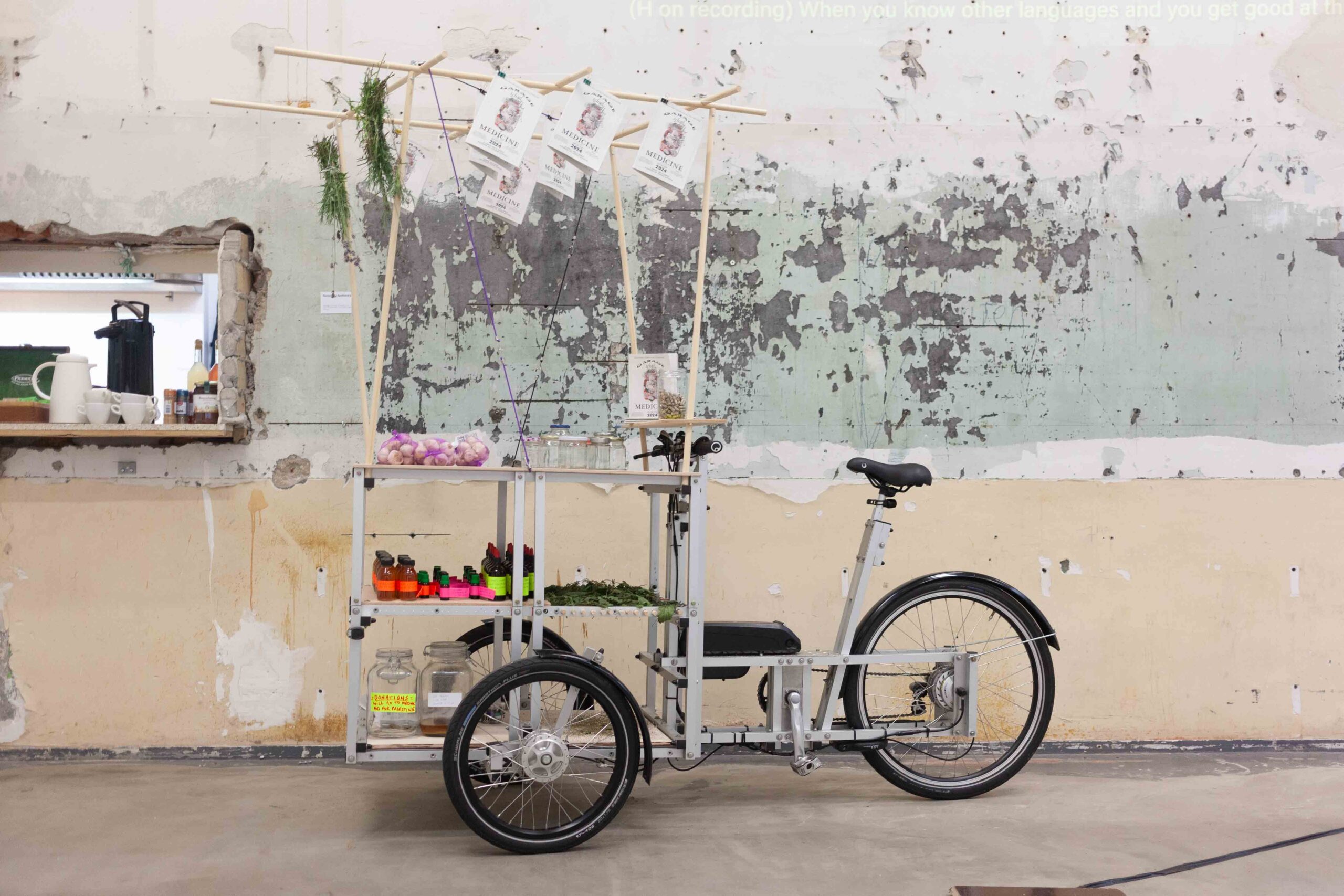
The Garage School of Medicine @ Research Interrupted, BAK, Utrecht - Garage School of Medicine received support from CBK to publicly present our research at ‘Research Interrupted’ at BAK from the 23rd - 28th July 2024. This presentation brought together all research fellows from the fellowship for situated practice 2023-24. Garage School of Medicine's presentation consisted of several elements: The Community Apothecary workshop was well attended beyond our expectations(!). We asked participants to bring to the session a home remedy from their own context, or any ingredient that supports them and/their community, for example a herb, fruit, spice, a pill. If they did not have a home remedy in mind it could also be a plant that is otherwise significant for them. After making a brief presentation of the school research each of us shared our contributions to the apothecary: burning of peganum harmala for the evil eye, sage, spit and ash, saffron, laurel tea, nettle tea, mallow flowers, etc. These ingredients and what to do with them will be added to a second edition of the publication we presented that day. After this we invited participants to, alone or in collaboration with other(s), devise a remedy (recipe, ritual/spell) for someone or something else. They could incorporate ingredients we gathered there on that day, or that they could find growing nearby, on the street, for sale at the market, supermarket etc. To help we made a guide to a nearby public physic garden called Pandhof st.Marie. We closed the session with a reflection on inflammation under late capitalism and with a cooking session of remedies with honey: An anti-inflammatory spread with turmeric, honey, coconut oil and dried spices, and a fermented garlic honey. We presented the Mobile Apothecary on the XYZ BakFiets we made together with architect and bike mechanic Tomi Hilsee from Doe Het Zelf Werkplaats. The display contained both the text/booklet publication we produced and a series of ‘expanded publications’ in the form of distilled/ infused remedies and a ‘mobile herb garden’ seed bomb. The design we opted for kept the BakFiets quite open, effectively a series of shelves and table top with an awning. We arrived at this design both because it is reminiscent of informal street stalls that might sell sweets, cigarettes or home made street food and also because it allows maximum adaptability; the bike can be a structure for display or mobile work space. We agreed with Tomi that the design would be iterative; this initial structure was a first test to see what works and what doesn’t. Visiting members of the public were invited to take anything they wanted from the apothecary with instructions on how to use it and if they wanted could leave a donation for Medical Aid for Palestinians in exchange. For the Publication booklet we printed a two ink Riso limited edition of 50 booklets (also available online) with the help of Ook_huis Riso printers and expertise. The booklet included an insert by Adaptör Projekt (Sıla Bozdeveci and Gülşah Özgen) who contributed an extract of their research "hapsedilmiş araçların feminist eleştirisi" (A Feminist Critique of Imprisoned Tools).
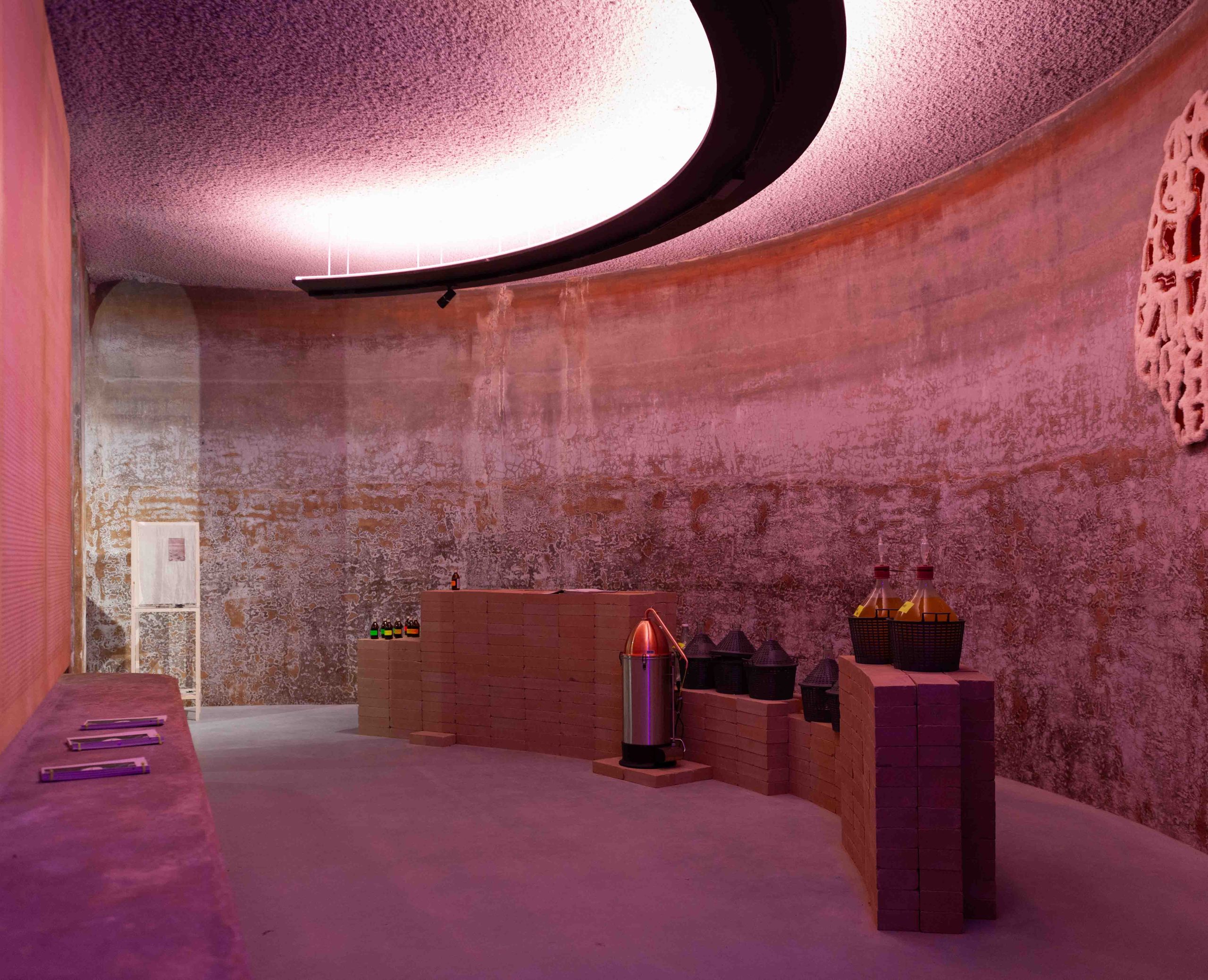
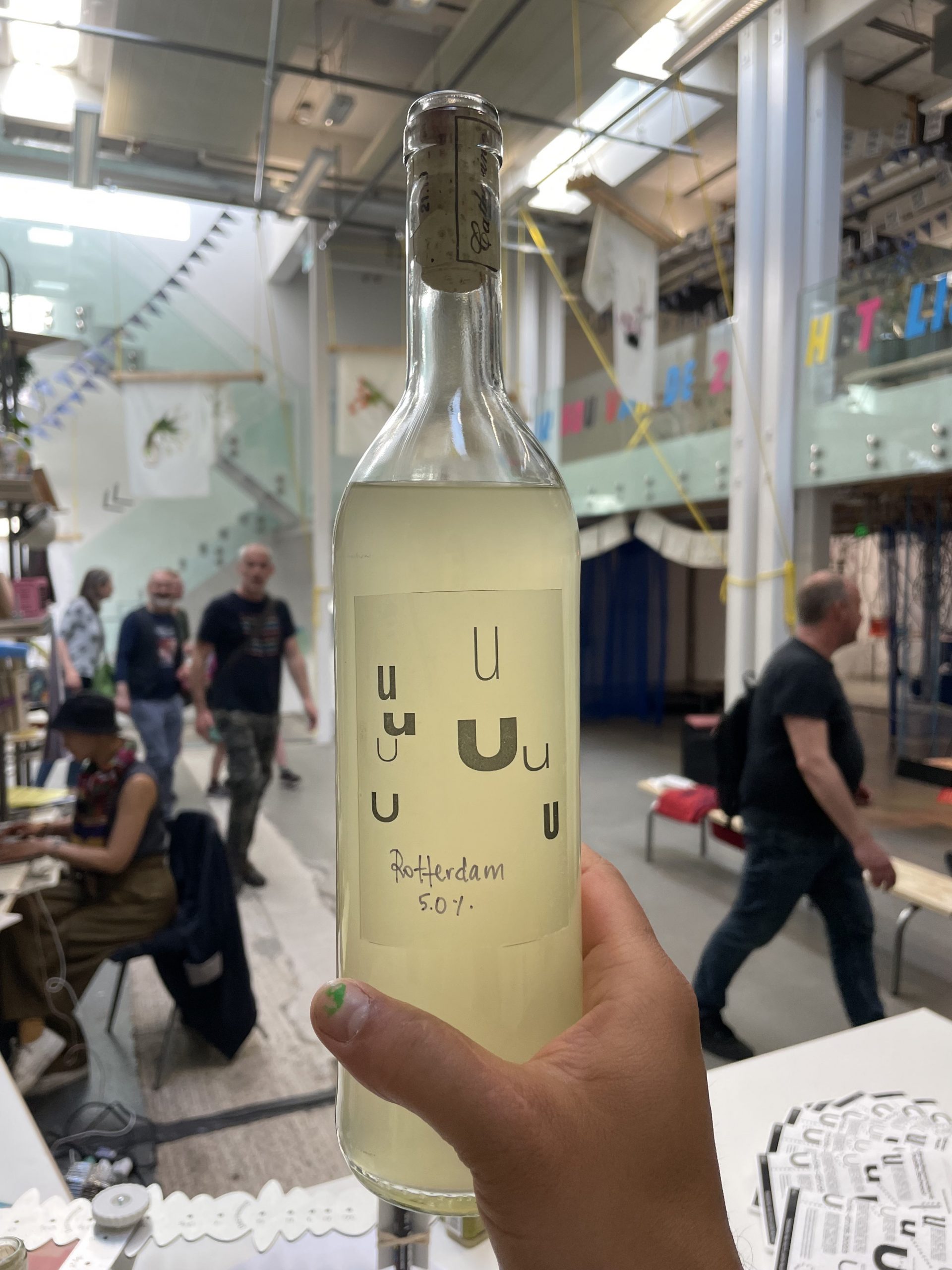
“garage school: underground” (Radical Symbiosis: Social Life with Microbes) 2023 @ Radius - The “garage school: underground” was a response to the architecture of Radius CCA in Delft, the other artists (Radical Symbiosis: Social Life with Microbes), long term non-human collaborations, and specially the celebration of the “Antoni van Leeuwenhoek Jaar ”. Emerging from a proposition of decentering a universalist ontology based on vision and transparency, we went underground to explore the possibility to imagine and meet otherwise. The school had many moving parts, gestures, details: - a bar made with compressed soil bricks with a fully functioning distillery located at the belly of the exhibition. - a free printed “bootleg reader" with texts contributed by the ecosystem of Radius: the other artists, curators, and staff. - an expanded, multisensory publication in the form of a short run edition series of bottle publications. The bottles were labeled with texts about the history, context or use of the spirit we distilled and fermented: honey spirit, black berry spirit, malt wine and mead. - three sessions that happened after hours, when the exhibition closed to the public (toxic) soil study group (Kari Robertson, Canach McBride, Michelle Teheran, Fleur, Skye). Each of the five members brought one 'ingredient' to the conversation , hospicing and gathering. The movement from one ingredient to another was an easy going conversation, between friends, each finding relationships for moving between one ingredient to the next. Hosted by Guillem Arquer and Kate Price we dipped our senses into 12 delicious samples from different communities in Rotterdam. We played and tried to connect our impressions with their refined descriptions of the samples, all while playing darts and drinking games. Last was an “Intersemiotic under-trance-lation” session by Decolonial (re)mediators (María Angélica Madero + Santiago Pinyol) feat. Laura Emsley. We went on a profound exploration of imagery: guided by the concept of the mind as an underground cave, we delved into the deep subconscious. And drawing inspiration from the ancient Paleolithic era, we tapped into the collective memory of humanity, from a bottle neck moment in history when there were no more than hundreds of us. We thank all, human and non-human, who visited and participated in any measure. To the Radius team (for all the care and labor), Oksam (for the bricks) and to CBK (for the support) ??
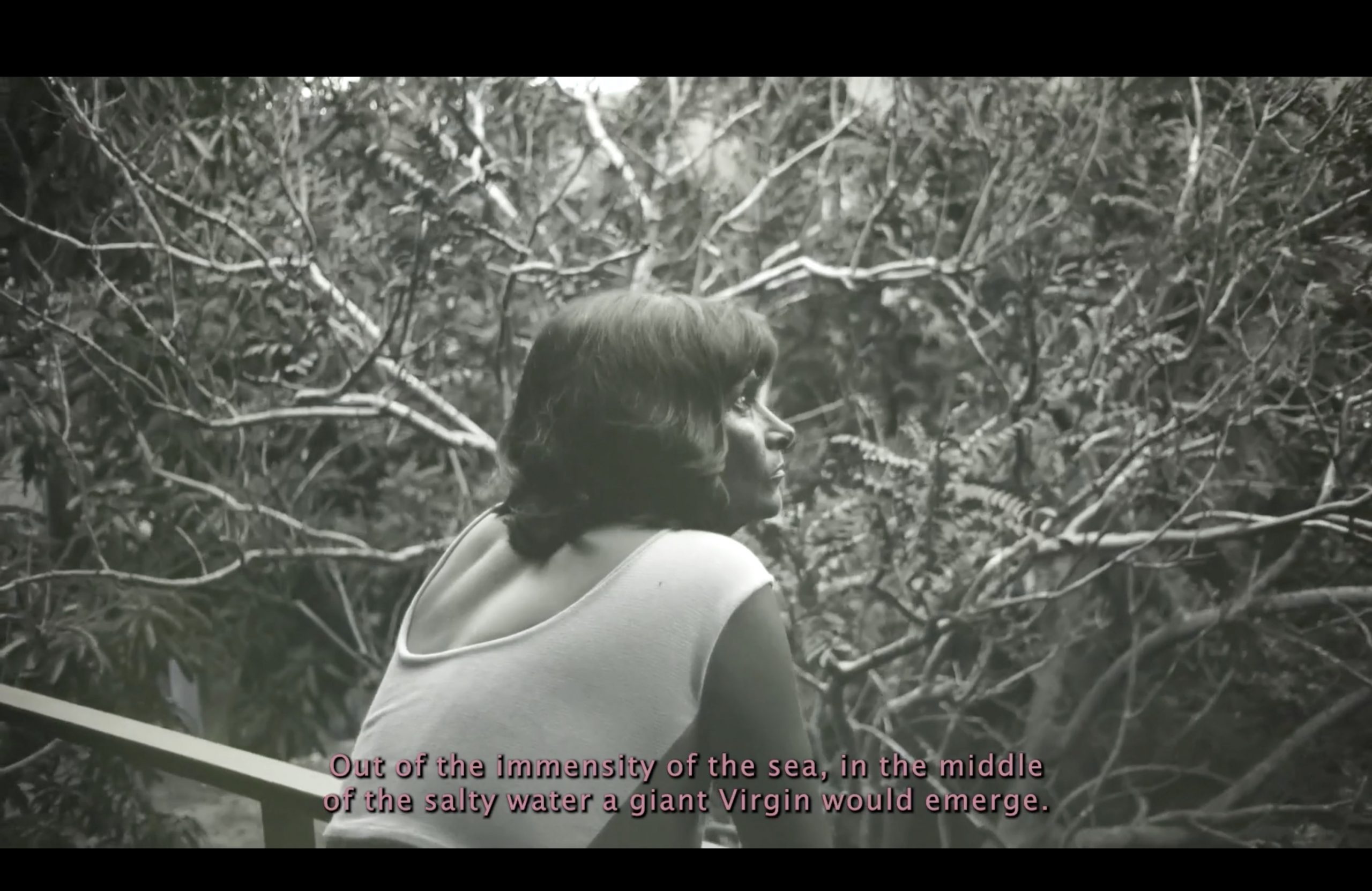
the shadow of the plum tree. (group show, próximamente, Barranquilla, Colombia) - "La sombra del ciruelo" is a trailer for a feature film that does not exist. A work made in a couple of days that starts from talking to Maria Isabel about the unbearable heat right now, and how the plum tree in her garden - which normally works "like clockwork" - has not yet borne fruit this year. The trailer shows glimpses of the conversation with her over a couple of days, touching on theories about photography, about the visible and the invisible, about the change we are living through and how the non-human registers it. Looking for the invisible and listening to this register, the images document the ultraviolet spectrum, made with a multispectral camera. In the trailer, Maria Isabel reads a dream that translates and communicates with the feeling of this moment of the end of a world.
what there is of others in us (solo show. Sgr Gallery. Bogota) - In 2017, a swarm of bees colonized the statue of George Washington (Carrera 10 con calle 26). Made by Luis Pinto Maldonado in 1963 to commemorate John F. Kennedy's visit to Bogotá as part of his Alliance for Progress tour, a program designed to contain communism in Latin America. It was the bees that entered and left the crotch of the statue that revealed the Washington Monument to me. As Robert Musil stated: "The extraordinary thing about monuments is that you don't look at them. There is nothing in this world as invisible as a monument." With this research I am interested in understanding the action of occupying the statue by the swarm as a form of non-human deliberation within the open debate on monumentality and memory at this time. What effects can this occupation have? Can this process affect the materiality of history? Open history to other gestures and languages?
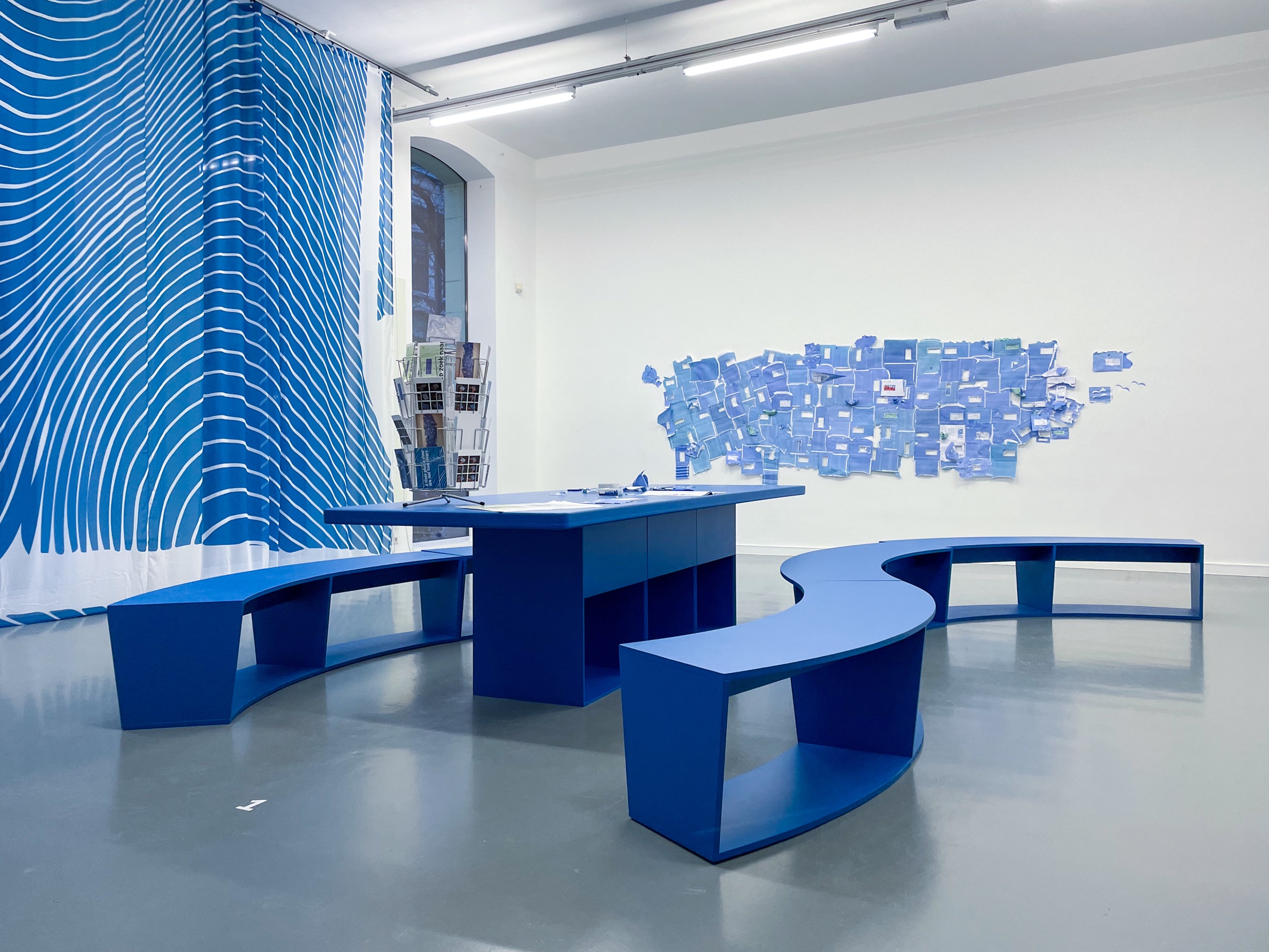
a river plus a river are not two rivers: a temporary support office for those who fear closed envelopes - Dear Rotterdam, After many office days with countless conversations and all sorts of contributions, the envelope collage was carefully wrapped in the company of Marika, Linnea, Darly and Anke to be mailed back upstream to the "Ideas and suggestions" department of Gemeente Rotterdam. The temporary support office for those who fear closed envelopes thanks everyone who trusted the project and joined their rivers, brought their envelopes, share stories or opinions, wrote messages, bureaucratic poetry, insults, suggestions, made drawings, origami, hearts, monsters, architectures, middle fingers, and in general improvised from their muscle memory of doing something with paper. In the end, the collage is a sum of many feelings, from love to anger, and went from trying to do something big to a very detailed landscape. And no, I do not expect a response (but I am open to it), and the conversations about the imaginaries of power, violence of bureaucracy, state theory, the personality of the state, design and power, the feelings we have about institutions (and hopefully how to reverse them) were kind of the point. Of course, the team acknowledgments: cannot thank enough Marika, we edited, read, archived, had fun and felt like a collaboration. Special thanks to the teams of mediators Simon, Tracy, Floor. And to all the teams at Tent: Judith, Esther, Aletta, Jordy, Menno, Raquel, Darly, Dico, Eden… And of course to my partner Kari @firmlarvae for having the patience and supporting all the extra-time that the office demanded… Thank you all, *This project was part of exhibition There is no party so noisy as the one you're not invited to, curated by Linnea Semmerling.
ultradependentpublicschool. (Fellowship, group show. BAK, Utrecht. 2023) - The ultrahospitality node was a temporary cultural platform for diasporic affects and practice exchanges around the kitchen as a site of study. A place for those interested in working and learning with food activists and agri-cultural workers, in preparing and serving food as a way to gather community and enact communal forms of study. It is convened by escuela de garaje (Garage School), under the ministration of undisciplined artist Santiago Pinyol. The goal of the ultrahospitality node is to exchange, smuggle or try to translate recipes for survival, by making connections between the ongoing research of the escuela de garaje in Utrecht and its previous affects in other places. Its curriculum unravels informally in the experience of walking, sharing, and cooking together. The learning object proposed for the ??ultradependentpublicschool?? was a batch of 80 liters of wild fermented mead honey wine made from honey from Rotterdam harvested by Rauke (who I met in the fermentation school in 2020) and honey from Utrecht by Bijnkasten. ?? The process started it during the opening of the UPS, “culturing” that moment, a simple ceremony to capture who’s in the room and what was on the air that day. After that it was ?? happily stirred two times a day by many hands, sharing updates and signing in to keep track of who did it. ?? But, the fermentation became stuck at some point following the whole telenovela of the exhibition space being closed for one month, (half the running time of the UPS) and awoke again once the exhibition opened ?? to the public again (and when we balanced the Ph with Potassium bicarbonate). This mead was really a learning object in many ways, pushing us to look closely at the honey as a the unique substance ?? that it is, as a snapshot full of life of a moment and a place, to know more about the process of wild fermentation, about the history of mead (oldest alcoholic drink) geeking ?? by looking at ph, working with a hydrometer. All in all it connected us to the Utrecht and to each other, grounding us (why is grounding a synonym of punishment?) while reminding us ??of the climate crisis we are in, and the delicate state of the bee population at this moment.??
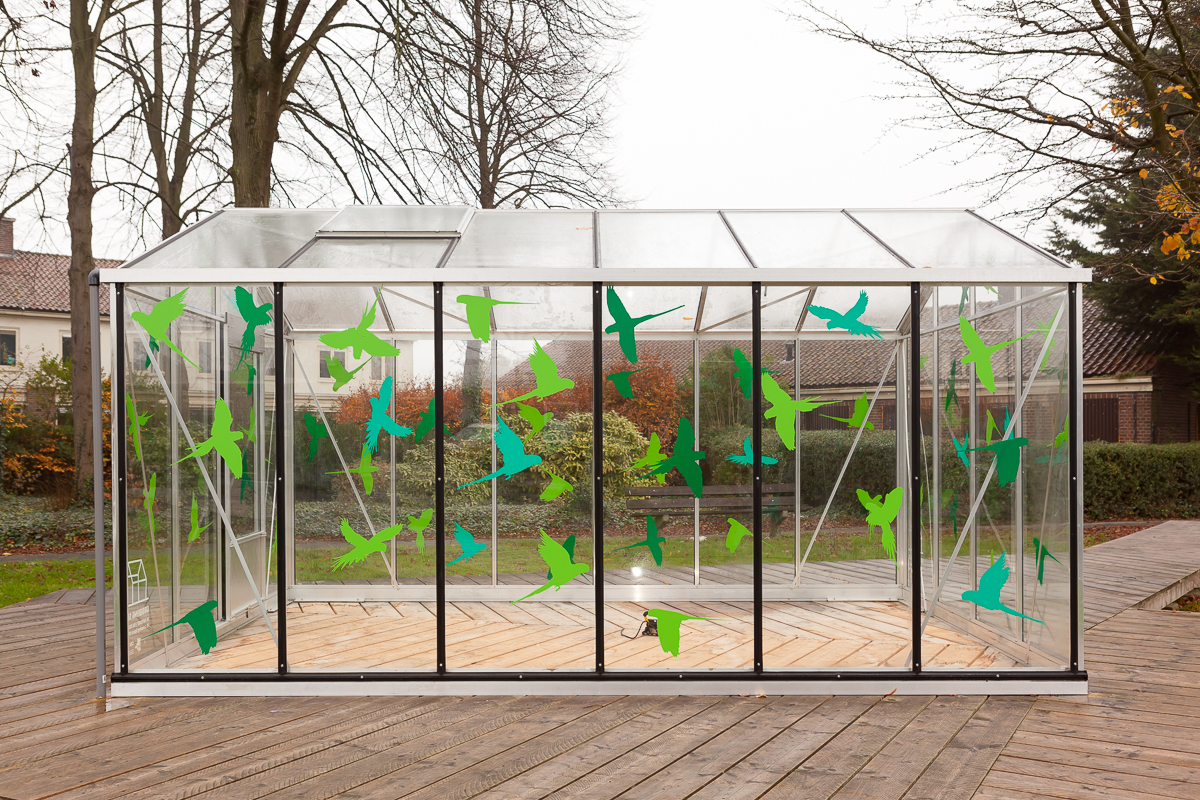
A Naked Palace. Growing Space. Rotterdam. 2020 - Public art installation. Vinyl cut "Vogelstickers" of parakeet silhouettes. Dimensions variable. When I arrived in the Netherlands two years ago one of the things that immediately caught my attention were some little green flying aliens. Soon it became clear to me that they represented how I felt. A little bit like the Bororos, the indigenous people of Brazil that fascinated european anthropologists and ethnographers, who proclaim “we are red parakeets”. And no, they don’t mean it metaphorically. But rather in a way of being in the world in a way in which the instruments of Western reason are lacking. At the same time in asking questions to others about them I realized that most narratives surrounding the parakeets are informed by a combination of urban myths and colonial tropes, complicit with exoticist world-views throughout history, revealing the connections between ecology, coloniality, and representation. The response to the growing numbers of parakeets in Europe has been uneven and contradictory; some governments and municipalities have gone as far as total eradication, laws to forbid feeding them, while some are “still studying the situation”. But they are also considered an example of successful synurbanisation; an evolutionary process whereby animals adapt to living in urban areas, a process that could, in turn, be applied to endangered species according to dutch ornithologist Roelant Jonker. Parakeets went from pets to pests, as some articles describe, leaving them trapped in a dichotomy that only allows for domesticación or erradicación mirroring extrativists view of nature. This discourse has normalized into one of politized ecology and of natural purism, which understand ecosystems as closed systems that fit into notions of landscape mired in the anthropocentrism characteristic of the nation state model. These new cases of non-human migration into urban centers have given way to the concept of ‘Eco-xenophobia’, which designates ill informed judgments and segregation of non-human actors marked by cultural ideas of what is native, what is alien, what is welcome and what is not. This view is historically linked to the colonial practice of classifying nature and everything in it, a fundamental part of processes of expansion and domination. When a species is categorized as exotic, it automatically creates a center and a periphery, and inside and an outside, that configures colonial power relations. The construction of the exotic is also exemplified in the history of institutions such as the Zoos, Botanical Gardens, and incipient Museum collections. In addition to these large ideological configurations, non-human animals lost their voice and political rights through this categorization. Perhaps now is a unique moment to act from “the importance of listening to animal voices, introducing ways to help us bridge the divide between the human and non-human world (...)” as Eva Meijer proposes in her groundbreaking work When animals speak: Toward an interspecies democracy.
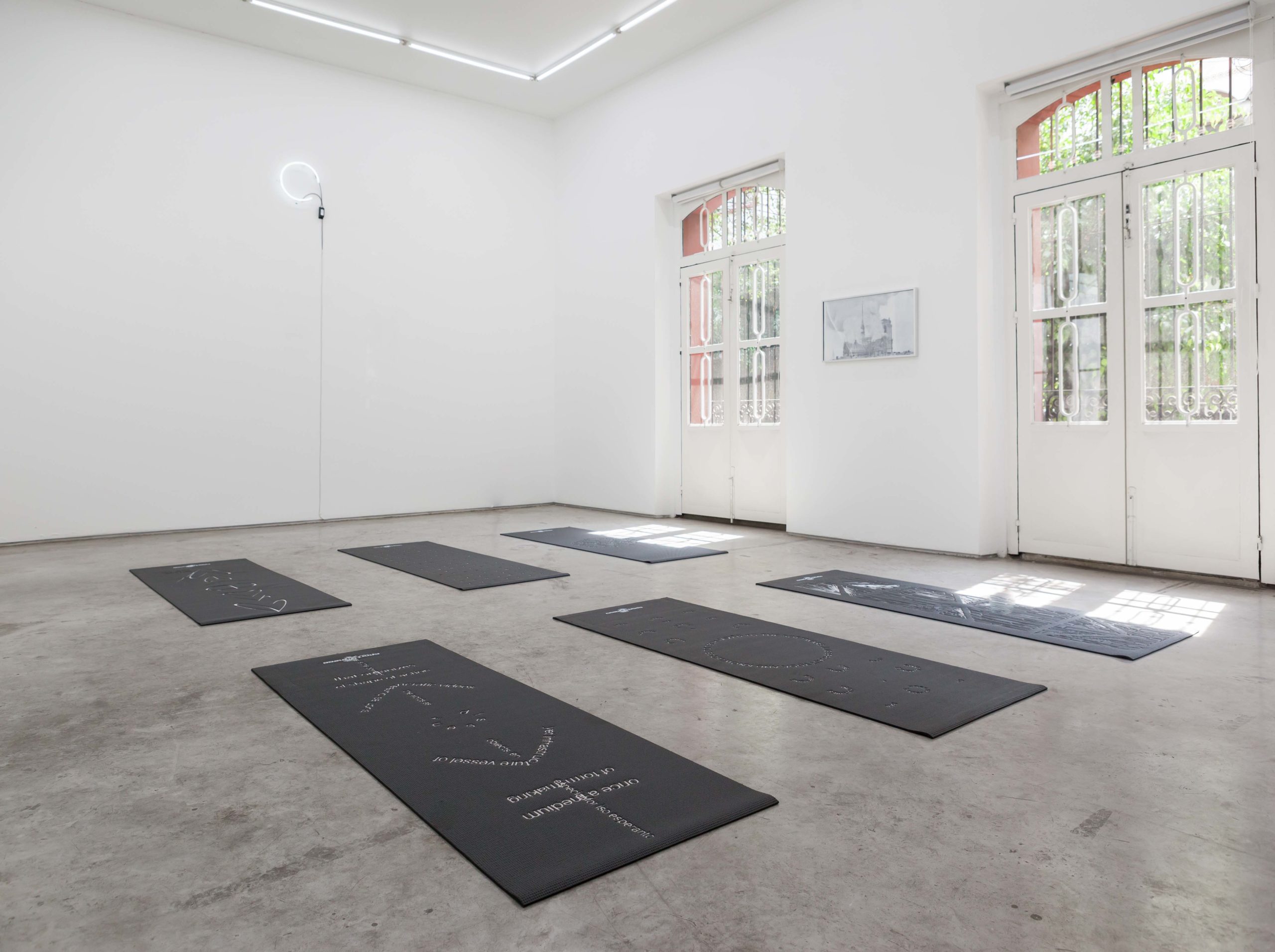
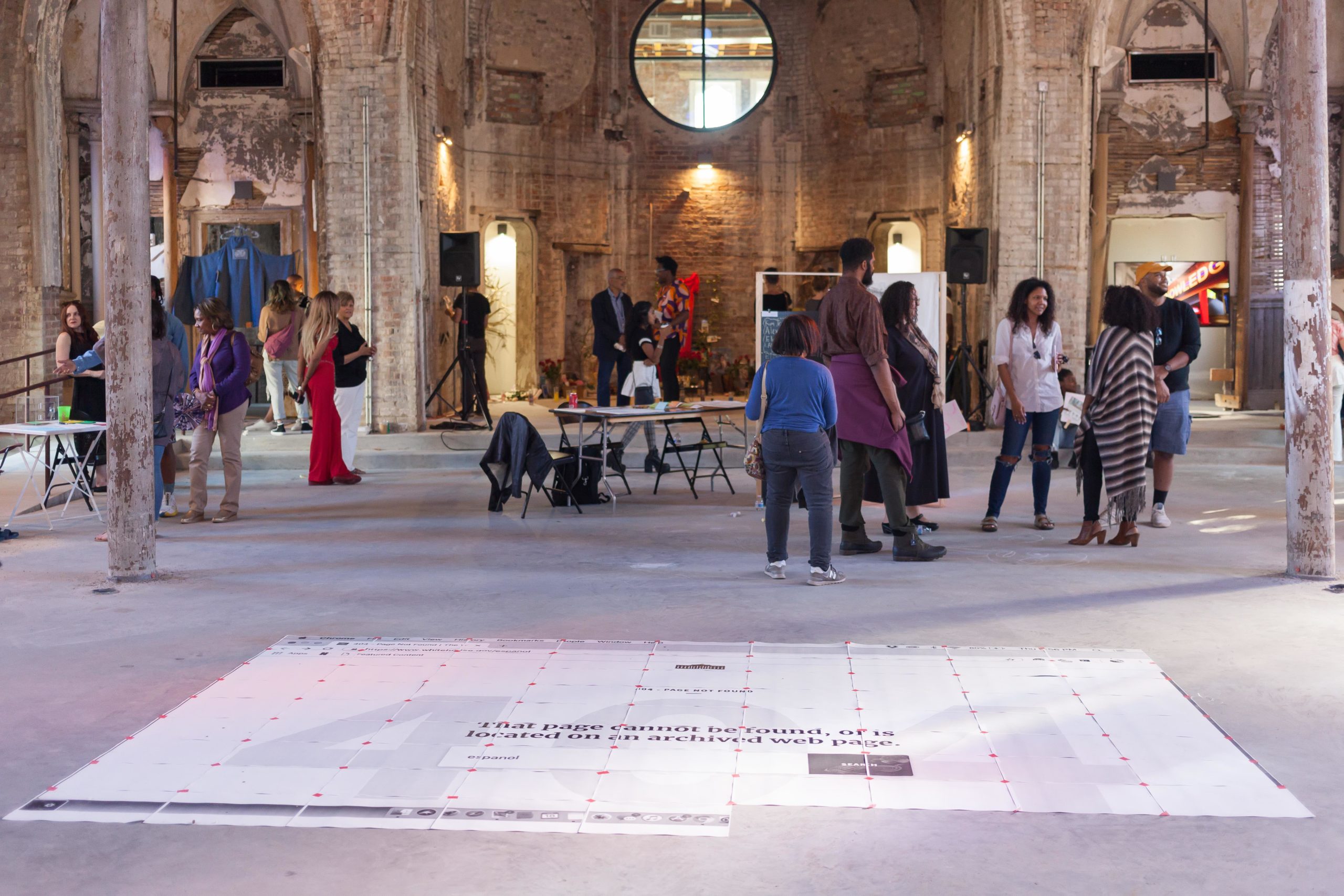
What has not been lost. 2019 Enrique Guerrero Gallery, México City. - Installation. Embroidered yoga mats, neon, screen printing on screen, other. The death of God as the sole observer and regulator of the body, through the notion of soul or second body, has involved the construction of other places of validation and social construction of the body. The eye is now precisely in society itself, whose gaze validates or rejects, codifies and regulates. This validation is no longer ethical but erotic, it is not a must be because the body wants the validation and acceptance of the desire of others, wants to be desired, which does not cease to have a deep anguish in the face of mortality and safe extinction of the species that also stimulate desire. In the background there is also a technological framework for the production of validation images, codes of behavior that regulate the spaces and moments of production of subjectivity. Sport is one of those spaces. Sport is first and foremost an idle activity, the temple of self-design and the factory of desire, it is the space where there is the time necessary for the formation of subjectivities. Idleness is precisely the time necessary for the formation of the subject as a civic, observant and critical being, not only operative and functional according to the Kantian distinction in which selfless contemplation in the contemplative life was the highest expression of the spirit. In the work of Santiago Pinyol, poetic intervention actions go beyond physical spaces to really intervene in their codes and in the invisible mechanisms of subjectivity production. The invisibility becomes evident precisely by pointing out the limit that separates the codes of the bodies. That limit is identified on the screen on which symbols of a waiting state or throbbers appear: the throbber is the previous symbol in the production of recognizable images, throb is pulpit, but more than a constant rhythm is an acceleration as a result of a stimulation. Precisely in place with sport, the moment of acceleration in the production of stimulating images. Pointing out the limit is a well-known resource of sacred architecture, composed of places that symbolize boundaries and thresholds between chaos and order. A sacred place is where you can see the divine or cosmic order that regulates us. The spaces for the sport fulfill a similar function, they are spaces of construction of subjectivities from codes of regulation and validation, perhaps the sport has always been a sacred space, Delphi testifies. Finally, the body is also constructed by overcoming it, not insisting on its corporality but on the opposite, on a condition of post-humanity or transhumanity. This path was opened by Lyotard when he asked if thought could exist without a body. The body exists before and after in language, it is part of a code or a technique, and the place of concrete poetry in the intervened objects is relevant here: poetry is an indirect way of accessing knowledge, even if it seems otherwise Due to the apparent deformation of conventional language, poetry, like the sphere, hides but does not deform. Alejandro Piñol
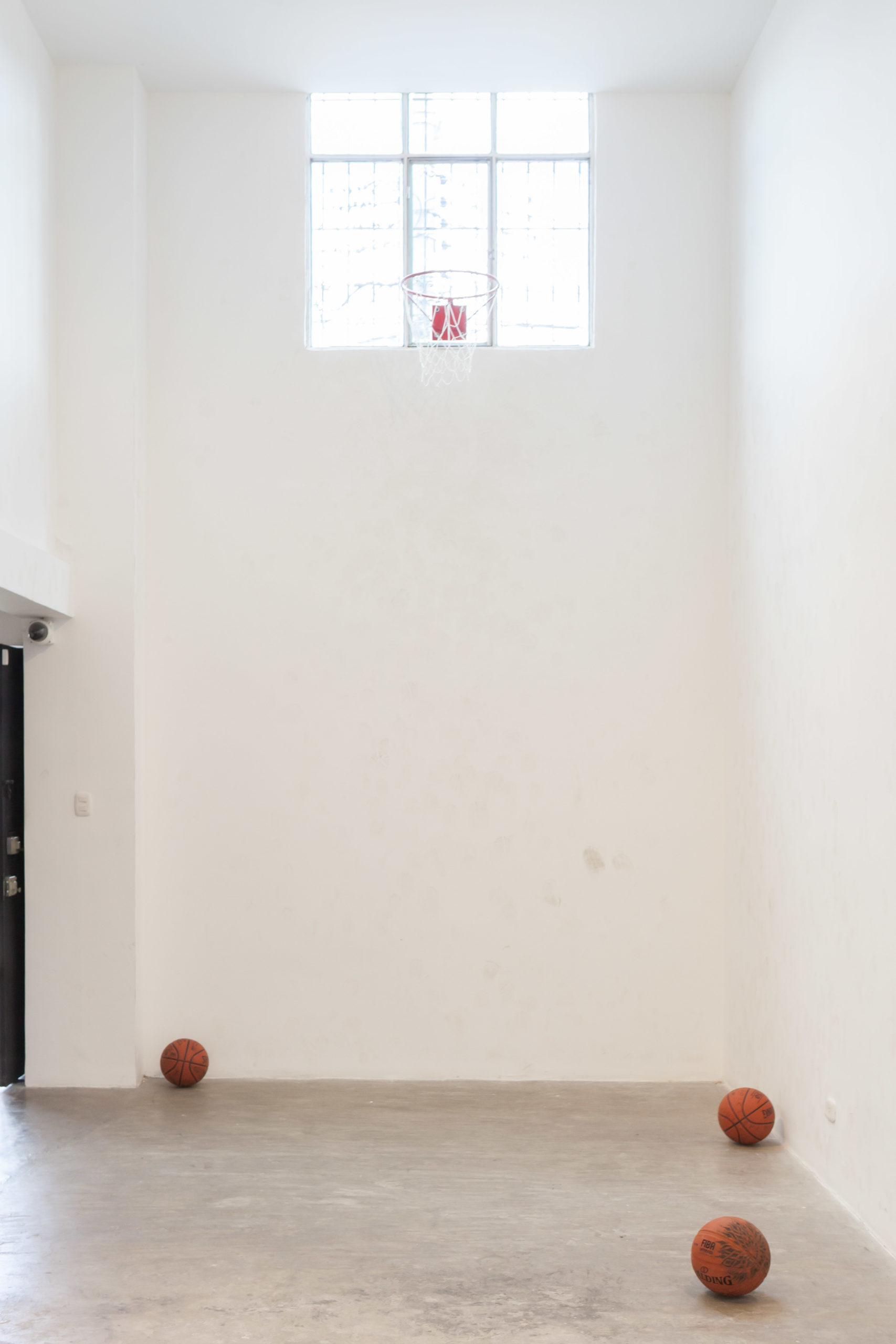
Before everything disappears. 2018. Sgr Gallery. Bogota. - Installation. Tattooed basket balls, other. Spaces or urban infrastructures are usually thought of as a collection of static volumes and objects that do not act. This is especially true for art spaces that supposedly function as anonymous places that offer only a background structure that disappears in the light of the works it hosts. In spite of the efforts to neutralize the differential characteristics of these spaces to guarantee the “adequate” visibility (and sale) of the works, their organization is active. There, grammars, codes and distribution logics are articulated that, far from being neutral, imply dispositions that exert a power and determine a behavior. These spaces are in themselves media or technologies that carry information, and that presuppose specific gestures and relationships between the bodies articulated therein. Pinyol refuses to maintain the idea of that supposed neutrality of the gallery that seeks to “disappear” to fulfill its function. Instead of occupying the space with objects, ready for sale, they carry out operations that emphasize that this space is not empty of meaning, and that from its volumes and distribution, information that has to do with its history can be made visible, on the one hand; and with its dynamics of power, institutionality and visibility on the other. Pinyol intervenes minimally the space and, rather, activates it through game and the event, as a way to show the ways in which space hides its forms of power, in the same way that technology tries to become invisible inside of everyday life to be more effective. In the case of technology, its invisibility also generates the illusion of neutrality, which makes it easy to believe that its codes, algorithms and processes are not mediated and impartial. As if they were not connected with human and non-human bodies, and ecological, political and economic systems. Through the exercise of emptying the space to transform it into a basketball court, and of inserting balls that are tattooed with theories and norms occupy the place of the body, those power relations that are established between the interface (the screen or the space) and bodies becomes more evident. The body that plays in space, which adapts to its conditions and rules, which is limited by borders and borders, as well as by the rules of sport itself, which is molded and transformed to accommodate technology and generate efficient choreography and productive between human and machine. But, perhaps, by proposing this space as a place of visibility, play and encounter, and not as a space that focuses on the object and its fetishization, a crack is also opening for technology to fail, for subversion to appear and the indiscipline; and new corporalities, choreographies, and forms of contact are generated that confront the naturalization processes of the norms and instrumentalization of the bodies. Throughout the exhibition there was a series of actions in which this basketball court was activated through games, classes and discussions. Alejandra Sarria
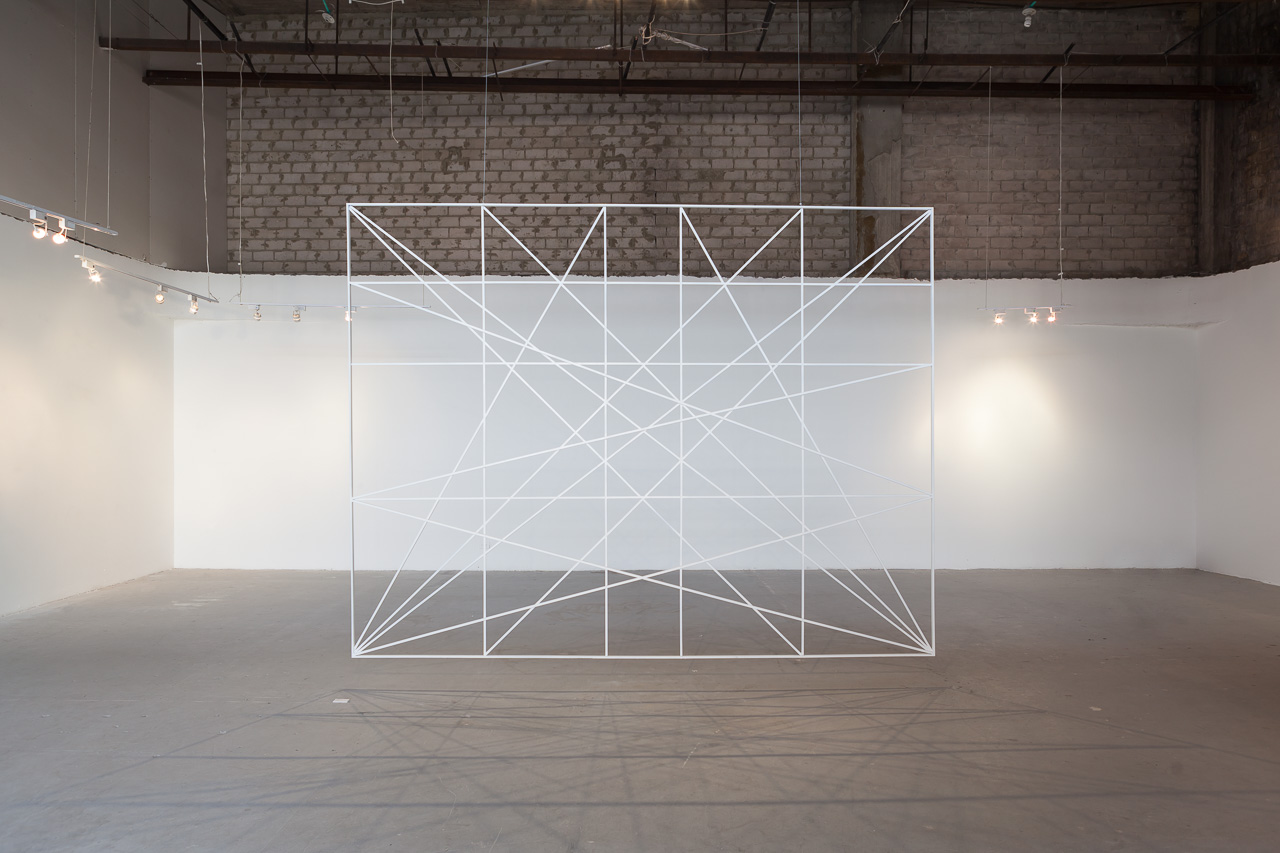
3rd May 1808. 2017. The space and the time. Espacio Odeon. Bogota. - Iron bars, electrostatic paint. 268 x 347 cms 1 painting as living dead There is an awkward relationship between reproduction and experience in art history and how it is taught in Latin America. It is a relation based on distance, reproductions in art books of masterpieces, works with which one never comes in contact beyond a discursive relationship, primordially textual. Curiously, we also witness a time when historical painting, and history in general, is being “revived” in an immersive experience through a “symphony of light and sound” from “a new way of experiencing art.” This fact can reveal both bureaucratic problems in the displacement of a historical work (permits, insurance, conservation, etc.) and an updating and mediation of the pictorial experience towards a contemporary, measured, calculated and, never better, spectacular phenomenology. This phenomenon can be seen represented in Van Gogh Alive, whose page can also read the following review “Gone are the days when the only way to appreciate art is by the work hanging on the wall of an art gallery … “ 2 parenthesis (After “Critique and Experience” by Bernardo Ortiz) John Baldessari’s The Best Way to Do Art reproduces a photograph of an airplane, a Boeing 747. Under the photograph a caption says: “A young artist at the arts faculty idolized Cézanne’s paintings. He looked and studied all the books he could find on Cézanne and copied all the reproductions of Cezanne he found in them. He visited a museum and for the first time saw a painting of Cézanne in real life. He hated it. It looked nothing like the Cézannes he had studied in books. From that day, he made all his paintings the size of the reproductions and painted them in black and white. He also painted the captions and the explanations that the books offered about his paintings. Many times he used only words. And then one day he realized that very few people, on the other hand, see books and magazines as he did, and also like them, they receive them by mail. The moral of this history: It is difficult to introduce a painting in a mailbox. “ (Lippard, Six Years 254) 3 distance and exclusion Our relationship with art history as a discursive process can be deployed in terms of exclusion, as a distance that can not be salvaged, and at the same time as a starting point. The effects of this distance can be seen in how art education is structured in Colombia: an inherited idea of practice and academy that has little to do with our reality.
Ideas City Festival, Bell ArtSpace Campus, New Orleans. - IdeasCity New Orleans culminated in a public program on April 20, 2019, featuring conversations, artist talks, prototypes, and demos by an array of local and internationally acclaimed cultural agents.

próximamente

Datum:
Locatie: Calle 42 #50b-80

Próximamente is a promise kept. A simple promise of friends and acquaintances working together and for everyone, without the need for institutional recognition, without a curatorial script, without many things that sometimes seem essential.

The Shadow of the Plum is a trailer for a feature film that does not exist. A work done in a couple of days that starts from talking to Maria Isabel about the unbearable heat of the Global Warming.

Tongue Twisting Dinners Digest | Session 2: who owns, who belongs, who reigns, who cooks

Datum:
Locatie: Bevelandsestraat 10, Rotterdam
In samenwerking met: an.other.world.project.space, Eat House, Alaa Abu Asad, Michael Lewis

On Sunday, 4th June, we gathered at an other world for the second session of Tongue Twisting Dinners. The conversation during the second dinner focused on issues of food sovereignty, belonging and recognition of cultures through local culinary practices. We invited guests Alaa Abu Asad, Escuela de Garaje (Santiago Pinyol) and Michael Lewis to elaborate on their experiences and knowledge.

https://eathousecooks.com/Tongue_Twisting_Dinners

a river plus a river are not two rivers: a temporary support office for those who fear closed envelopes.

Datum:
Locatie: Witte de Withstraat 50, 3012 BR Rotterdam
In samenwerking met: TENT, Marika Vanderkaats, Gizem Üstener

An installation where visitors could bring their Gemeente Rotterdam blue “wavey” envelopes to participate in the co-creation of a giant collage. A participatory artwork open during three months that was part of the exhibition “There is no party so noisy as the one you're not invited to”. Made with countless conversations and all sorts of contributions by many visitors from all ages and places.

https://www.tentrotterdam.nl/en/tentoonstelling/there-is-no-party-so-noisy-as-the-one-youre-not-invited-to/?ref=home

ultradependentpublicschool

Datum:
Locatie: Pauwstraat 13A, 3512 TG Utrecht
In samenwerking met: BAK, B.asic A.ctivist K.itchen, De Voorkammer

Ultradependent Public School is a curriculum to learn what we really need to enact the worlds we really want. UPS is co-convened with an extended faculty of students, educators, and practitioners. Emphasizing study as a radically collective, public labor that lives in-between institutionalized hierarchies, UPS inhabits the edges between formal classrooms and everyday life.

https://www.bakonline.org/program-item/ultradependent-public-school-2/

what there is of others in us

Datum:
In samenwerking met: Sgr Gallery

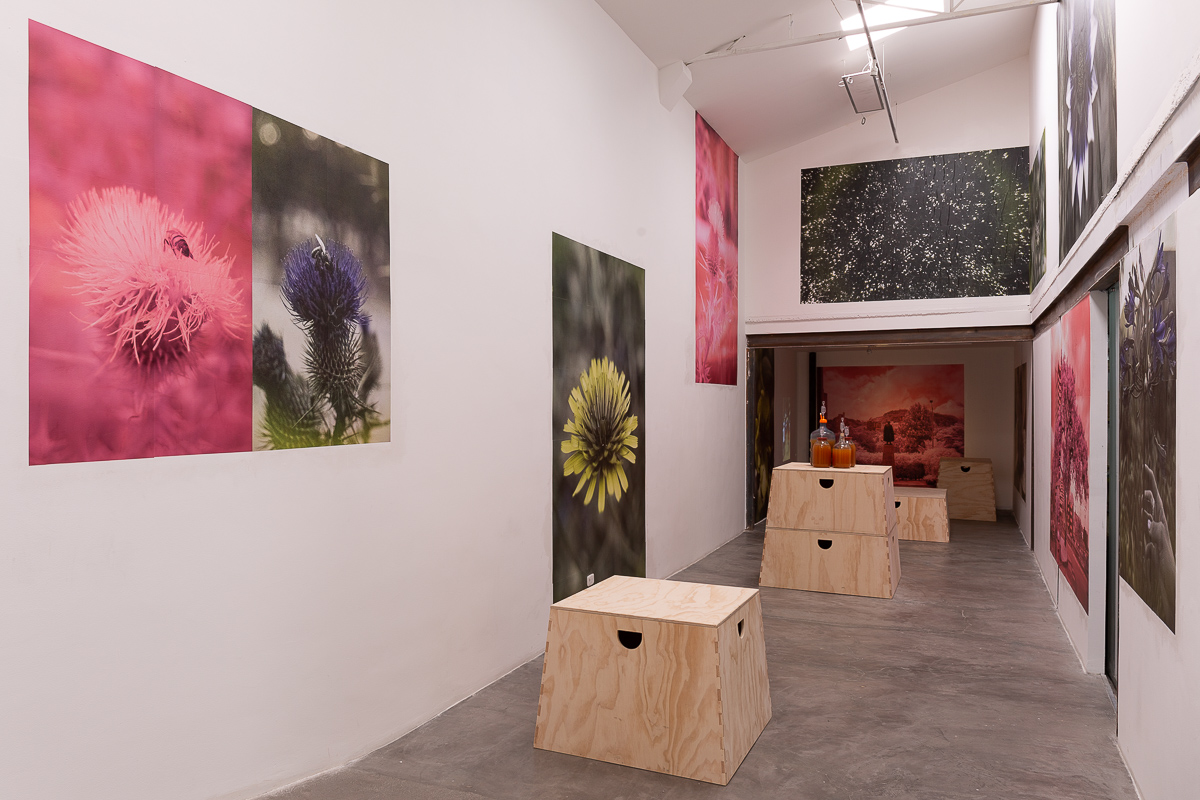
Just like the architecture of bees, which does not distinguish between container and content, the gallery is occupied by a series of photographic prints pasted directly on the walls. The photos are taken in the ultraviolet and infrared spectrum. A documentary about the experimental honey extraction process that we carry out with the Biabejas team, a national company dedicated to responsible beekeeping and a mead made with the containers of honey extracted from the monument.

https://spinyol.com/otrxs-others

Garage School vol. Fermentation

Datum:
Locatie: Rib
In samenwerking met: Rib

During August 2020 laagencia developed the escuela de garage vol. fermentation as a summer lab at Rib in Rotterdam (NL), in collaboration with artist and writer Juan Pablo Pacheco. This escuela proposed a critical exploration of our intimate relationship with the microcosmos of bacteria, focused on the biopolitical dimension of fermentation processes and the transformation they entail.

http://laagencia.net/wp-content/uploads/2020/09/SUMMER-FERMENT-ZINE-WEB.pdf